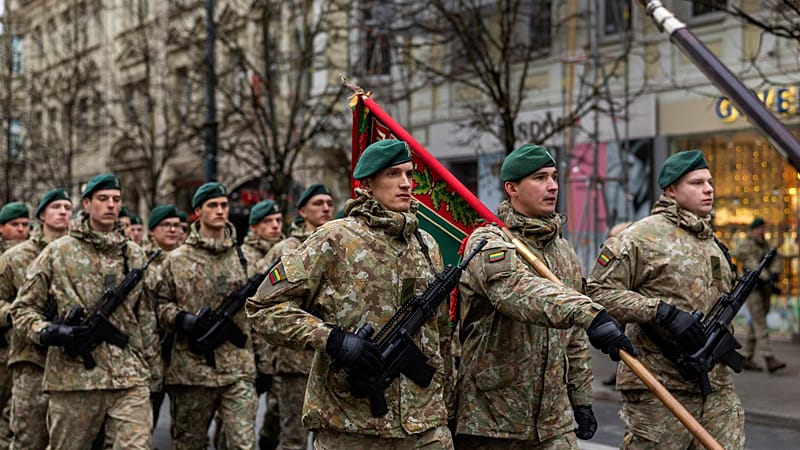
In Vilnius, daily life continues as usual, but beneath this normality, Lithuania focuses on reinforcing its security in response to new uncertainty in Europe’s security order.
For Lithuania, a NATO and EU member bordering Russia’s Kaliningrad exclave and Belarus, the war in Ukraine has not been a distant conflict. It has been a warning.

A rising threat perception
Lithuania sees a rising threat from Russia in the next three to five years, according to Vice-minister of National Defence Karolis Aleksa. He cites Russia's military buildup, readiness to use force, and ambition to reshape Europe's security as key drivers.
Lithuania’s preparations are a direct response to these developments.
“Russia has demonstrated both the will and the readiness to employ military force to pursue its goals,” Aleksa told Euronews, pointing to Ukraine as the clearest example. This is not only about Ukraine. "The Russian regime will employ military force as a tool to change the European security architecture.”
The war’s outcome, whether a ceasefire or peace agreement, will affect Russia’s posture. Still, Aleksa said Vilnius expects Moscow to keep strengthening its forces along NATO’s eastern borders, including in Kaliningrad. All indicators show an “increase of the conflict and of the Russian aggression” if deterrence is not strong enough, he added.
Allies on the ground
Deterrence, in Lithuania’s view, begins with a visible allied presence. Since 2022, NATO activity in the country has intensified significantly, with the United States and Germany playing a central role.
A key milestone is Germany’s decision to permanently deploy a brigade to Lithuania by 2027. Aleksa described it as “a huge political and military signal”, demonstrating that the defence of Lithuania is a collective NATO responsibility, not just a national one.
“This is about defending from the first inch of our territory,” he said. “We really have to demonstrate collectively that this is not only a national business of each NATO member state, but it's really a collective effort.”
German forces are already present, while Lithuania is rapidly upgrading its infrastructure to facilitate the missions and host the full brigade. US troops also maintain a constant presence, and other allies, including the Netherlands and Norway, contribute across land, air, and maritime domains.
Air defence now plays an important role. Lithuania is building its own systems, while NATO allies rotate surface-based air defence units and fighter aircraft through the Baltic region. At sea, NATO continues its Baltic mission, complemented by European Union efforts to strengthen critical infrastructure protection.
Building national military power
Beyond allied presence, Lithuania’s top priority is an ambitious national defence build-up to ensure the country is ready and resilient to current threats.
The government has committed to establishing a fully operational national division by 2030, capable of fighting alongside NATO forces. Aleksa identifies this as the central pillar of Lithuania’s military modernisation.
“This means not only combat brigades, but also all the enabling support capabilities in order to fight shoulder to shoulder with our allied forces here in Lithuania.” Logistics, engineering, medical support, command and control are equally important, he explained.
To achieve this, Lithuania is investing billions of euros in modern equipment. Major procurement projects include tanks, infantry fighting vehicles such as the CV90, German and French artillery systems, and US-made HIMARS rocket artillery. These investments are on a compressed timeline, creating pressure to acquire equipment, integrate it, and make units combat-ready by the end of the decade.
“We are not just buying platforms,” Aleksa said. Lithuania is building “interoperable, ready to fight by the end of 2030 units.”
Total defence and society’s role
Preparedness in Lithuania goes beyond the military: the total defence concept centres on strengthening national resilience and readiness at every level of society.
A key element is the Lithuanian Riflemen’s Union, a volunteer force like a national guard. Its membership has grown from around 10,000 in 2021 to more than 18,000 today.
“This shows the energy and commitment of our society,” Aleksa said. “We understand that we are a small nation, but we have to have a resilient and to-the-point defence industry.”
Defence spending reflects this sentiment. This year, Lithuania will spend about 5% of its GDP on defence. Public support for allies and military investment is high. A defence ministry poll found that nearly 80% of Lithuanians support the stationing of allies and NATO forces in the country.
There is also growing acceptance that preparedness must go beyond professional soldiers. While debates continue around the future of conscription, including whether it should be universal and how women should be included, Aleksa said the direction is clear: “A much, much bigger part of the society understands that they need to do more.”
Education is part of these efforts. Lithuania is expanding national security and civil resistance lessons in schools and supporting informal initiatives such as civilian drone training centres. “It is not preparation for war in this brutal sense, but providing possibilities for our kids to use drones,” Aleksa stressed. “It is about building civilian skills and resilience in a modern security environment.”
Hybrid threats and grey-zone warfare
Lithuania’s defence planning increasingly focuses on threats that fall short of open conflict. Cyberattacks, disinformation, sabotage, and other forms of hybrid warfare are seen as persistent risks, not only from Russia but also from its partners, like Belarus.
“We already see these methods being used,” Aleksa said. “Future conflicts may begin without tanks crossing borders.”
As a result, Lithuania is investing in cyber defence, information resilience, and counter-disinformation to enable society to resist manipulation and disruption.
The EU’s role: money, mobility and regulation
Lithuania closely links its defence build-up to European and transatlantic support. The EU will provide a significant share of funding through "safe loans," allowing Lithuania to access up to €6.3 billion by 2030 for around 50 defence projects. Lithuania also expects additional support through EU defence programmes and the bloc’s next multiannual budget.
Equally important, Aleksa said, are regulatory reforms aimed at boosting Europe’s defence industry. Cutting bureaucratic hurdles and accelerating production is essential if Europe is serious about deterrence.
Military mobility remains another priority. Faster movement of troops and equipment across borders, often called a "military Schengen", would directly support NATO’s defence plans on the eastern flank.
Ukraine as the first line of defence
Lithuania remains one of Ukraine’s strongest supporters, committing at least 0.25% of its GDP to military assistance. Beyond donations, Vilnius is working on joint defence production projects with Ukraine and European partners.
“Supporting Ukraine is supporting our own security,” Aleksa said. “Ukraine’s resistance is the first line of defence for Europe.”
Lithuanian officials stress that Europe cannot afford complacency. The main challenge is maintaining deterrence momentum, even as others are tempted by complacency or a false sense of peace.
“We don't want war,” he said. “What we want is deterrence.”
His message to Europe is clear: real security demands constant preparedness and investment in collective defence. Europe must be ready and act together, as revisionist powers are already preparing for action.