
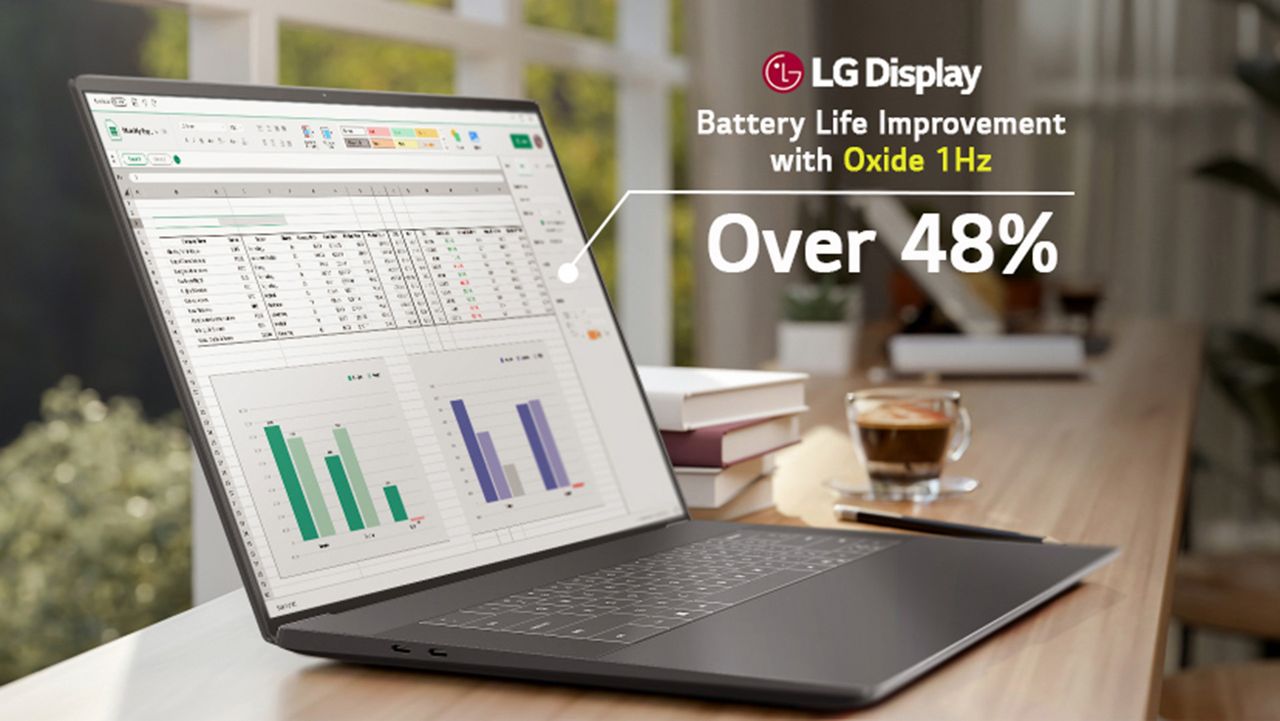
Smartphones have been using highly power-efficient, 1 Hz-capable OLED displays for a few years to improve power efficiency, but now that same display technology is finally making its way into laptops. LG has announced the world's first mass production 120 Hz LCD laptop display capable of spinning down to 1 Hz.
LG's new tech takes advantage of an Oxide TFT display that exhibits low power leakage while the display is in its low refresh rate mode. The display can automatically detect when screen changes occur, and will transition from 120 Hz down to 1 Hz when motion is static. LG claims its new display exhibits 48% greater battery efficiency compared to "existing solutions." LG also announced it will be debuting OLED counterparts of its 1 Hz-capable LCDs beginning in 2027.
LG's new display tech will debut with Dell's new XPS laptops that were first unveiled at CES 2026. The base display option will offer a 1920 x 1200 resolution with LG's 1 - 120 Hz variable refresh rate display, but the more premium display options lose the 1 Hz capability, opting instead for an OLED that has a VRR window of 20 - 120 Hz.
Laptop display manufacturing as a whole is starting to shift to variable refresh rate displays that can dip down to 1 Hz to save energy. Intel and BOE are also working on new displays that achieve the same thing and are building their new displays with LTPO technology. These new displays will use AI algorithms to detect the appropriate time to shift the display down to 1 Hz, including when the user is away from their screen.
We first saw 1 Hz-capable refresh rate screens in the mobile industry in the late 2010s. Apple was the first to pioneer the technology in the Watch Series 5, with an LTPO display that could switch from 60 Hz to 1 Hz to save power. A few years later, smartphones began to incorporate this same technology, including the OnePlus 9 and Oppo Find X3 Pro.