Get all your news in one place.
100's of premium titles.
One app.
Start reading
Tom’s Guide
Tom’s Guide
Technology
Michael Desjardin

LG C6 vs Hisense UR9: Should you buy the OLED or RGB LED TV?

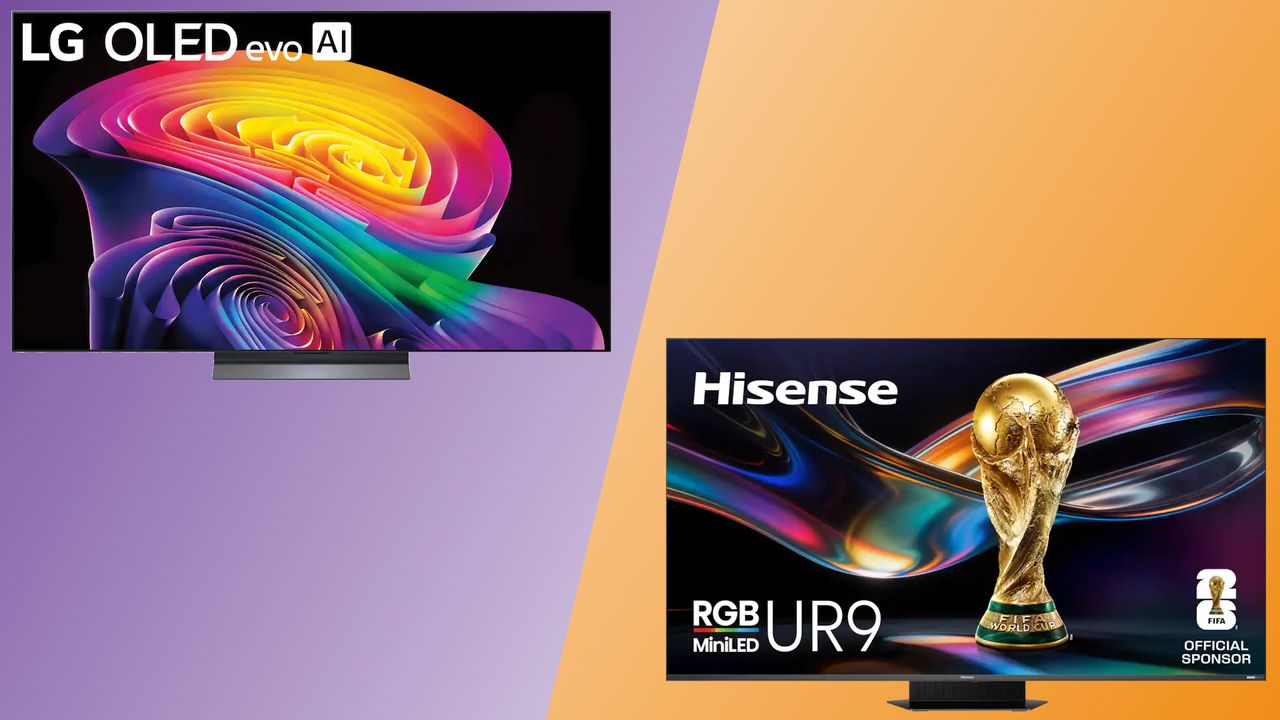
The LG C6 OLED and the Hisense UR9 RGB Mini-LED TV.

The C6 OLED is LG's newest, mid-range OLED for 2026. It's the latest in a long line of popular, award-winning OLEDs that offer incredible picture quality and an array of extra features for less than the cost of a higher-end OLED TV.

The Hisense UR9 is the brand's first flagship-level RGB LED TV. It leverages an all-new type of TV technology known as RGB LED, the advantages of which are high brightness and better color volume than run-of-the-mill Mini-LED TVs.

One of them offers mid-range-level OLED performance while the other — Hisense's top-shelf TV for 2026 — promises bright, eye-popping color. Now's an especially interesting time to be deciding between these two TVs, as the Hisense UR9 was just heavily discounted almost immediately after making its debut. Here's how the C6 and UR9 compare — from performance to features and price.

LG C6 vs Hisense UR9: specs compared

LG C6

Hisense UR9

Sizes

42", 48", 55", 65"

65", 75", 85", 100"

Ports

4x HDMI 2.1

3x HDMI 2.1

Resolution

3,840 x 2,160p

3,840 x 2,160p

Refresh rate

165Hz

180Hz

HDR

Dolby Vision, HDR10, HLG

Dolby Vision, HDR10+, HDR10, HLG

Smart TV software

webOS 26

Google TV

ATSC 3.0 support?

No

Yes

Processor

a11 AI Processor 4K Gen3

Hi-View AI Engine RGB

First, let's chat about the C6's size availability. In addition to the sizes listed above, the C6 is also available in 77- and 83-inch versions. However, these sizes are classified as an altogether different model: the LG C6H. This means if you're considering a 77- or 83-inch C6, you'll technically have to spring for the C6H OLED.

While haven't tested the C6H in our labs yet, LG promises better performance on these sets as they're equipped with LG Display's newest, fanciest RGB Tandem OLED. The 42- to 65-inch versions of the C6, on the other hand, leverage a standard WOLED display. It's still a fantastic set of hardware, but it's worth knowing the difference between the two panel types.

The UR9, meanwhile, is currently only available in 65-, 75- and 85-inch sizes. There's a gigantic, 100-inch version of the TV on its way soon, but at the time of publishing, this version isn't available to purchase yet.

Although all of the main ports on both the C6 and UR9 are of the high-bandwidth, HDMI 2.1 variety, the UR9 is limited to three HDMI inputs while the C6 carries the standard set of four. The UR9 makes up for this somewhat with an added USB-C port, but keep this in mind if you own several HDMI-compatible devices.

Both TVs support Dolby Vision, but like most Hisense TVs, the UR9 also supports the royalty-free format, HDR10+. Of the two, Dolby Vision is more widely available among streaming platforms and physical media.

Like all LG OLEDs, the C6 does not support ATSC 3.0 support. The UR9, on the other hand, does include this feature. It allows over-the-air broadcasts to be received in their native 4K resolution. Such ultra-high definition broadcasts are still relatively rare, but it's nevertheless a nice feature to have for future-proofing purposes.

Both TVs bring a lot to the table in terms of specs, so let's call this one a tie.

Winner: Tie

LG C6 vs Hisense UR9: design

(Image credit: Tom's Guide)

The C6 (seen above) features a similar design to its predecessor, the LG C5, but given its elegant look, that's not necessarily a bad thing. I especially dig the marble-like finish on the back of the TV.

The C6's downward-slanting, wedge-shaped stand attaches itself to the back of the panel in a sturdy fashion. Here's something important to keep in mind: The stand's shape keeps the C6's screen relatively close to whatever surface it's sitting on, so people with exceptionally tall soundbars should make sure in advance that it won't obstruct the screen.

Like many of LG's C Series OLED TVs that came before it, the C6's panel is among the thinnest you'll find on shelves. The TV's chassis widens out around the middle of the screen, but even with the added bulk, the TV is narrower than many of the slimmest Mini-LED TVs.

(Image credit: Tom's Guide)

If the light, sleek-looking C6 practically floats into your home, the UR9 (seen above) may as well drop an anchor. It's not an overly thick TV, to be clear, but it has a heavier exterior. It's as though the UR9 is working overtime to contain the power within its panel.

It, too, sits atop a centered, pedestal-style stand, but the plate at its base is much more accommodating for soundbar placement than the C6's configuration. That convenience is the best thing I can highlight about the UR9's overall design, as I do find it to be utilitarian to a fault.

Winner: LG C6

LG C6 vs Hisense UR9: performance

(Image credit: Tom's Guide)

Before we dive into which of these TVs is the better performer, let's compare their test results. (Both TVs were in their respective Filmmaker picture modes when these tests were taken.)

LG C6

Hisense UR9

SDR Brightness (10%, in nits)

355

2,486

Delta-E (lower is better)

1.5

2.7

HDR Brightness (10%, in nits)

1,355

3,327

UHDA-P3 Gamut Coverage

99.77%

99.83%

Rec.2020 Gamut Coverage

75.92%

93.03%

Input latency (milliseconds)

9.1

12

The standout detail here is the gulf between the brightness of both sets. Even in garden-variety, non-HDR content (like cable TV or most streaming shows), the UR9 is wildly bright. For HDR content, this serves as a feather in the UR9's cap. For SDR content, you might its 2,000+ nits of brightness to be too much. Nevertheless, this makes the UR9 a more viable option for people with a sun-drenched living space.

The UR9 put up some of the best color volume-related test results I've ever seen. It covers around 93% of the BT.2020 color space, which is higher than even most quantum dot-enhanced OLED TVs.

This is an impressive figure, no doubt, but according to my colleague Dylan Haas (who recently reviewed the UR9), the punchy palette doesn't always quite translate to real-world content. With color volume being the bread and butter of an RGB LED TV, some might find this disappointing.

(Image credit: Tom's Guide)

The C6 is significantly dimmer than the UR9, but it's got a serious trick up its sleeve: OLED display technology. OLEDs are capable of perfect black levels and pixel-level dimming, which has a hugely positive impact on picture quality. Its ability to produce perfect black levels means its contrast is through the roof.

Since specular highlights can be controlled with surgical precision, HDR highlights on the C6 tend to stand out more. 1,400 nits of highlight brightness is way less than the UR9's 3,400-nit benchmark, but the C6's perceptible contrast carries its picture further. This allows for a deeper, more-detail-rich presentation, too.

The C6's picture is better tuned out of the box, too. In Filmmaker mode, the Hisense UR9 manages to put up a Delta-E of below 3 (widely considered the threshold for color error perceptibility), but the C6 is incredibly accurate in LG's Filmmaker mode — more so than the UR9. That, combined with its top-notch contrast control, leads to a more refined presentation.

In a side-by-side comparison, you'll almost certainly clock the UR9's bolder, more-voluminous color. It will surely be the brighter of the two pictures, too. But contrast is the first thing our eyes notice when assessing an image, and Hisense's RGB LED TV still falls short of the C6 in the contrast department.

The C6, therefore, is the safer pick for A/V enthusiasts, home theater-builders and all-around picture purists. If you're looking for the brightest possible experience, however, it's hard to deny the UR9's sheer horsepower.

Winner: LG C6

LG C6 vs Hisense UR9: smart platform and features

(Image credit: Tom's Guide)

The C6 comes with the newest version of LG's webOS built right in. It's similar to last year's version of the software (webOS 25), but LG has tossed in some new, AI-based features on webOS 26. Unfortunately, my colleague Dylan Haas referred to them as "meaningless" if you don't already use AI-related features around the house, and I'm inclined to agree with Dylan.

Although webOS isn't my favorite (I find its interface to be cluttered and sluggish at times), I suspect that casual users won't mind bumping up against it from time to time. If you want to silo your streaming experience into a separate streaming device, you'll get no complaints from me; I recently decided to replace webOS with Roku and haven't looked back.

Good news for dedicated gamers: The C6 arrives with almost every gaming-related feature under the sun, including support for 4K gaming at 120Hz (and up to 165Hz), Variable Refresh Rate (VRR) and AMD FreeSync Premium. Support for these features runs across all four of the C6's HDMI 2.1-compatible inputs, so you won't have to juggle devices depending on your needs.

One of the C6's best gaming-related features is LG's Game Optimizer mode. This quick-menu puts all of your most-important settings in one place and automatically launches when you access the settings menu during gameplay.

(Image credit: Tom's Guide)

The UR9 is built around the Google TV smart platform. All told, I prefer Google TV over LG's webOS, as its interface is easier to navigate and tends to be snappier. Along with Roku, Google TV is one of my top picks for streaming software.

As mentioned, the UR9 is limited to just three HDMI ports. They're all HDMI 2.1 compatible, thankfully, but people with several devices (more than one console, a streaming device and soundbar, for instance) might end up feeling restricted by the lack of a fourth.

Across those HDMI inputs, the UR9 supports 4K gaming at 120Hz (and up to 180Hz with a gaming PC linked up), as well as VRR and FreeSync Premium Pro. Hisense does offer a dedicated gaming settings menu like LG's Game Optimizer mode, but I don't find its contents to be quite as useful as what LG is cooking with.

Winner: LG C6

LG C6 vs Hisense UR9: outlook

LG C6

Hisense UR9

Specs (25)

22

22

Design (25)

23

21

Performance (25)

23

22

Features (25)

24

23

Total Score (100)

92

88

What we're left with is a better-designed TV in the C6 that offers a more refined picture with sensational, OLED-driven performance, more size options to choose from and an additional HDMI input.

The UR9 has a leg up on the C6 when it comes to overall brightness, which makes it more viable for bright-room viewing. That said, the C6 doesn't exactly wilt in a sunny room, so your living space would have to be pretty dang bright for me to recommend the C6 (and its OLED display) over the Hisense UR9.

But there's another critical factor to consider: price. Right now, you can spring for a 65-inch C6 for $2,699 on Amazon. The 55-inch LG C6 can be had for $1,999. These prices are certain to steadily drop throughout the year, but for now, it's tough to find the C6 on sale.

The UR9, on the other hand, just saw a massive price cut a mere week and a half after its initial launch. The 65-inch Hisense UR9 is just $1,999 at Best Buy right now after making its debut at $3,499. The 75-inch UR9 is $2,999 at Best Buy, but when it first hit shelves, it was priced all the way at $4,999.

The UR9 is a bright, capable TV, but Hisense's RGB Mini-LED technology can't quite eclipse the self-lit pixels of an OLED display. At the very least, its current sale price puts the UR9 further in line with its performance profile.

More from Tom's Guide

Sign up to read this article
Read news from 100's of titles, curated specifically for you.
Already a member? Sign in here
Related Stories
Top stories on inkl right now
One subscription that gives you access to news from hundreds of sites
Already a member? Sign in here
Our Picks
Fourteen days free
Download the app
One app. One membership.
100+ trusted global sources.