
Get all your news in one place.
100’s of premium titles.
One app.
Start reading
Digital Camera World
Ben Andrews

Lexar Professional GOLD CFexpress 4.0 Type A card review

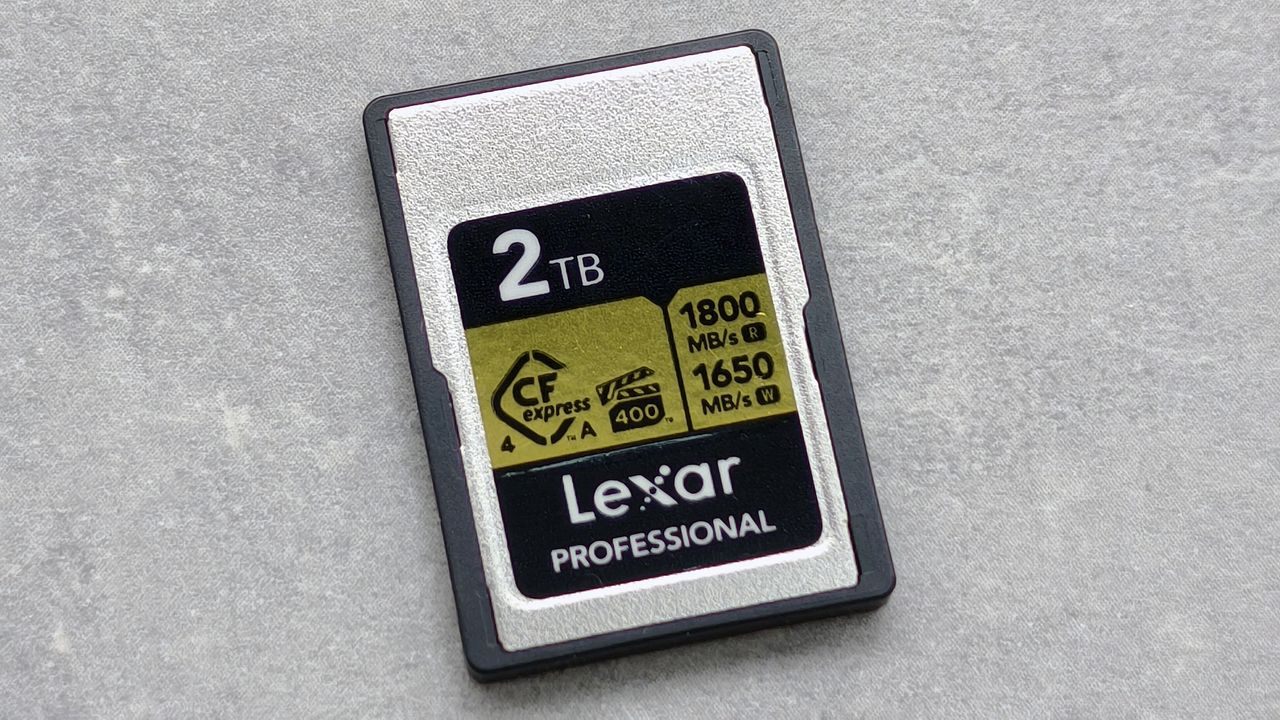
Lexar Professional GOLD CFexpress 4.0 Type A card.

CFexpress Type A cards are still a relative rarity in the memory card world. Since they were first utilized by the Sony a7S III in 2020, the format has been used in several full-frame Sony bodies, but other camera manufacturers have stuck with the physically larger, and (generally) faster Type B variant.

We say "generally", as not all Type A cards are inferior to their Type B siblings, and this Lexar card is a good case in point. It uses the next-gen CFexpress 4.0 standard, which makes it twice as fast as the first generation of Type A cards (confusingly called CFexpress 2.0). This makes CFexpress 4.0 Type A cards just as fast as version 2.0 Type B cards (CFexpress 4.0 Type B cards are twice as fast again, but precious few people actually need that much speed).

The Lexar Professional GOLD CFexpress 4.0 Type A card is available in five capacity options, from 256GB up to the 2 terabyte capacity we're testing here. All capacities boast read speeds of up to 1800MB/s and an impressive 1650MB/s max write speed. The larger capacity cards are also capable of a 1400MB/s sustained write rate, and though the 256GB and 512GB versions can 'only' manage a 1000MB/s sustained write speed, that's still more than fast enough to gain VPG400 certification. This means the card is guaranteed to sustain a minimum 400MB/s during video recording - ideal for capturing 6K or 8K footage.

Specifications

  • Max read speed: 1800MB/s
  • Max write speed: 1650MB/s
  • Available capacities: 256GB, 512GB, 640GB, 1TB, 2TB

Build and handling

The Lexar Professional GOLD CFexpress 4.0 Type A card is exactly like any other Type A card, at least on the surface. That is to say, it's remarkably small. If you took a Type B card and split it in half widthways, each half would be around the size of a Type A card, only the actual Type A card would be thinner. A Type A card is also smaller in terms of length and width than an SD card, and only around 50% thicker. Considering this Lexar Type A card is around 6x faster than even the fastest UHS-II SD cards, you get an awful lot of performance crammed into a tiny form factor.

Lexar claims the Professional GOLD CFexpress 4.0 Type A card is IP68-rated against dust and water ingress, while also being drop-proof from heights up to 5 meters. The card is built to be bend-resistant, shock- and vibration-resistant, and it's able to resist pressures of up to 150 newtons. Lexar even states that it's been tested to withstand up to 12,000 insertion and ejection cycles.

(Image credit: Lexar)

Performance

To determine exactly how fast the Lexar Type A card really is, I fired up my memory card benchmarking software of choice: CrystalDiskMark. This is capable of extracting the maximum possible performance from a memory card, but only if the supporting hardware is up to the job. So to ensure no testing bottlenecks, I used a fast Windows 11 laptop with USB4 connectivity. USB4 has a maximum 40Gbps bandwidth, equating to around 5000MB/s - more than enough to max out any Type A card. I also used Lexar's WF370 Workflow CFexpress 4.0 Type A card reader, which is based around a USB4 interface, so it too should enable any Type A card to work at full speed.

(Image credit: Future)

And the results are pretty respectable. Though a little way short of Lexar's claimed 1800MB/s read and 1650MB/s write speeds, the difference isn't enough to be concerning, or particularly noticeable.

Storage benchmarks are all well and good, but to determine the real-world performance you're likely to get when using the card to transfer images or video to a computer for editing, I took a single large video file, as well as a folder full of small images, and moved them to and from the card to see what sort of read and write speeds you can expect during typical use:

Read (peak)

Write (peak)

Single video file

1059 MB/s (1.09 GB/s)

813 MB/s (870 MB/s)

Multiple image files

1020 MB/s (1.06 GB/s)

673 MB/s (760 MB/s)

These real-world results are a bit disappointing when you consider that the card was nearing 1700MB/s read and 1550MB/s write speeds in benchmarking software. Even so, this level of performance is still comfortably quicker than a CFexpress 2.0 Type A card, and way faster than any UHS-II SD card.

Verdict

If you're lucky enough to own a camera such as a Sony a1 II, a9 III or a7R V, you're going to want the fastest, most reliable memory card to use with it. The Lexar Professional GOLD CFexpress 4.0 Type A card fits the bill almost perfectly. It's easily fast enough for 8K Raw video recording, and it won't even break a sweat keeping up with the a9 III's 120fps burst shooting mode.

When it comes to transferring footage for editing, then that too will be blisteringly fast, assuming you've got a computer and card reader that are up to the job. It's a bit disappointing that we couldn't get closer to Lexar's speed claims when moving files between card and computer, though it's possible that's an issue confined to our particular test set-up.

But that's our only issue with this otherwise stellar Type A card. It also comes in a good range of capacities, is built to last, and is priced fairly for the performance on offer. If you need a fast, capacious, and reliable Type A card, the Lexar Professional GOLD CFexpress 4.0 Type A card should be high on your shortlist.

Sign up to read this article
Read news from 100’s of titles, curated specifically for you.
Already a member? Sign in here
Related Stories
Top stories on inkl right now
One subscription that gives you access to news from hundreds of sites
Already a member? Sign in here
Our Picks
Fourteen days free
Download the app
One app. One membership.
100+ trusted global sources.