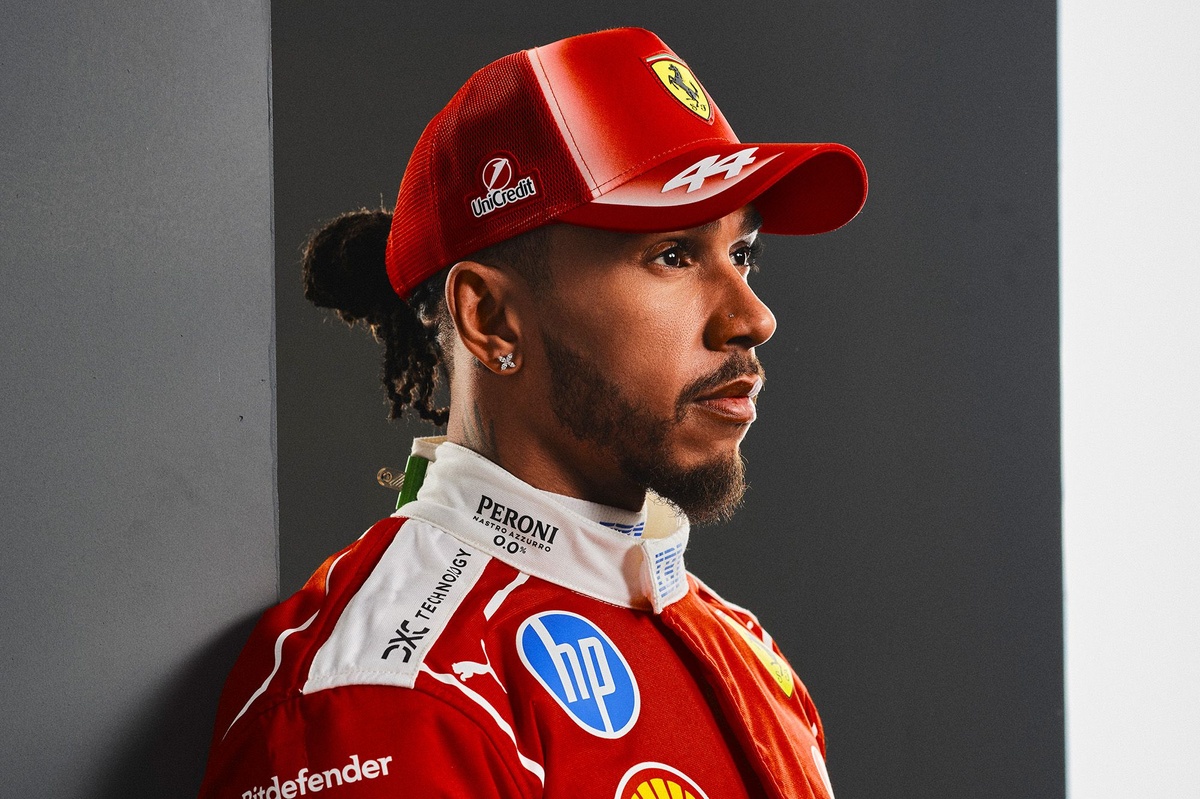
With Ferrari preparing for Formula 1’s 2026 technical reset, Lewis Hamilton continues a career that has already reshaped the sport’s record books.
From a title-challenging rookie F1 season with McLaren in 2007 to a dominant hybrid-era partnership with Mercedes, Hamilton has repeatedly adapted to change and delivered under pressure. Given his past success, wins are what the Tifosi are hoping to see from him in 2026.

Born in Stevenage, UK

Born: 7 January 1985
Born in Stevenage, Hertfordshire, Lewis Hamilton began karting at just eight years old in 1993. Backed by his father Anthony, who worked multiple jobs to support his son’s career, Hamilton quickly progressed through British karting.
1995 Autosport Awards

Year: 1995
A meeting with Ron Dennis at the 1995 Autosport Awards was a crucial stop along the way to Hamilton’s signing with McLaren’s young driver programme in 1998.
British Formula Renault champion

Years: 2002–2003
Hamilton stepped up to British Formula Renault and won the 2003 championship with 10 victories from 15 races. The title confirmed him as McLaren’s leading long-term Formula 1 prospect. His rise through British F3 and appearances at Macau further strengthened his reputation.
GP2 Series champion

Year: 2006
Though Hamilton had already tested F1 machinery as early as 2004, he still needed to prove himself in the junior ranks. GP2 became exactly that: driving for ART Grand Prix, Hamilton clinched the 2006 GP2 Series title at his first attempt, helping to seal his promotion to Formula 1 for 2007.
Formula 1 debut with McLaren

Year: 2007, Australian Grand Prix
Hamilton qualified fourth and finished third on his F1 debut in Melbourne. He became the first black driver in F1 history and immediately established himself at the front of the grid. Consecutive podiums early in the season made him the youngest championship leader ever at the time.
First grand prix victory

Year: 2007, Canadian Grand Prix
In Montreal, Hamilton secured his maiden pole position and converted it into his first F1 victory. He led every lap of the race: the win confirmed that his early podium streak was no anomaly, and that Hamilton was just getting started in F1.
Title bid as a rookie

Year: 2007
Hamilton entered the Brazilian Grand Prix finale leading the championship standings. A gearbox issue dropped him to seventh, and he lost the title by a single point to Kimi Raikkonen. His rookie season still delivered four wins, nine podiums and 109 points.
First world championship

Year: 2008, Brazilian Grand Prix
Needing fifth place to secure the title, Hamilton overtook Timo Glock on the final corner of the final lap for enough points to claim the championship. At 23 years and 300 days old, he became the youngest world champion in history at that time. This was McLaren’s first drivers’ title since 1999.
McLaren era consolidation

Years: 2009–2012
Hamilton won races in every season during the remainder of his McLaren tenure. A recovery victory in Hungary in 2009, a 2010 title challenge, and four wins in 2012 highlighted his consistency. By the end of 2012, he had established himself as one of the sport’s great drivers.
Shock move to Mercedes

Year: 2013
Hamilton signed a three-year deal with Mercedes, replacing Michael Schumacher. The move was widely seen as a gamble, with Mercedes having taken just one win in 2012. It would become the defining decision of his career.
First Mercedes victory

Year: 2013, Hungarian Grand Prix
Hamilton took pole position and controlled the Hungarian Grand Prix to secure his first win for Mercedes. The result signalled the team’s upward trajectory ahead of F1’s regulation overhaul.
Hybrid era dominance begins

Year: 2014
With new turbo hybrid regulations introduced, Hamilton won 11 races and secured the championship in Abu Dhabi on 23 November. It marked his second world title and the start of Mercedes’ sustained dominance.
Three-time world champion

Year: 2015
Hamilton clinched his third championship win at the United States Grand Prix on 25 October. Ten wins across the season reinforced his control of the hybrid era, as he joined the few elite drivers with multiple F1 titles.
Rosberg rivalry peaks

Year: 2016
Hamilton won 10 races but lost the championship to team-mate Nico Rosberg by five points. The title was decided at Abu Dhabi on 27 November. Days later, Rosberg retired from Formula 1.
Fourth world title

Year: 2017
Hamilton secured his fourth title at the Mexican Grand Prix on 29 October. Earlier that season at Monza, he surpassed Ayrton Senna’s pole position record. Nine wins underlined his championship form.
Five titles – Matching Fangio

Year: 2018
At the Mexican Grand Prix on 28 October, Hamilton claimed his fifth championship. With 11 victories that season, he equalled Juan Manuel Fangio’s tally of five world titles.
Sixth world title

Year: 2019
Hamilton secured his sixth title at the United States Grand Prix on 3 November. He won 11 of 21 races as Mercedes collected a sixth consecutive constructors’ championship.
Record-equalling seventh world title

Year: 2020, Turkish Grand Prix
In wet conditions at Istanbul Park, Hamilton sealed his seventh world title. The victory equalled Michael Schumacher’s long-standing championship record. He finished the shortened 2020 season with 11 wins.
Historic 100th victory

Year: 2021, Russian Grand Prix
Hamilton became the first driver in Formula 1 history to reach 100 race wins. The milestone came at Sochi during a season-long title fight with Max Verstappen.
2021 title duel

Year: 2021, Abu Dhabi Grand Prix
Hamilton entered the finale level on points with Verstappen. A late safety car period and final-lap restart decided the championship. The result and ensuing controversy concluded one of the sport’s most intense season-long rivalries.
Challenging new regulation era

Years: 2022–2023
The 2022 ground-effect regulation reset produced Hamilton’s first winless Formula 1 season. Mercedes struggled with porpoising and performance consistency. In 2023, he returned to regular podium finishes, but the team, car and driver all failed to find their previous form.
Final Mercedes season

Year: 2024
Early in 2024, Ferrari announced that Hamilton would join the Scuderia for 2025, bringing his 12-season partnership with Mercedes to a close. The 2024 campaign marked the final chapter of a collaboration that delivered six drivers’ championships and helped power Mercedes to eight consecutive constructors’ titles from 2014 to 2021. It ended the most successful driver-team partnership in F1 history.
Lewis Hamilton, Ferrari driver

Year: 2025
Hamilton began a new chapter in 2025, joining Ferrari on a multi-year deal. The move represented one of the most significant transfers of the modern era, pairing a seven-time world champion with F1’s most historic team. It marked his first team change since leaving McLaren for Mercedes ahead of 2013.
China sprint win with Ferrari

Year: 2025, Chinese Grand Prix
During his debut season with Ferrari, Hamilton secured a sprint victory in Shanghai. It was his first competitive win in Ferrari colours and an early statement of intent in red. The result demonstrated his continued ability to adapt quickly to new machinery and environments, despite a post-race infringement disqualifying the result.
Entering the 2026 regulation reset

Year: 2026
As F1 prepares for a sweeping technical overhaul in 2026, Hamilton enters another new era with nearly two decades of experience since his 2007 debut.
With Ferrari targeting a return to sustained title contention, the new rules present both challenge and opportunity for the sport’s most decorated driver.
This year, can Hamilton win a grand prix with Ferrari?