Get all your news in one place.
100’s of premium titles.
One app.
Start reading
Guitar World
Guitar World
Entertainment
Charlie Starr

“Legend has it that, while recording, Clarence said, ‘Hey, I need another finger to play this chord!’” Charlie Starr on the origins of the B-Bender – and how you can play those licks without one

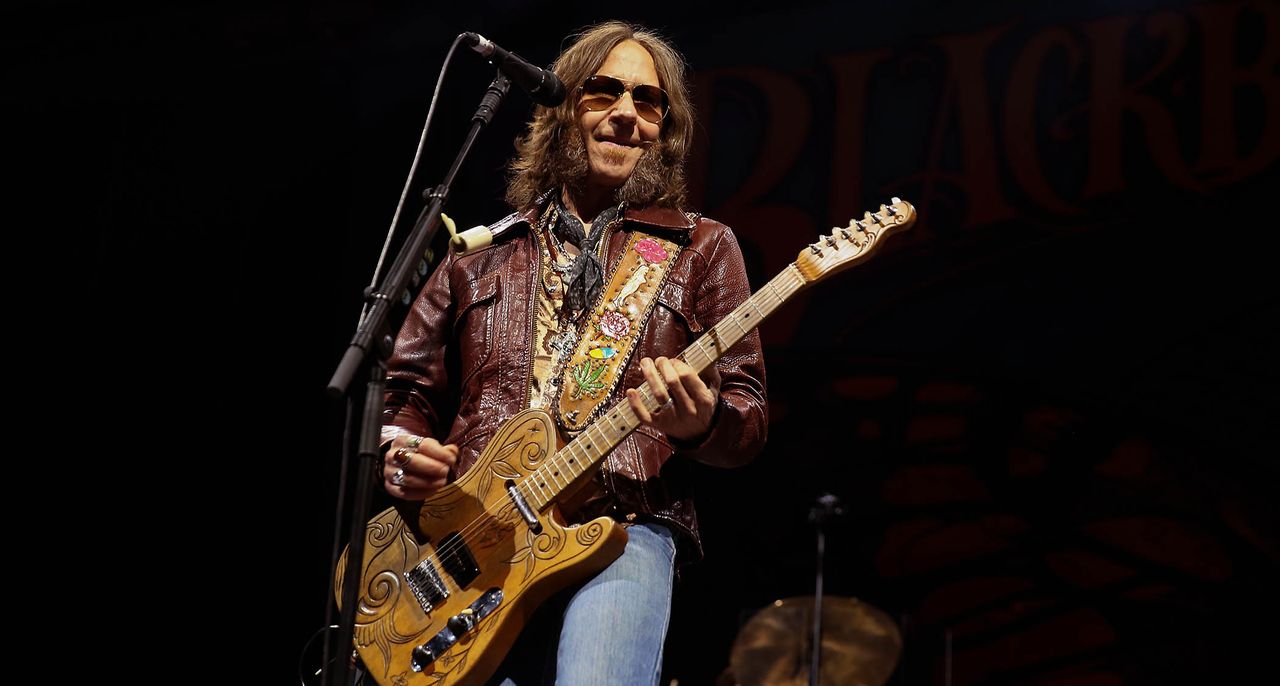
Charlie Starr of Blackberry Smoke performs live with his custom Tele.

A staple of many great country and country rock songs – and, in the hands of Jimmy Page and Albert Lee, rock songs – is the sound of the B-Bender.

For those unfamiliar, a B-Bender is a string-pulling device built into a guitar, most often a Fender Telecaster, that allows the player to raise the pitch of the B string by simply pulling down on the guitar strap. This enables one to emulate the pitch-bending sound of a pedal steel guitar, which works in a similar way, with pedals used to raise the pitches of individual strings or groups of strings.

The B-Bender was originally known as the “Parsons/White Pull-String,” because it was the brainchild of guitarist Clarence White and drummer Gene Parsons of the Byrds and Nashville West.

Legend has it that, while recording, Clarence said, “Hey, I need another finger to play this chord! Gene, come over here and push down on my B string behind the nut to raise the pitch.” Gene reportedly said, “You know, I can build a device that will do that for you.” And thus the Parsons/White B-Bender was born.

Part of the guitar’s body is hollowed out for a pulley system: a rod is attached to the strap button above the neck, and when this rod is pulled downward (by pulling on the strap), the pulley system raises the pitch of the B string inside the bridge up to one whole step.

As a young guitarist, I was completely under the spell of all of the fantastic B-Bender players, including White, Marty Stuart, Lee and Page, who used a B-Bender guitar brilliantly on the 1979 Led Zeppelin album In Through the Out Door.

Like most players, I was forced to learn how to attain the B-Bender sounds on a standard guitar long before I attained one equipped with a B-Bender.

As shown in Figure 1, while holding down the notes B and F# at the 7th fret on the top two strings, I can bend the F# up to G#. This technique, where one note rises while another remains stationary, is known as an oblique bend.

We have a Blackberry Smoke song called Sleeping Dogs, in which I play B-Bender-type licks on a standard guitar. As shown in Figure 2, there’s a turnaround in the song that goes D5 - E (or E7) - G7 - D.

(Image credit: Future)

Figures 3 and 4 illustrate the licks I play over these chords, for which I bend my G string downward to raise an E note up to F#.

(Image credit: Future)

Years ago I’d go see Rick Richards from the Georgia Satellites, who played a Les Paul Junior through a dimed Hiwatt amp. He was the king of Chuck Berry-style licks, like the one shown in Figure 5, and he’d play beautiful licks like Figures 6 and 7 that emulated the B-Bender sound by bending his G string while holding two-note forms on the top two strings.

(Image credit: Future)

In Figure 8, I begin by bending into an E major triad (E, G#, B) and then play a lick based on E major pentatonic (E, F#, G#, B, C#) combined with the E blues scale (E, G, A, Bb, B, D).

(Image credit: Future)

In Figure 9, the oblique bend technique is applied to the top two strings with the bends on the B and G strings.

(Image credit: Future)
Sign up to read this article
Read news from 100’s of titles, curated specifically for you.
Already a member? Sign in here
Related Stories
Top stories on inkl right now
One subscription that gives you access to news from hundreds of sites
Already a member? Sign in here
Our Picks
Fourteen days free
Download the app
One app. One membership.
100+ trusted global sources.