Get all your news in one place.
100’s of premium titles.
One app.
Start reading

Leaders urge action in 2026: "We are on the brink of tyranny and authoritarianism"

A year into President Trump's second term, civil rights leaders say the nation is entering a more volatile phase for civil rights enforcement and democratic norms — and they're no longer waiting for signals from Washington. They're suing, organizing, and drawing new lines around power, protest and equal protection.

The big picture: Civil rights leaders say the country isn't facing a single crisis — but a convergence of legal, economic and democratic threats.



Zoom in: The second Demand Diversity Roundtable, convened by the National Urban League, on Thursday brought together more than 30 leaders not just to defend diversity, equity and inclusion — but to challenge what they describe as an authoritarian-style playbook that they argue is threatening civil rights enforcement, protest freedoms and fracturing democracy.

What they're saying: Marc Morial, president of the National Urban League, framed the moment as one defined by consequences rather than rhetoric.

  • "This is not theoretical," Morial said. "It's showing up in paychecks and classrooms, in courtrooms and communities."
  • "We are on the brink of tyranny and authoritarianism."

Catch up quick: The first roundtable, convened two days after Trump's 2025 inauguration, drew 18 participants.

  • The second comes a year into the administration, as states like Illinois and Minnesota take stock of their legal response.

State of play: In year two, leaders said the impacts are showing up unevenly — and forcing responses at the state and local level.

  • Illinois Attorney General Kwame Raoul said states are no longer waiting for federal intervention, describing litigation as a primary tool to challenge what he called increasingly racialized enforcement strategies by federal agencies.
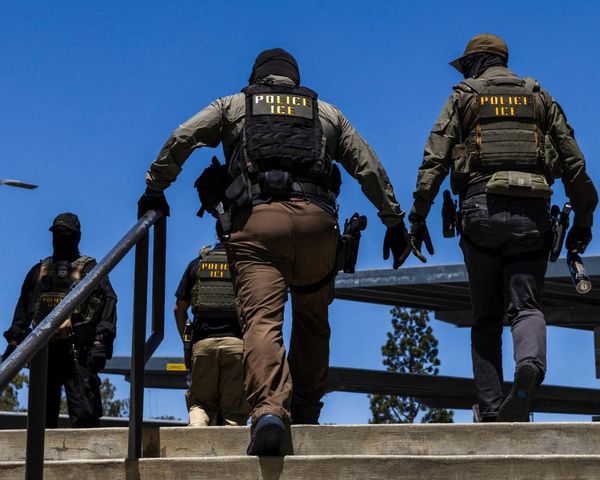
  • He pointed to recent ICE tactics in Chicago and police stops in Minneapolis as examples of how civil rights concerns are now surfacing at the local level — and landing in courtrooms.
  • The White House did not immediately respond to a request for comment.

Asian American leaders at the roundtable said they are frequently left out of national civil rights strategy discussions — even as their communities face parallel impacts from immigration enforcement, education rollbacks and civil rights retrenchment.

  • Sarah von der Lippe, chief counsel at the Minority Business Enterprise Legal Defense and Education Fund, said white women "have benefited an extraordinary amount from diversity, equity and inclusion policies. All of us who have benefited need to stand up and talk about it."
Leaders at the second Demand Diversity Roundtable at the National Press Club in Washington, D.C., on Jan. 22, 2026. The event drew more than 30 leaders focused on defending civil rights amid what they called an authoritarian rollback.

At one point, Benjamin F. Chavis Jr., president and CEO of the National Newspaper Publishers Association, asked the room to pause and take in the view — Black, white, Latino, Asian, Arab, Jewish, Indigenous, LGBTQ+ — before saying, "This is America."

  • "This is not about one community or one issue. This is about whether we will allow civil rights to be dismantled piece by piece — or defend them together," Chavis said afterward.

Bottom line: One year in, civil rights leaders say the fight has moved decisively out of Washington and into states, courts and coalitions — where enforcement, not rhetoric, now defines whether rights hold.

  • "When equal opportunity is sidelined, institutions lose legitimacy. Litigation increases. Courts become battlegrounds for rights that should never have been up for debate," National Bar Association President Ashley Upkins said afterward.

What's next: Morial said 2026 won't just be about candidates; it will be a test of political will. He previewed a pledge campaign that will ask voters to withhold support from politicians who won't explicitly back civil rights and equal opportunity.

  • "If you won't sign it, you haven't earned our vote," he said, adding that showing up to vote isn't optional in this moment.
  • "Not that voting is a panacea... but it's how we slow this down. It's how we build barriers to the damage."

Go deeper: America stares down erasure of Black history and progress

Sign up to read this article
Read news from 100’s of titles, curated specifically for you.
Already a member? Sign in here
Related Stories
Top stories on inkl right now
One subscription that gives you access to news from hundreds of sites
Already a member? Sign in here
Our Picks
Fourteen days free
Download the app
One app. One membership.
100+ trusted global sources.