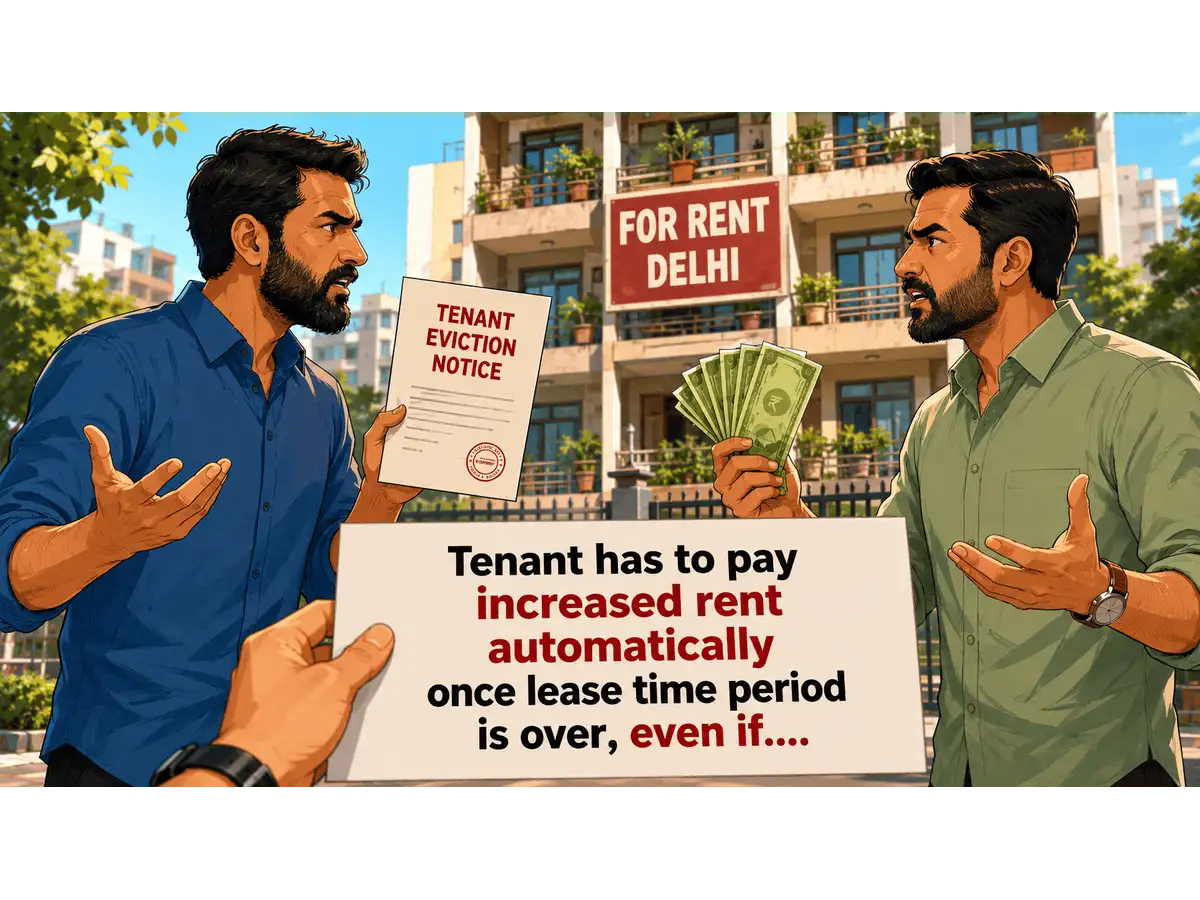
The Delhi High Court in a judgement from earlier this year held that a rent increase clause can still be enforced even if a rent agreement is not registered, particularly in cases where the tenant has requested more time to vacate the property, resulting in an overstay beyond the originally agreed rental period.
The high court ruled that the rent escalation clause in an unregistered lease is valid if the tenancy continues beyond the original lease term.

The ruling came in a rental dispute case filed by the Gupta family from Delhi. According to the submissions before the court, the Gupta family (landlords) rented out the second and third floors of their commercial property in Karol Bagh, New Delhi, to tenants under an unregistered lease deed executed on July 12, 2017.
The monthly rent was fixed at Rs 2,14,935, with the provision for an increase to Rs 2,57, 922 from August 1, 2018. The tenants had also paid a security deposit of Rs 4.45 lakh with the landlords (Gupta family). However, after the original lease agreement expired on August 1, 2018, the tenants asked for more time and ultimately vacated the property in October 2018.
Also read: Tenants cannot avoid paying increased rent on the ground of rent agreement not being registered
Although the tenants ultimately vacated the property in October 2018, they had asked for more time after the original lease agreement expired on August 1, 2018. So this period of overstay by the tenants was seen by the commercial court as notice period and the court held that there was no reason to demand increased rent during this time. The landlord felt aggrived and filed an appeal in high court.
The Delhi High Court observed that the unregistered rent agreement stated that the rent will go up 20% after August 1, 2018 and it is an acknowledged fact that since the tenant enjoyed the property till October 2018, they are required to pay enhanced rent from August 2018 till October 2018.
The Delhi High Court said: “The escalation clause was not contingent upon execution of any fresh instrument, but was to operate automatically during the subsistence of the tenancy.” Thus on January 31, 2026, the landlord family won the case of unpaid rent in Delhi High Court.
Tenant liable to pay increased rent during overstay as per lease agreement, even after requesting more time to vacate
A rent escalation clause is a contractual provision in a lease agreement that increases the rent after a certain period, usually annually. Rent escalation clauses are common in commercial and many residential leases to account for inflation and market value changes.
Prof. Rahela Khorakiwala, BITS Law School, says that the Delhi High Court's judgement explains the concept of rent escalation clauses and the continued occupation by a tenant.
Khorkiwala says: "The Delhi High Court clarified that if a lease agreement contains a rent escalation clause, the increased rent becomes payable automatically once the specified time period passes, even if the tenant is staying only temporarily after being asked to vacate."
In this case, the tenants were asked to vacate the property in July 2018, but they continued to occupy the premises until October 2018.
According to Khorkiwala, the Delhi High Court held that the critical factor is possession of the premises, not whether the tenant intends to vacate. The court explained that the tenants continued to occupy and use the premises after the completion of one year.
Khorkiwala says: "The escalation clause automatically came into effect after one year of tenancy; merely requesting more time to vacate does not terminate the tenancy or suspend contractual obligations."
Kshitij Bishnoi, Partner at CMS INDUSLAW, says that the core concept here is that a pre-agreed escalation clause is not a new negotiation; it is a triggered obligation that matures the moment the initial term expires.
"Even if a tenant requests more time to vacate, during such period, they continue to derive the benefit of the property; therefore, the law holds them to the price they originally agreed to pay for that continued use," says Bishnoi.
The "holding over" concept under the Transfer of Property Act means that the tenant continues to occupy the property after the expiry of the rent agreement, as the landlord consented to this by accepting the rent or giving explicit assent.
According to Bishnoi, while the technical concept of "holding over" under Section 116 of the Transfer of Property Act usually requires the landlord's consent, the court has made it clear that the terms of the original lease remain operative during the period of continued occupation.
Apart from rent escalation, can landlords also increase the security deposit by proportionate amount?
Khorakiwala says that landlords can increase the security deposit proportionately, but only if the rent agreement specifically provides for such an increase.
Khorakiwala says: "Unlike rent escalation, which is commonly included as a contractual clause, security deposit increases are not automatic and depend entirely on the terms agreed between the landlord and the tenant."
In landlord-tenant law, the security deposit is governed primarily by the lease agreement between the parties. Khorakiwala says that courts treat a security deposit as a contractual arrangement meant to secure the landlord against risks such as unpaid rent, damage to the property, and unpaid utility bills.
If a tenant is not paying the escalated rent, then can the landlord ask him/her to vacate?
Bishnoi says that non-payment of enhanced rent constitutes a violation of contractual obligations. "Under Section 111(g) of the Transfer of Property Act, 1882, persistent non-payment entitles the landlord to determine the lease by issuing a valid notice of termination."
According to Bishnoi, beyond seeking eviction, the landlord can also:
- Institute a suit for recovery of arrears of the unpaid lease rent.
- Claim interest on the outstanding dues.
- Claim mesne profits for the use and occupation of the premises after the lease has been terminated.
Landlord can take these legal steps instead of forced eviction
Khorakiwala says that if the tenant refuses to pay the increased rent, the landlord may file a civil suit for recovery of arrears of rent. In this judgment, the landlords filed a commercial suit for recovery of unpaid rent, electricity charges, water charges, and repair expenses, and the court partly decreed the claim after examining the evidence.
Khorakiwala says: "Thus, landlords can legally recover unpaid rent through court proceedings."
Khorakiwala says that if the tenant continues occupying the premises without paying rent, the landlord can also file an eviction suit before the appropriate court or rent controller (depending on whether rent control laws apply).
Khorakiwala says: "Common legal grounds for eviction include non-payment of rent, breach of the agreement terms and non-use of the premises."
Bishnoi says that he always advises landowners to practise restraint during this process and avoid measures such as forcible dispossession or the disconnection of essential services, as the legal route provides the necessary mechanisms for recovery.