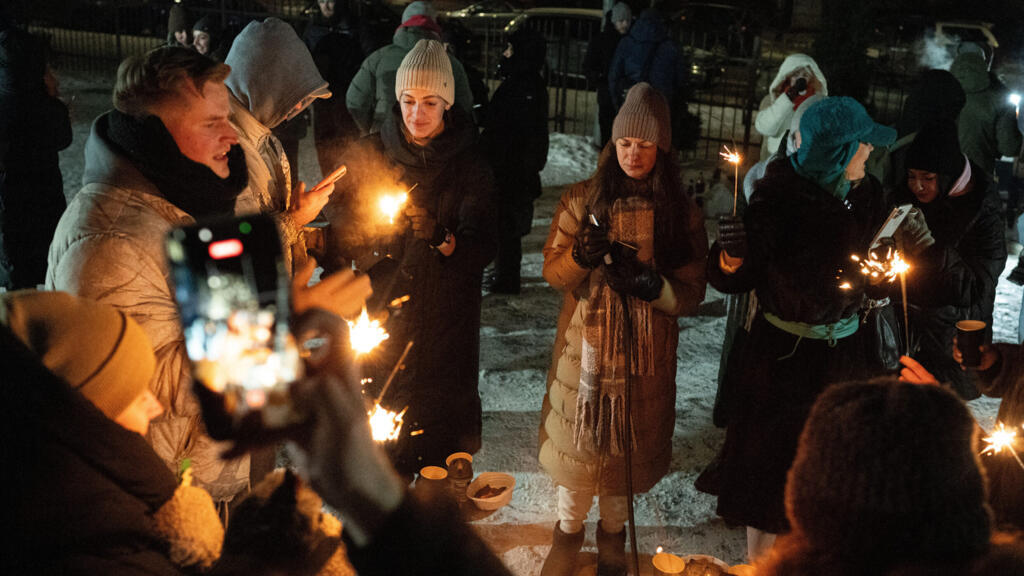
For more than three months, not a day has passed without Russian air raids striking Ukraine's power plants, plunging the country into cold and darkness in the depths of winter. RFI spoke to residents in the capital, Kyiv, where the situation is particularly critical.
Millions of Ukrainians have been under constant threat of Russian air strikes since the war began in 2022. In Kyiv, large-scale raids typically came every two or three weeks – but this year, Russia has ramped up its attacks, which now pound the capital daily.

While Moscow denies targeting Ukrainian civilians, they have become the primary victims of hundreds of drones and missiles that have struck the country's energy infrastructure since October.
More than 3 million residents in Kyiv are facing prolonged shortages of electricity, water and heat in the middle of a harsh winter. Ukraine is in the grip of a polar cold snap, with temperatures approaching -20C in the past two weeks.
Following a devastating strike on the city's power stations on 9 January, Mayor Vitali Klitschko urged residents to leave Kyiv if they could.
Two weeks later he said that, according to estimates based on mobile phone use, nearly 600,000 people had left the Ukrainian capital.

Not everyone can get out.
On the left bank of the city, home to several working-class neighbourhoods, residents of high-rise apartment blocks are particularly vulnerable. They live close to power stations targeted by the Russians, and they can no longer rely on basic utilities.
"We find ourselves without electricity for 10 hours, 20 hours at a time," says Oksana, who lives in the area with her children.
"When it does come back on, it's in the middle of the night, so I get up to charge all our batteries. Without electricity, there is no water either, and as the building has several floors, it no longer reaches the upper floors."

Her building has already been gutted by a drone strike, the windows on lower floors replaced with wooden boards.
Yet Oksana has no plans to leave Kyiv. "We do have family in the west, where we took refuge in early 2022, but my husband is disabled and awaiting surgery, so I can't see myself leaving now. What's more, all our loved ones, including my parents, live here in buildings nearby."
Ukraine seeks $43bn in climate compensation from Russia over war
Islands of warmth
For residents who remain, daily life revolves around the few hours of electricity – their only chance to recharge phones, run the washing machine, or stock up on tap water.
Valentina, a pensioner, is in survival mode. "Thank God, part of the building is still heated, and at home, I keep my coat on so I don't get cold."

Faced with a worsening humanitarian crisis, the city has deployed around 50 mobile generators. In the courtyards of some apartment blocks, rescue workers have set up large orange tents that serve as so-called "points of invincibility" – energy islands where residents can come to warm up, work remotely or even spend the night if conditions no longer allow them to sleep at home.
In the historic centre of Kyiv, opposite Taras Shevchenko National University, a yurt set up by a Ukrainian-Kazakh association serves as a sanctuary of warmth and electricity. Natacha welcomes visitors with hot tea and Kazakh pastries.
"The Kazakhs believe in our victory, and with this yurt they are showing us a little love and support. They can't supply us with weapons, but they are showing us in other ways that they are on our side," she tells RFI.

Ukraine has turned thousands of public buildings, restaurants and schools into similar shelters since the start of the air raids in the winter of 2022.
But in Kyiv, many of these havens are no longer able to take residents in.
Schools closed
Until recently, the city centre – home to government offices, embassies and international organisations – had been relatively spared from power cuts. Now the situation has deteriorated significantly.
Cafes and restaurants are still operating, albeit in semi-darkness, thanks to small diesel generators that put out a deafening hum and heady fumes. Yet public buildings that once stayed open 24/7 to provide residents with heat and electricity remain shut.
Alla, caretaker at a deserted school, explains why. "There's no heating, no internet connection, no electricity here, and no one to come and fill the generator's tank, so we're staying closed."
Schools in Kyiv will remain closed for several more days: the school holidays have been extended until early February so that pupils can stay out of the city.
Corruption scandal exposes ‘absolute impunity’ in Ukraine’s energy sector
"The city's energy grid is still operating in emergency mode," main private electricity supplier DTEK warned in one of its latest statements.
"Nothing like this has ever happened on a global scale. For the past month, there has not been a single day without power cuts, and our engineers have the historic task of getting us back on our feet."
Ukraine's new Energy Minister Denys Shmyhal has promised to restore infrastructure as quickly as possible, but has also warned of further Russian strikes – "including on infrastructure that keeps nuclear power plants running".
This article was adapted from the original in French by RFI correspondent Emmanuelle Chaze.