
Get all your news in one place.
100's of premium titles.
One app.
Start reading
Digital Camera World
Gavin Stoker

Kodak Pixpro FZ55 review: this charming compact camera has become a surprise bestseller

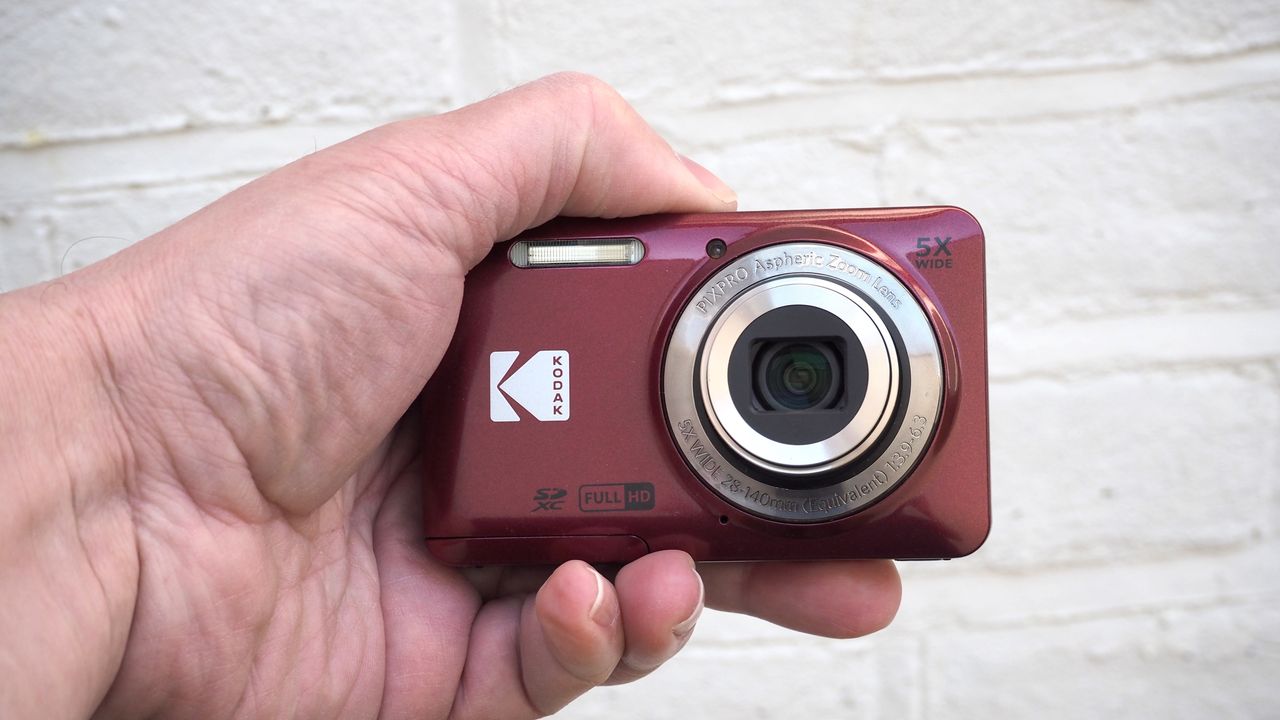
Kodak PIXPRO FZ55 point and shoot compact camera.

Conventional wisdom had it that placing cameras in mobile phones has led to the gradual decimation of the traditional camera market. When the Kodak Pixpro FZ55 launched simple point-and-shoot cameras like this had practically disappeared... and that meant if you wanted a compact camera for around $100/£100 you bought this or its similar sibling the Kodak FZ45. They were highly successfuly... and then compact cameras became trendy again – and for ages it was even hard to find the FZ55 in stock.

Four years on from its launch, the FZ55 remains as popular as ever – although other manufacturers have spotted the boom in low-cost camera sales, so it has more rivals.

But just how does this unassuming-looking compact actually handle and perform?

(Image credit: Gavin Stoker / Digital Camera World)

Specifications

Sensor: 1/2.3-inch CMOS
Resolution: 16 megapixel
Sensitivity range: Automatic
Video: Full HD 1920x1080 pixels
Lens: 5x optical zoom, 28-140mm equivalent
Monitor: 2.7-inch LCD
Viewfinder: No
Battery: lithium ion rechargeable
Battery life: Up to 200 shots
Dimensions: 91.5x56.5x22.9mm / 3.6 x 2.2 x 0.9in
Weight: 106g / 3.7oz
Colors: Blue, black, red or pink

Key features

Simple to operate point-and-shoot digital cameras have long held appeal for entry-level photographers, the young, the old, and the family market in general, as well as anyone who appreciates a conveniently compact size. The Kodak Pixpro FZ55 is certainly diminutive, being broadly the dimension of a credit card and the width of a finger, which ensures it’ll readily slip into any pocket or purse. You may not want to hide it away though, as our review sample came in an attractively glossy red rust color.

(Image credit: Alan Palazon / Digital Camera World)

While, unlike a smartphone, this camera can’t directly upload our photos and videos to the Internet – there’s no built-in Wi-Fi or Bluetooth, just a USB cable supplied for PC connectivity, plus the ability to insert and remove an optional SD card – it does offer one advantage over a smartphone in possessing a 5x optical zoom, as opposed to just a digital alternative which crops the image.

Featuring an automatic lens cover to protect its glass, the Kodak’s lens is retracted within the camera body when the FZ55 is powered down, thus ensuring maximum compactness. A slender lozenge-shaped built-in flash broadens the range of scenarios in which the camera can be used, as does 63MB of internal memory to get us started out of the box. Inserting an SD card supplements this and is an essential purchase alongside the camera.

Build & Handling

While the Kodak Pixpro FZ55 may be diminutive and slender, the build quality feels reassuringly solid, with its most delicate aspect being the spring-loaded plastic cover protecting the slots housing its lithium-ion battery and memory card. We don’t get a mains charger bundled in the box, just a USB lead that allows us to add our own mains plug, or charge the device via an available USB port on a desktop or laptop computer. Also supplied is a wrist strap that threads through an available lug on the camera’s side, just below the vacant USB port, which doesn’t have a rubber cover, meaning that pocket lint, fluff, and biscuit crumbs may well intrude over time.

(Image credit: Gavin Stoker / Digital Camera World)

We were struck by how much this Kodak’s appearance and operation is exactly the same as the kind of compact digital camera that was being sold everywhere 10 to 15 years ago, and has largely disappeared since. Navigating its functions is mostly via a very familiar multi-directional control pad on the backplate, to the right of a 2.7-inch LCD that takes up two-thirds of the rear. As we’d expect given the fairly basic nature of the device, there’s no eye-level viewfinder of either optical or electronic variety.

The zoom, modest though it is, is controlled via a thumb-operated rocker switch. Beneath this are dedicated shooting mode, menu, and playback buttons, while a dedicated video button nestles next to the power and shutter release controls on the top plate. Press this video button no matter what other shooting or program mode we may have manually selected and the FZ55 automatically begins recording a clip. Luckily the top plate buttons are partially recessed, so it’s less easy to hit them accidentally when handling the camera, with the main shutter release button being the largest of the three.

(Image credit: Alan Palazon / Digital Camera World)

Performance

Using this camera is like the clock has been turned back to the mid-2000s – or that the world of technology has been in stasis since then. As well as its 5x optical zoom, the Kodak Pixpro FZ55 features an all-encompassing 28mm equivalent at its widest setting, reaching up to 140mm at maximum zoom, with stills and video both composed and reviewed via its 2.7-inch backplate LCD.

(Image credit: Gavin Stoker / Digital Camera World)
(Image credit: Alan Palazon )

Video is of the Full HD variety rather than the now more commonplace 4K, but that’s always been acceptably the standard at this entry level. Effective stills resolution here is a quoted 16.76 megapixels from a bog standard 1/2.3-inch CMOS sensor, and, with maximum lens aperture being f/3.9, it’s no surprise the automatic flash fires when taking shots indoors, even in daylight. We can however turn it off ourselves if it gets annoying.

Battery life here is sufficient for a modest 200 photos, or an hour-and-a-half of Full HD video at 30fps before recharging is required. Just like any ‘old school’ point and shoot, we get sundry subject pre-optimized scene modes and the ability to press a button to achieve macro photography – here as close as 5cm from our subject.

As with any LCD screen, when using the camera in bright sunlight it’s very hard to see what’s displayed on the back screen; not only is it rendered very dark, but its resolution is so modest it’s hard to pick out detail. Given this, it’s no surprise to find the screen isn’t a touch screen. Safe to say that although screen brightness is manually adjustable to an extent, visibility is better indoors than out.

(Image credit: Gavin Stoker / Digital Camera World)

Though we weren’t expecting to be blown away by the image quality from this camera, in not expecting much we were pleasantly surprised. Colors are as bright and as rich as one would hope and expect of any product associated with the Kodak brand, and there’s a pleasing degree of detail in the snapshots.

It’s easy to get more critical, however. At maximum wide angle setting, we’re getting converging verticals, and, on a bright day, isolated instances of lens flare, but neither of these are overly distracting. Slightly more serious is that there is a noticeable fall-off in terms of sharpness into the corners of the frame, but busier subject matter will distract from this. Similarly, brighter conditions result in burnt-out highlights and images are generally softer towards the telephoto end of the zoom, even with the digital zoom function disabled.

Image blur is partly down to the camera being so small it’s tricky to hold good and steady to avoid the effects of hand wobble and camera shake. In fairness, there is actually a screw thread at the base of the FZ55 for optional tripod attachment, should we want to go that far to achieve a pin-sharp image.

Above: sample video clips shot with the Kodak FZ55

Verdict

If you’ve ever wondered why they don’t make simple and affordable digital cameras like they used to – or are looking for an inexpensive starter option to gift to a son or daughter showing a fledgling interest in photography, who is nevertheless too young to be entrusted with a smartphone, then the Kodak Pixpro FZ55 will tick a couple of boxes that have been left empty for a while.

With many of the main camera manufacturers now focusing on much higher-priced and more sophisticated interchangeable lens cameras of interest to the photo enthusiast, t the casual photographer who has otherwise been left to their smartphone now has a user-friendly alternative. As one of a few such options out there, Kodak’s current license holder has found a receptive audience in those seeking a camera putting simplicity and affordability first.

Alternatives

See also our guide to the best Kodak cameras

Sign up to read this article
Read news from 100's of titles, curated specifically for you.
Already a member? Sign in here
Related Stories
Top stories on inkl right now
One subscription that gives you access to news from hundreds of sites
Already a member? Sign in here
Our Picks
Fourteen days free
Download the app
One app. One membership.
100+ trusted global sources.