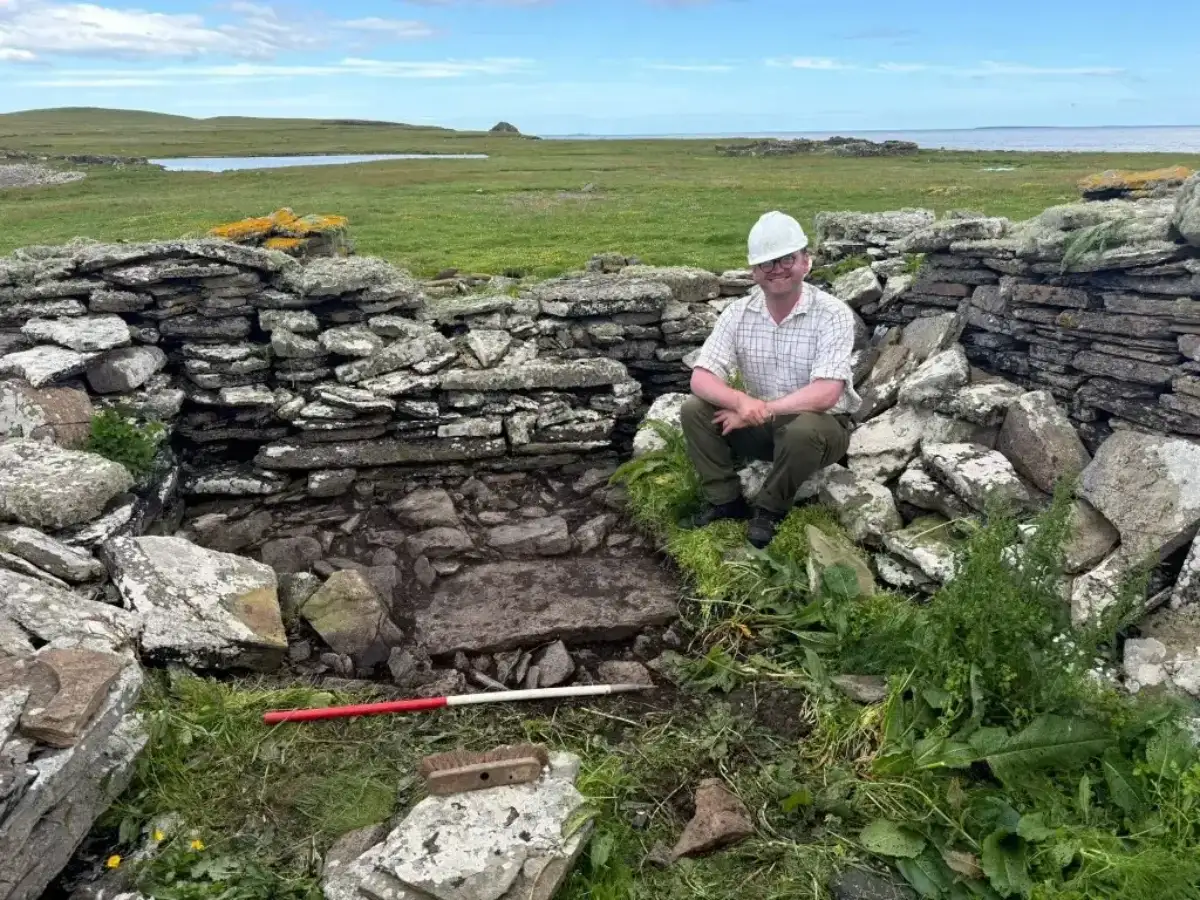
In a stunning discovery, a group of boarding school students in Scotland stumbled upon what could be a 1,000-year-old Viking-era church, after finding the foundations of an altar and a step during an archaeological project on a remote island. The discovery was made on Swona, a deserted island in Orkney, during an annual service trip organised by Gordonstoun, the Scottish boarding school that counts King Charles III and his late father, Prince Philip, among its alma mater. The school runs the Swona Service Project, through which students travel to the isolated island to take part in archaeological investigations and restoration work.

The ruins on Swona had long been known locally as a “kirk,” the Scots word for church, but there had been uncertainty over whether the structure was actually a place of worship. That changed when students and staff excavated the inside of the building's eastern wall. Gordonstoun housemaster Daniel McLean, who organises the project, said the team had surveyed the site the previous year and identified several features that appeared consistent with an early medieval church.
These included the building's size, its length-to-width ratio, its east-west orientation, the position of the doorway and the construction methods.
“Everything about the structure [fit],” McLean told Fox News Digital. “The size of it, the length, the width ratio, the east-west orientation, the location of the door, the construction methods — it all [fit] for it to be an early medieval church.” When the students returned, McLean suggested digging near the eastern wall, where an altar might have stood.