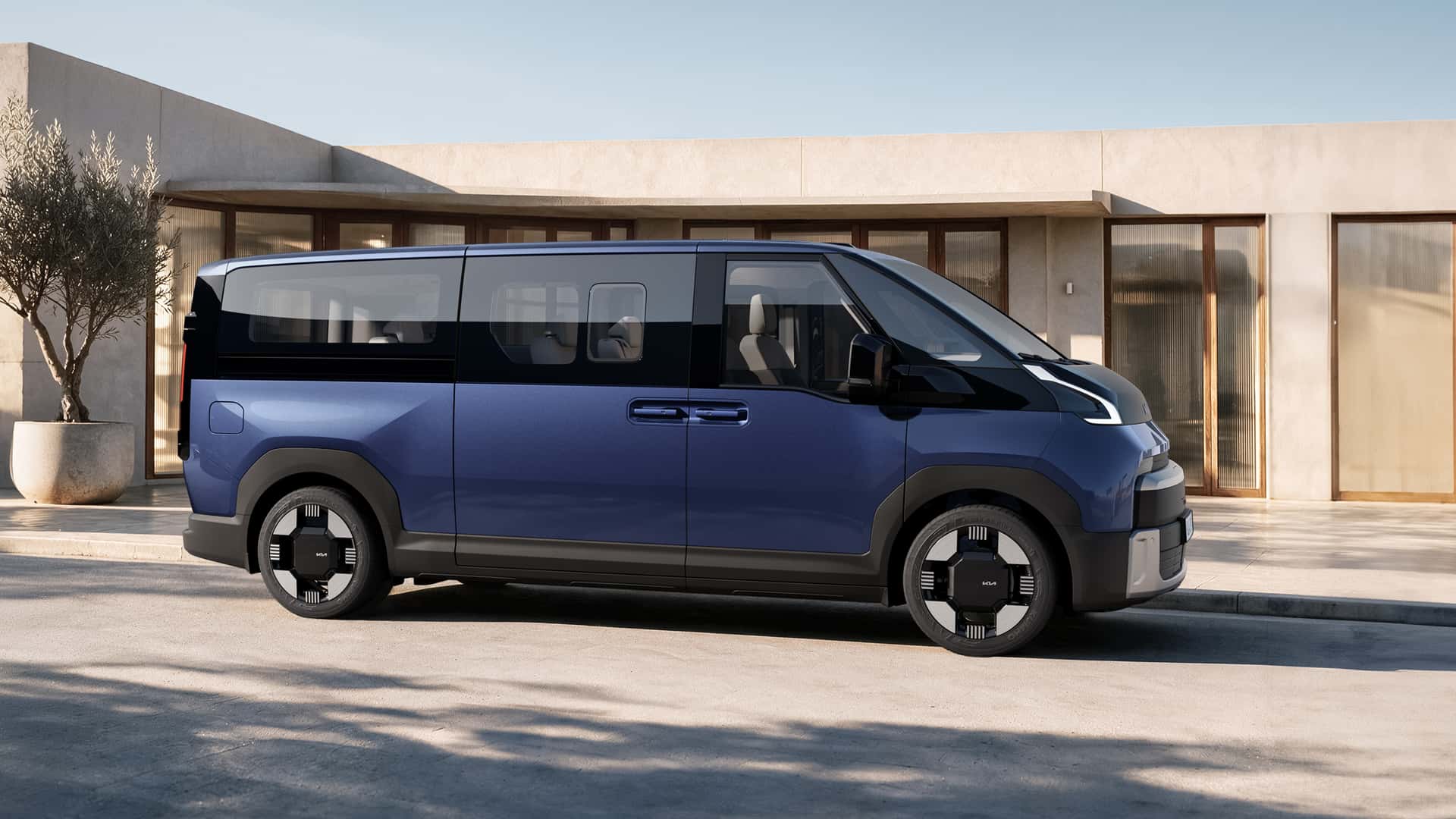
Kia is no stranger to making impressive electric vans. Its PV5 just won the 2026 International Van of the Year award, and while that isn't the most prestigious or exciting award in the world, it proves that Kia knows how to apply electrification to this segment. This new PV7 expands on everything that made the PV5 great. Quite literally, too, as the PV7 is longer and has more interior space, with better tech and more versatility.
Visually, the two vans look pretty much the same, with the new PV7 just being a little bit longer. Under the skin, though, the PV7 packs more impressive specs. Its base battery is a 71.5 kWh unit, which is the optional long-range battery in the PV5. You can get an even bigger 96.2 kWh battery only in the PV7, though. A single-motor, front-wheel drive setup with 268 horsepower and 310 lb-ft of torque is the only powertrain available to start with, but a dual-motor, all-wheel drive setup is coming.

If you opt for the long-range battery, you get a maximum 289-mile range, but that's only in its lightest spec "Long Range Cargo" spec, and on the more generous WLTP cycle. However, much of that range can be recharged pretty quickly. With 800-volt charging tech, and using a 350 kW charger, the PV7 can go from 10-80% state-of-charge (SOC) in around 20 minutes. (While the PV5 onIy has 400-volt charging, it's said to be getting 800-volt in the future.) There's a "Heavy Load Driving" mode, too, which adjusts the car's powertrain and dynamics to handle heavier payloads.
The PV7 comes in two flavors: Cargo and Passenger. They're pretty self explanatory; the Cargo model is made for work vans, while the Passenger is meant for average folks. The PV7 Cargo itself has a few different models, like the Compact (the regular Cargo van), Long, and High Roof. The latter obviously has the most interior space, with 86 square-feet versus the Long's 6.1, because it has, ya know, a higher roof. If you get the Long body, it has a max payload of 2,568 pounds, but the normal compact can carry 2,646 pounds. The Long also has a 550 mm loading height, which allows it to fit three full-size Euro pallets.
Cargo models get two choices of tailgate, either a typical lift up one or a barn door-style setup with dual swing-open doors. A load-through bulkhead is available, too, as is a Smart Walkaway feature that automatically closes the side sliding door when you walk away with the key. And you can remotely check if the tailgate open. Seating is for only two or three, since the Cargo is meant to carry stuff, not people.
The Passenger model is the opposite. It's a people-hauler, with seating for either seven or nine in most countries but up to 11 in Korea. So it's perfect as an shuttle, transport vehicle, or even a family van. Rear passengers get their own climate control, 100W USB-C chargers, and Long-Rail Easy Remove Seats.
Both Kia PV7 models launch in Korea and Europe in 2027. It's a shame these won't come to the U.S., as they could really help the electric work van movement. The PV7 has some pretty good specs for an electric workhorse and it should only improve on an already award-winning foundation.