
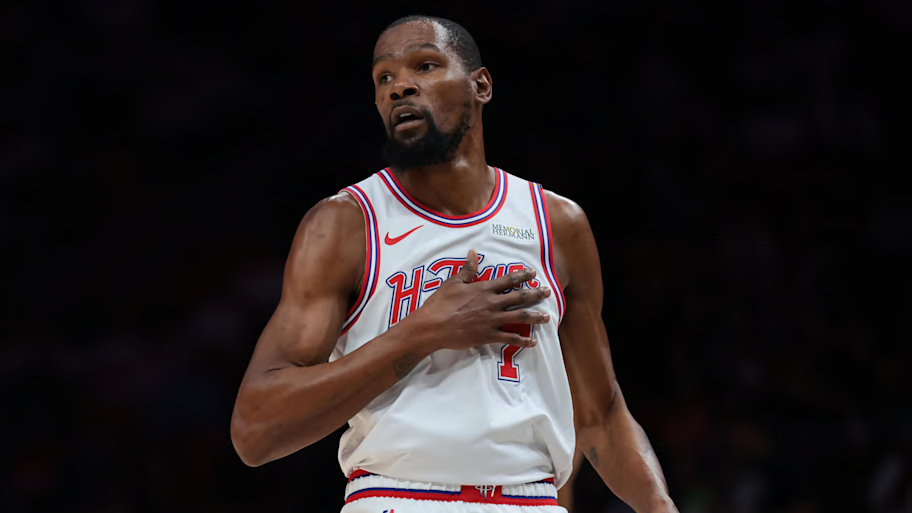
Kevin Durant is a big fan of the NBA’s much-maligned salary structure.
The NBA’s championship race is wide open this season, and the Rockets’ All-Star credits the league’s current collective bargaining agreement and payroll aprons. Durant’s Houston squad is firmly in the mix in the Western Conference.

“Thank God for second aprons and the first aprons,” Durant said.
That’s a fair assessment, honestly. While the NBA’s luxury tax aprons are onerous, they also have prevented teams from loading up on players with skyrocketing salaries. The result has been a more even distribution of talent across the league.
Durant seemed excited about it.
“We wanted some parity and I think the last few years we’ve gotten exactly that,” he said. “I mean, it’s fun for everybody watching the game, not knowing exactly who’s going to be around at the end of the season. And as a team, it gives you confidence to know that even though you don’t play your best ball around this time, nobody really is. ... Teams are trying to figure out which lineups they want to use, [after] trades, all of that stuff, so it’s a fun time to be in the league.”
Parity is definitely present in the NBA right now. The Pistons lead the Eastern Conference by 4 1/2 games over the Celtics, but only three games separate Boston from the fourth-place Cavaliers. The 76ers occupy sixth place, 12 1/2 games back of Detroit, but are only 2 1/2 games up on the 10th-place Hawks.
The Thunder lead the Western Conference by three games over the Spurs, but only 3 1/2 games separate the third-seeded Rockets from the seventh-seeded Suns. The middle of the conference is an absolute blender, and any of the teams could emerge to challenge Oklahoma City.
The top nine teams in the West each have at least one household-name star:
- Thunder: Shai Gilgeous-Alexander
- Spurs: Victor Wembanyama
- Rockets: Kevin Durant
- Timberwolves: Anthony Edwards
- Nuggets: Nikola Jokić
- Lakers: LeBron James, Luka Dončić
- Suns: Devin Booker
- Warriors: Stephen Curry, Jimmy Butler, Draymond Green
- Clippers: Kawhi Leonard
That is an incredible distribution of top-level talent, and the league’s salary structure has prevented deep-pocketed teams from stockpiling stars the way they used to.
Explaining the NBA’s salary cap, first and second aprons
The NBA currently has a salary cap set at $154.647 million. The cap is the spending limit set by the league’s collective bargaining agreement. But unlike the NFL, the NBA has what is termed a “soft cap,” meaning the team can exceed that level to sign players to certain types of contracts.
There is a long list of types of contracts that serve as exceptions to the cap, one of which is a player who has “Bird Rights.” If a team has a player for three-plus years without releasing him or losing him in free agency, the player then has “full Bird rights,” which allows their to re-sign the player for up to the max salary even if they’re over the salary cap. The exception, named for Celtics legend Larry Bird, was put in to help teams keep their key players for longer.
Other contract exceptions—like the mid-level exception, the taxpayer mid-level exception and the bi-annual exception—have detailed rules attached to who can use them and when. Rookie contracts and minimum contracts are both exceptions to the cap as well, so teams can go over to sign those players.
The luxury tax line begins at $187.9 million this season. Once a team surpasses that level, it pays penalties to the league. The level of payment increases as the team goes further over the cap. For up to the first $5 million, a team must pay $1.50 per every dollar over the limit. From $5 million to $10 million, it’s $1.75 for every dollar over, and it progresses from there. If a team has paid luxury taxes for three of the previous four seasons, the penalty increases dramatically. For up to $5 million, it would pay $2.50 for every dollar over and increase from there.
Teams over the luxury tax are allowed to make trades but the salaries sent in each direction largely have to line up.
The so-called first apron begins at $195.9 million. If a team is above that level, not only do they pay penalties, but they also cannot use certain types of exception contracts, like the full mid-level exception. They also can’t do sign-and-trade deals, while trade matching becomes stricter and tighter.
The second apron begins at $207.8 million and imposes very strict limits on teams. Teams at this level have essentially no free agent flexibility. They can’t use the mid-level exceptions, and aren’t allowed to include money in trades. They are also restricted from combining multiple salaries to match a trade for a bigger contract. Those franchises also can’t trade first-round picks seven years out, and that pick becomes frozen. If a team stays above the second apron for two out of four seasons, their frozen pick moves to the end of the first round.
All of these restrictions work to prevent big market teams from stockpiling talent like in the past, and Durant, a player who has been part of some high-profile superstar team-ups, seems to appreciate the parity.
More NBA on Sports Illustrated
Listen to SI’s NBA podcast, Open Floor, below or on Apple and Spotify. Watch the show on SI’s YouTube channel.
- ‘I’m Not Dirty’: Lu Dort Rejects Label but Takes Accountability for Flagrant Foul That Set Off Nikola Jokić
- Mics Caught LeBron James’s Powerful Postgame Message to Zion Williamson
- Peter’s Points: NBA Best Bets Today (Predictions, Prop Bets for Thunder-Knicks, Hawks, Clippers, Ryan Rollins)
- NBA Championship Power Rankings: Eliminating One Team Every Week Until the Playoffs
This article was originally published on www.si.com as Kevin Durant Credits NBA’s Bemoaned Salary Cap Rules for Thrilling Playoff Race.







