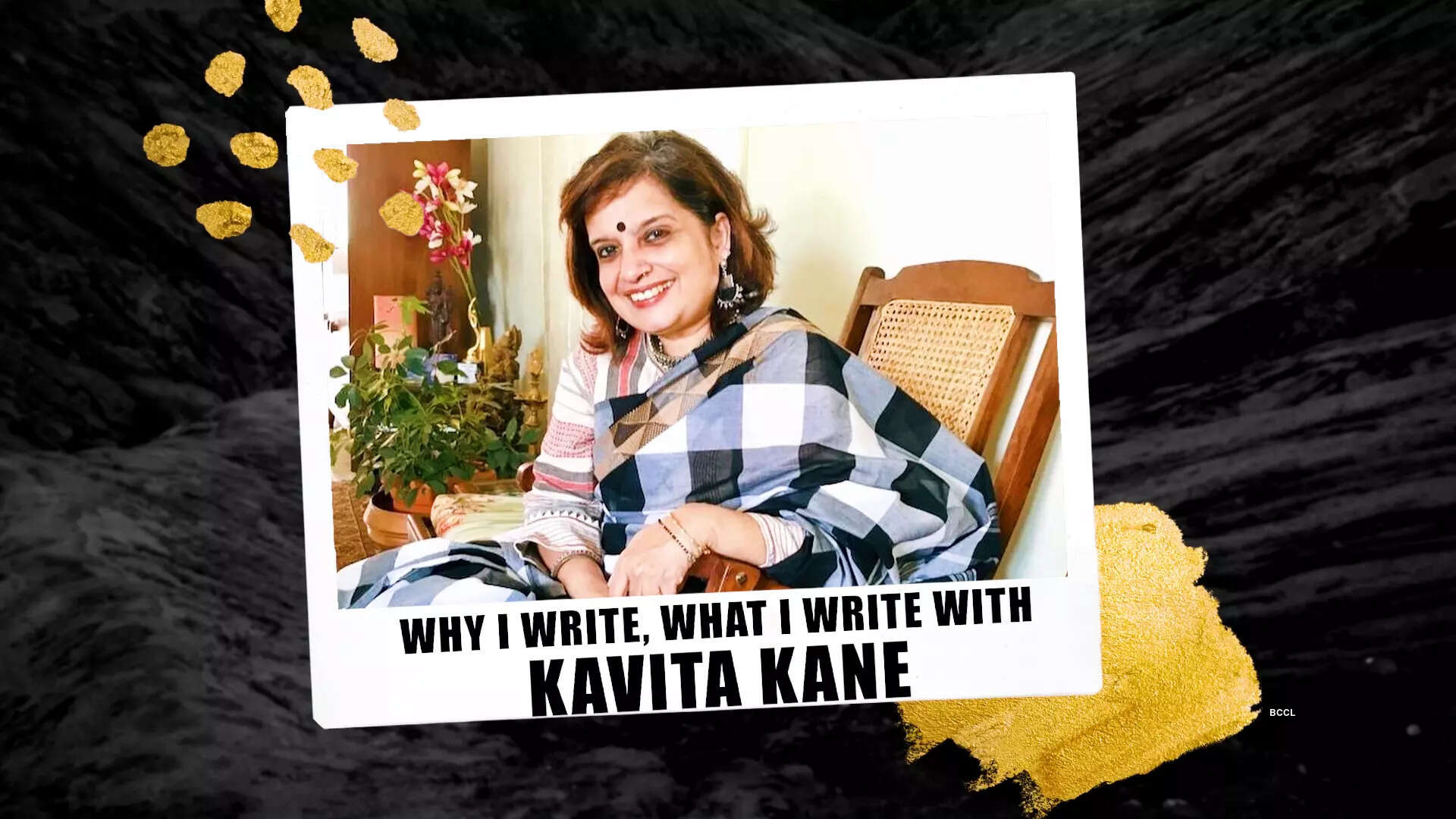
Popular Indian author Kavita Kane is known for writing feminist mytho-fictions. She has authored seven books so far, her latest being 'Sarasvati's Gift' which was published in 2021. On the occasion of Basant Panchami today, a day when Goddess Sarasvati is worshipped as per Hindu traditions, we connected with author Kavita Kane to discuss her books and writing. In this candid chat with us, she tells us about her book 'Sarasvati's Gift', her inspiration for writing mytho-fictions, her writing process, top five book recommendations, and more. Excerpts:
1. Tell us a bit about your latest book 'Sarasvati's Gift'.

'Sarasvati's Gift' is, of course, about Goddess Sarasvati who is the goddess of music, knowledge, arts that we all know. We tend to remember her on this one day of Sarasvati puja every year, but I think personally Sarasvati is one Goddess who is constantly there-- she is the constant teacher, constant guide, she is your inspiration, your entire creativity. My book is not just about her as a Goddess, but about her being beyond a Goddess. There is a certain spiritual notion about her. She is a personification of knowledge, and the book tries to deal with this distinction between words that we tend to use very easily. In the book, I have also tried to address that she was also a river Goddess and what it actually means, and the fact that the river Sarasvati is not there anymore. I have taken that not just as an allegory. There is a certain scenario that just like the river vanished, what would happen to the world if knowledge vanishes from the earth... In today's world, we talk more about power and money rather than intelligence and information.
Coming back to the book's title, 'Sarasvati's Gift', what is that gift? And if we are blessed with that gift, how are we using it? So the book is more about her being a Goddess. It's about how we as earthlings have interpreted Sarasvati and how we are interpreting the knowledge in today's world. It's not just about her story, but our story as well.
2. How do you plan to celebrate Sarasvati puja today?
I'm not a very ritualistic person. Personally, I'll wear yellow, make some dishes which she likes and I like as well, and I have a beautiful Sarasvati's idol which I'll deck up for the day. It's a day of humility that we have been blessed by her, that she is our constant teacher and I really believe in that especially in today's world. I wrote the book during the peak of the Coronavirus pandemic when we realized that we have this power of knowledge and we should utilize it for everyone's benefit.
3. You are a journalist turned author. What inspires you to write mytho-fictions?
Mythology itself is a literary device, I think. It is an elaborate backdrop to contemporary sensibilities and ideals because these aren't old stories that we are being retold. These stories are talking about universal experiences, emotions, love and loyalty, hope and disappointment. It is not a story about Gods and Goddesses, it is about us-- about man, his flaws, his faults, his inner battles, and eventually his trials and triumphs. I think that is why these stories are so relatable because we identify with them-- the characters, their situations, the dilemmas they are in because they are our stories. We think they are the stories of some ancient Gods and Goddesses but they are not. They are very much relevant, relatable stories and that's why I think this genre is popular.
4. Tell us about your writing process.
There has to be a certain discipline to write every day. I never write at night as that's when the ideas keep on popping, there's brainstorming, etc. So I keep a writing pad, I jot down my thoughts so I can go back to them the next morning. I don't have a desk because I feel constrained writing on a desk. I sit near a window, where there is lots of sunlight and greenery, and I write. I have written enough on a desk as a journalist... I think it is symbolic that I don't want to be restricted with a physical entity like a desk, or any rules or regulations (when I write). I also keep a personal deadline so that my writing becomes time-bound. I think it becomes a habit as a journalist to have deadlines. If I dislike a desk, I definitely do not dislike a deadline.
5. You have written short stories which are available as audiobooks. Tell us a bit more about it?
As a reader, I loved reading short stories. My favorite authors are short story writers. I always wanted to write short stories, so when this opportunity came I really jumped at it. I wrote an anthology of three stories; they wanted me to write on the theme of love and lust. There were three characters that were selected and that is how these three stories came about-- the enchantress, the seductress, and the lover. Each of them is completely different.
Writing short stories gave me a certain amount of courage and confidence that I can write a short story. Short stories are more difficult to write than novels because everything has to be concise. I think the training as a journalist helps-- to cut down the words or thoughts. For audiobooks, the credit goes to the narrators as they bring the story alive... And through audiobooks, we actually revert to the old format of storytelling that is oral narration, which is how the epics were originally told.
6. What are your top five book recommendations?
I tend to be a little archaic. I like 'Yugant' by Iravati Karve, 'Cuckold' by Kiran Nagarkar, Leo Tolstoy's 'Anna Karenina' is my favorite, any short story by Somerset Maugham, and fifth would be my book! Meanwhile, my favorite book is by PG Wodehouse, it is my constant stress buster. I have a habit of reading two books at a time so... PG Wodehouse is a constant because I love the way he writes. Humour is a very rare and difficult genre to write and there are very few good humor authors.
7. Tell us your three writing tips.
The first thing for writing is to read well. Secondly, write well. And thirdly tell the story well (for fiction)... Storytelling is also an art. I'll share a very personal example: I was a terrible bedtime storyteller, so my daughters can't believe that I became an author! I think I can tell a story well by writing and not by saying. I think it is important to fine-tune that way of telling a story; how you treat the subject is very important.
8. And lastly, what are you working on next?
I'm writing about another remarkable woman whom we seem to have forgotten in our epics. I won't name her... The book should hopefully be out by the end of this year or earlier next year!
READ MORE: