Away from the spotlight and mainstream attention of the general events at the State School Arts Festival runs the Arabic Kalolsavam and Sanskrit Kalolsavam, but in the close to two decades of their existence as separate entities, these festivals have gained quite a wide following among students who learn Arabic and Sanskrit in school. Participation in these festivals are limited to such students.
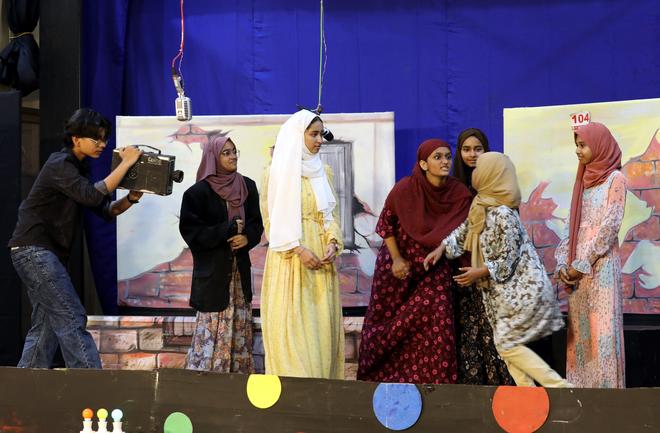
At the Kadappakada Sports Club, the main venue of the Arabic Kalolsavam, S. Gafoor from Kondotty is getting ready to watch a play, based on the Israeli onslaught on Gaza, in which his son Mohammed Rinfan is playing the lead role.
“I work in Saudi Arabia. I decided to apply for leave and come here during this time because he is performing at such a prestigious festival. He had won the best actor award at the district level,” says Gafoor.
Muhammed Aboobacker, an Arabic teacher from High School Pavumba in Kollam, who translated Santosh Echikkanam’s Biryani to Arabic for his school’s drama, has been a regular at the festival since 2008. But, increasingly, schools are depending on theatre professionals, who don’t necessarily know Arabic, to prepare their teams for the play with the Arabic teachers taking care of just the language part. Quite a few of the competing teams stage Arabic versions of popular Malayalam plays, while a few make plays based on contemporary issues.
Arabic seminar
“One of the highlights of the festival is the Arabic seminar, in which Arabic language scholars from across the State participate. Yesterday, we had a full house here,” says S. Ahmed Ukhail, convener of the Arabic Kalolsavam.
An interesting event is dictionary making, in which the contestants are provided a short article from which they have to prepare a dictionary of Arabic words, arranged alphabetically and marked as verb or noun. Arabic competitions in monoact, Kathaprasangam, group song, recitation, story writing, quiz, and translation have all witnessed enthusiastic participation.
Temple art
Less than a kilometre away is the Jawahar Balabhavan, the venue of the Sanskrit Kalolsavam, where a tight competition in Paadakam is ongoing. A traditional temple art form which involves storytelling using Sanskrit slokas and Malayalam narration, it is believed to have branched out from Chakyarkoothu.
“Other than at the arts festival, Paadakam is now performed mostly in temples and in seminars. Much of the performance is based on mythological stories,” says K. Anusree, who trains Paadakam performers at the SNDP Sanskrit High School, Vallikunnam.
Ashtapadi, performed based on Jayadeva’s Gita Govindam, with an Idakka percussion in the background, as well as the Sanskrit Koodiyattam events have witnessed tight competition. Just like the Arabic festival, the Sanskrit festival also has a seminar based on the language.
If the student participation at both festivals are any indication, the events are serving the stated role of promoting creative expression in these languages.