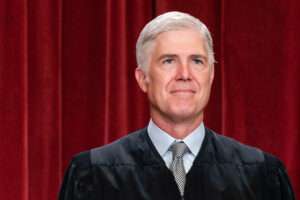
In a recent "fireside chat" before the Tenth Circuit conference, Supreme Court Justice Neil Gorsuch decried the trend towards abusive use of emergency powers (see also this slightly more detailed account):
"Everything is an emergency," he said…. "We've moved so much up to the federal level that needs to be done by states. And now through delegations of authority, through emergency legislation of all stripes, we've moved it over to the executive branch. And I just don't think that's a recipe for a healthy democracy over the long term."

Gorsuch is absolutely right about this. We should not allow emergency powers intended to be used only in extreme situations to become a blank check that the executive can wield at will. Sadly, we have increasingly moved in that dangerous direction. Presidents of both parties have abused emergency powers, though Trump - in his second term - has been a particularly egregious offender.
While much of the blame for this state of affairs rests with Congress and the executive branch, Gorsuch and other judges can help by rigorously enforcing constitutional and statutory constraints on emergency powers. As I outlined in more detail in a Dispatch article published last year, courts should engage in strong judicial review of both the meaning of terms like "emergency," "invasion," and "unusual and extraordinary threat," and whether the facts on the ground proves that these dangers are actually present (thereby justifying invocation of extraordinary emergency powers to deal with them). I also rebut the argument that courts should defer to the executive on these kinds of issues, because of the supposedly superior expertise of the latter.
The Supreme Court has in fact constrained executive abuse of emergency powers in several important cases, under both Biden and Trump. Notable examples include the IEEPA tariff case (which I helped litigate) and the Illinois National Guard case (both under Trump), and Biden v. Nebraska (2023) (in which the Court rightly struck down Biden's attempt to use Covid emergency powers as a pretext to forgive over $400 billion in student loan debt). Last year, the Supreme Court also blocked Trump's efforts to swiftly deport Venezuelans under the Alien Enemies Act, a statute that can only be used in the event of an "invasion" or a "predatory incursion" on US territory by a foreign government.
But in each of these cases, the Court never ruled on whether an emergency, "invasion," or other extraordinary circumstance justifying the use of emergency powers was actually present. It instead ruled against the executive on other grounds. In one of the "shadow docket" cases involving the Alien Enemies Act, the Court did rule that the meaning of "invasion" and other terms in the Act is subject to judicial review. But it did not address the question of deference on factual issues. Thus, the extent to which the Court is willing to constrain abuses of emergency powers remains at least somewhat unclear.
To his credit, back in 2022, Justice Gorsuch broke with the other conservative justices, and (along with the three liberals) dissented from a procedural decision that, in effect, required Biden to continue the abusive use of Covid emergency powers as a tool for immigration restrictions. As Gorsuch put it in his dissent, "courts should not be in the business of perpetuating administrative edicts designed for one emergency only because elected officials have failed to address a different emergency."
Judicial review cannot fully solve the problem of abusive use of emergency powers on its own. As noted in my Dispatch article, Congress needs to step in and take measures such as setting strict time limits on executive-declared invocations of emergencies. But the judiciary can, nonetheless, play a valuable role in preventing extraordinary emergency powers from becoming a blank check the president can use whenever he wants.
And, while we cannot rely on the judiciary alone to police abuses of emergency powers, we should also avoid the opposite error of relying solely on Congress. As Gorsuch points out in his compelling concurring opinion in the tariff case, it is very difficult for Congress to pull back delegations of power, if courts interpret them overbroadly:
When a private agent oversteps, a principal may fix that problem prospectively by withdrawing the agent's authority. Under our Constitution, the remedy is not so simple. Once this Court reads a doubtful statute as granting the executive branch a given power, that power may prove almost impossible for Congress to retrieve. Any President keen on his own authority (and, again, what President isn't?) will have a strong incentive to veto legislation aimed at returning the power to Congress. Perhaps Congress can use other tools, including its appropriation authority, to influence how the President exercises his new power. Maybe Congress can sometimes even leverage those tools to induce the President to withhold a veto. But retrieving a lost power is no easy business in our constitutional order. And without doctrines like major questions, our system of separated powers and checks-and-balances threatens to give way to the continual and permanent accretion of power in the hands of one man. That is no recipe for a republic.
That is all the more reason for the judiciary to rigorously enforce statutory and constitutional constraints on the scope of delegated powers - especially when we are talking about sweeping emergency powers that endanger civil liberties, threaten the stability of the economy, and have other potentially massive effects.
If anyone has access to the full text of Gorsuch's talk at the Tenth Circuit conference, please send it to me, if you can.
NOTE: For those keeping score, I also called for rigorous judicial review of invocations of emergency powers under Biden. See, e.g., here and here.
The post Justice Gorsuch on Abuse of Emergency Powers appeared first on Reason Magazine.