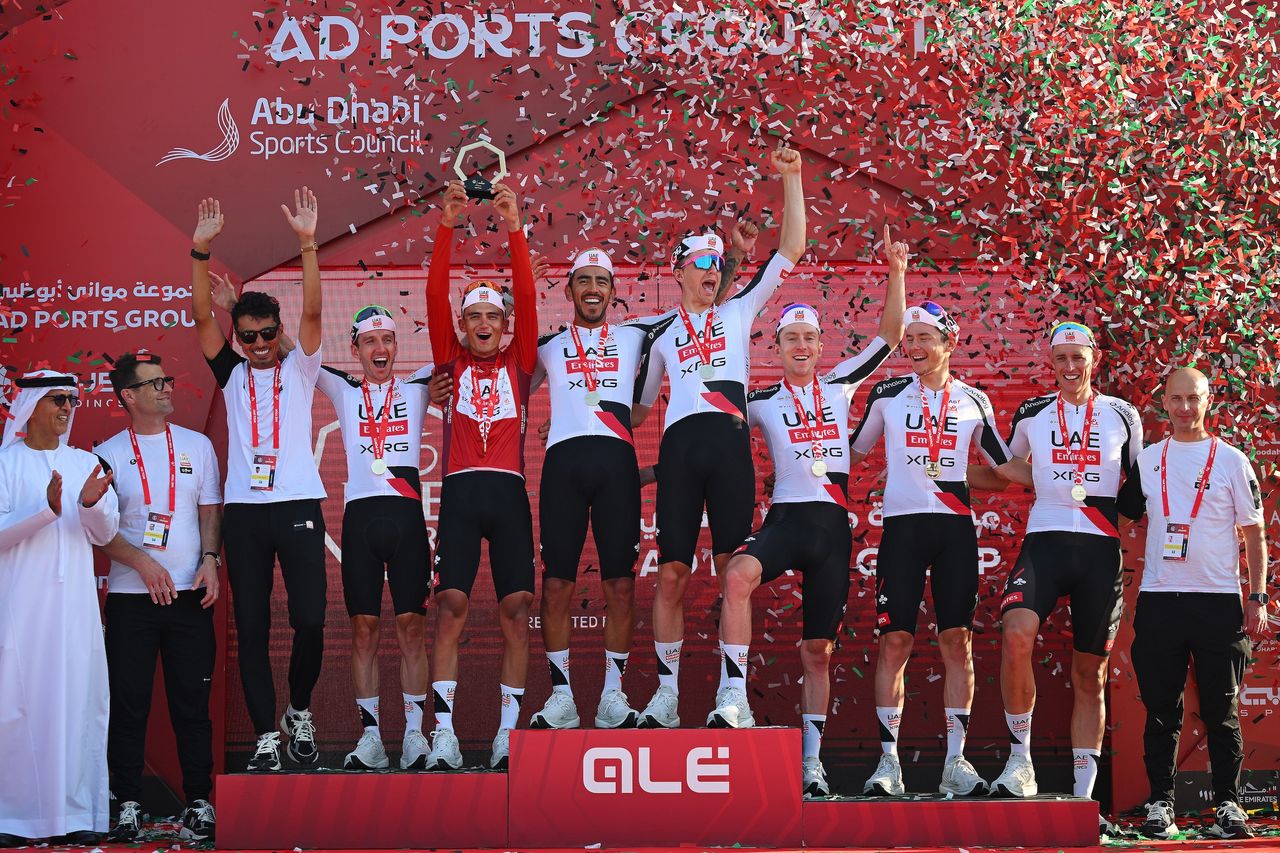
Running a men's WorldTour team has never been so expensive. It now costs around €30m a year - and that's just to be competitive. If you're a cash-rich business or billionaire who fancies knocking UAE Team Emirates-XRG off their perch, you'd need to find twice that much.
Where, you might well ask, does all that money go? Cyclists are not paid the megabucks of stars in other sports. Cycling Weekly ascertained from leading agents that, of the 1,182 professional riders (men and women, WorldTeam and ProTeam), only 60-70 earn more than €1m, and fewer than 20 exceed €2m. Tadej Pogačar, with his €8.4m salary (before bonuses, private sponsorship deals and appearance fees), is an outlier - as are Remco Evenepoel, Jonas Vingegaard and Mathieu van der Poel, who command salaries of between €4 and €6m (contrast with Manchester City's Erling Haaland's £27.3m).
If most riders aren't hoovering up the big money, where does it go? CW has obtained official figures from the UCI that break down where teams spend their dough. We have also spoken with senior figures in the sport to better understand how the costs of running a cycling team in 2026 stack up.
Budget breakdown
At cycling's World Tour seminar in Geneva, Switzerland, in December, UCI President David Lappartient's slideshow illustrated the projected cost structure of professional teams for the 2026 season - encompassing men's and women's WorldTeams, and the second-tier men's and women's ProTeams. The data showed the combined budgets of the 18 men's World Teams in 2026 will reach €620-630m, up from €570m last year. The average budget will be €33m, with a median of €28m.
The 15 Women's WorldTeams will share €80m, an increase of €10m from 2025 despite having one fewer team. The average budget is set at €5.7m. UCI ProTeams - such as Tom Pidcock's Pinarello-Q36.5 - have an average budget of €9.4m, while their female counterparts come in at €1.9m.
Most of the money, an estimated 90%, comes from sponsorship deals; teams have few other revenue streams. Spectators pay no admission fee, and only a minority of diehard fans buy replica team jerseys - contrast with Premier League football, where 15-20% of a team's revenue comes from matchday receipts, including ticket sales and catering.
By far the biggest expense is staff salaries. For the 2026 season, men's WorldTeams will spend on average 73% of their budget on "personnel expenses", most of it going to riders (capped at 30 per team). A 2024 UCI document seen by CW shows the median amount spent on riders' salaries was €11.2m. The gap between the highest- and lowest-spending teams was a whopping €22.1m.
Some pro cyclists are employed, others self-employed. The former have their various taxes paid out of their salary at source, while the freelancers have to cover it themselves. Figures show that the average salary for self-employed WorldTeam riders (57%) is €654,000, while the median is €350,000. For employed riders (43%) the average salary is €384,000, with a median of €350,000.
Those numbers don't take into account win bonuses, which can reach seven figures for winning the Tour de France, and around €250,000 for victory in a Monument. These bonuses are typically divided among team-mates, as per cycling custom, but for a big win a rider can expect to be rewarded with an extra payment. Riders on employed contracts earn 50% more than they did in 2023, while those on self-employed contracts have seen, on average, a 27% pay rise in the same three-year period.
Last spring, while reporting for Escape Collective, I spoke to Brent Copeland, general manager of Jayco-AlUla and president of the teams' union AIGCP, who told me: "The numbers keep growing by percentages it is difficult to comprehend."
The document also shows how rapidly team staff numbers have grown. Across men's World Teams, the total now exceeds 1,250. Most teams now average 65 personnel - a few years ago it was in the low 50s. Total staff salaries in 2024 amounted to €71.5m, which worked out at just under €4m per team on average; two teams, one of which is assumed to be UAE, forked out €7.7m on staff wages in 2024. "With the amount of work the staff put in - 180 days away from home, the commitments, the amount of travelling and driving around Europe - if you look at the daily European hourly wage for someone who works away from home, we've got to the point that most staff are earning what they should be earning," Copeland said.
Paying to race
Even after wages, teams spend millions attending races. According to the UCI's figures, 15% of men's WorldTeam spending is on "competition expenses". World Tour teams may skip only one WorldTour race, but it cannot be a Grand Tour or a Monument. Teams receive a few thousand euros per race day from organisers, and they're also provided hotel rooms to cover all riders plus essential staff; that number rises to 26 staff members during the Tour de France. Accommodation for any extra staff has to be paid for by the teams themselves - and at big races such as Grand Tours, this amounts to a major outgoing.
Added to this are the costs of getting to races, with 3% attributed to vehicle expenses. In effect, most teams pay to race. "Just to fill up a bus costs a fortune," Copeland said. Flights, road tolls and training camps also have to be factored in. "All these small expenses add up," Copeland said. "The operational side of teams has grown substantially in the past few years."
Stephen Delcourt, manager of the women's World Team FDJ United-Suez, revealed the cost of sending just a few of his team's riders to altitude. "We have three camps where three or four riders go, and one before the Tour where all seven riders go, plus a physio and a nutritionist," Delcourt tells CW. "In total it costs close to €100,000."
Growing financial disparities are also reflected in equipment spending. While teams generally receive bikes, parts, clothing and cars free of charge from sponsors and brands as part of multi-year deals, in 2024 teams spent an average €2m on equipment-related expenses, with some spending almost €5m. This includes activities such as aerodynamic and wind tunnel testing.
"General expenses" accounts for 6% of spending. This likely includes legal fees and insurance, as well as media and hospitality-related outgoings. Visma-Lease a Bike, for example, invest huge sums into their VIP offering. Finally, 3% of all costs is spent on unspecified "other expenses" which may include registration fees. For men's WorldTeams, a fee of €100,500 is paid annually to the UCI, plus a mandatory €215,000 anti-doping contribution. The respective figures for their female counterparts are €13,000 and €25,000.
Every euro counts
As the boxout illustrates, the breakdown of costs is similar across the various different divisions, but cannot be applied to the more than 180 third-division men's Continental teams who exist on shoestring budgets. An increasing number of these outfits are development teams for WorldTeams - Ineos Grenadiers Racing Academy is the sole British Continental team in 2026 but the vast majority are small set-ups racing the smallest UCI races. European Continental teams wanting to give their riders a competitive calendar typically require a minimum annual budget of around €500,000, with some reporting overall revenue from sponsors of around €1m.
One of those teams is ColoQuick, which was the first team of two-time Tour de France winner Jonas Vingegaard. Sports director Christian Moberg is one of two full-time staff at the Danish team and he told CW that his team has "more than 100 different sponsors", with the minimum fee to invest set at €2,000. "Every euro counts," Moberg said.
Except in France, Belgium and a select few other countries where riders are classed as professionals and thus must be paid, many riders on Continental teams are not paid and only have their basic expenses covered. Travel costs are the biggest expense for Continental teams, followed by insurance fees, which Moberg estimates at around €100,000 for his team - a 10th of their annual budget. Like World Teams, Continental outfits often receive bikes free of charge from sponsors, but some teams go it alone, either out of necessity or wish. "We buy all of our equipment ourselves because we want the best equipment," Moberg said. "We have very good deals with Trek and Shimano, but we still spend more than €150,000 a year on buying equipment."
David vs Goliath
Cycling's business model has been widely debated in recent years, with many World Team managers and owners pushing for a new model that would reduce teams' dependency on wealthy backers and companies. Yet even as inflation pushes up costs, investing in cycling teams remains attractive. Even adjusted for inflation, there has never been as much money in the sport.
Yet both Copeland and Moberg - two men sitting on very different budgets and operating in very different landscapes - agree that if cycling isn't careful the bubble might burst. Just like it did in the UK with the demise of the domestic scene at Continental level.
"With more World Teams starting development teams and those teams taking the spots in races like the Tour de l'Avenir and Baby Giro, it would be impossible for a team like ours to start now," Moberg said. "It's not sustainable and with the state of the world right now it's very difficult to get money out of companies."
At the top end, is it really fair or sustainable for the average team on around €30m to be expected to compete with goliaths UAE Team Emirates-XRG and Netcompany-Ineos, estimated to have budgets of €55-€60m? Copeland, who is a proponent of a budget cap in cycling's highest echelon, shared his concerns. "I'm not trying to put a negative spin on the fantastic period that cycling is going through and will continue to go through, but we need to carefully look at the trajectory of budgets in the sport and make sure we keep things sustainable."
How they spend it
These figures were disclosed at the UCI World Tour seminar in December 2025, and subsequently obtained by Cycling Weekly.
Men's WorldTeam |
Men's ProTeam |
Women's WorldTeam |
Women's ProTeam |
|
Median budget |
€28m |
€5.3m |
€5.7m |
€1.3m |
Average budget |
€33m |
€9.4 |
€5.7m |
€1.9m |
Personnel expenses |
73% |
64% |
65% |
64% |
Competition expenses |
15% |
20% |
18% |
24% |
General expenses |
6% |
7% |
6% |
4% |
Vehicle expenses |
3% |
6% |
7% |
6% |
Other expenses |
3% |
3% |
4% |
2% |
This feature was originally published in the 19 March 2026 print edition of Cycling Weekly magazine – available to buy on the newsstand every Thursday (UK only) while digital versions are available on Apple News and Readly. Subscriptions through Magazine's Direct.