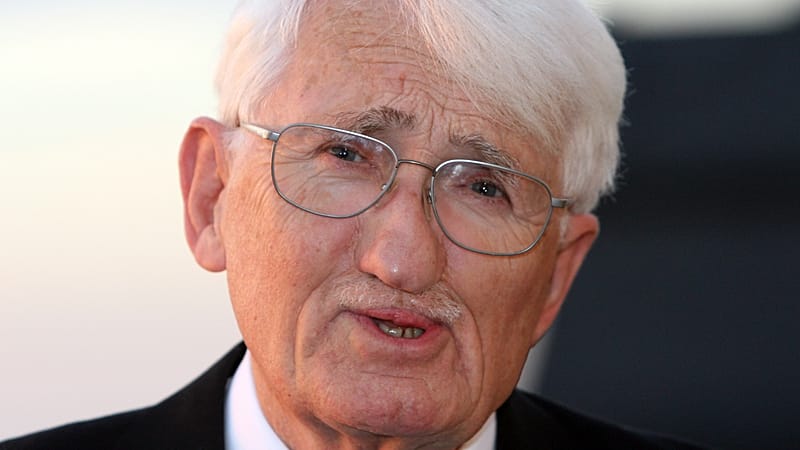
Habermas, one of Germany's most influential post-war philosophers, has died at the age of 96 on Saturday, his publishing house Suhrkamp announced.
Habermas' work on communication, rationality and sociology made him one of the most important contemporary German philosophers and the leading figure of the 'Frankfurt School', following in the footsteps of his teachers Theodor W. Adorno and Max Horkheimer.
The philosopher made an international name for himself for reworking the "Critical Theory" developed by Adorno and Horkheimer, an analysis of society, politics and culture that calls into question existing power structures, ideologies and relations of domination.
Habermas was the last surviving representative of the Frankfurt School and never shied away from speaking out on current political issues, publishing opinion pieces regularly in leading German dailies.
His magnus opum was, arguably, the two-volume "Theory of Communicative Action," published in 1981. In it, he develops a concept of reason as an emancipatory communicative act, culminating in the ideal of societal communication free of domination and violence.
Habermas was born in Düsseldorf in 1929 and had been enrolled in the Hitler Youth at a young age, as did many German boys, but soon became deeply marked by the collapse of Nazism when he was 15 years old.
He later recalled that the Nazi atrocities were a formative moment that ultimately guided him toward philosophy and social theory, recalling that "you saw suddenly that it was a politically criminal system in which you had lived".
The philosopher had an ambivalent relationship with the German left-wing student movement in the 1960s. While he engaged with it, he rejected any radicalisation and the use of violence, as well as warned against the danger of what he called “left-wing fascism".
Later, however, he acknowledged that the movement had contributed to a "fundamental liberalisation" of German society.
Habermas was born with a deep cleft palate and had corrective surgery several times as a child. He later said the experience helped shape his thinking about language. But it also led him to avoid the visual media. When Euronews approached him for an interview in 2002, he simply told us "sorry, but I don't do television".
His wife, Ute Habermas-Wesselhoeft, died last year. Their daughter Rebekka, an eminent historian, died in 2023. He is survived by his son Tilmann, a psychoanalyst and professor of psychology, and his daughter Judith, a designer.