
Get all your news in one place.
100's of premium titles.
One app.
Start reading
The Conversation
The Conversation
Mike Sori, Assistant Professor of Planetary Science, Purdue University

Jupiter's moons hide giant subsurface oceans – two upcoming missions are sending spacecraft to see if these moons could support life

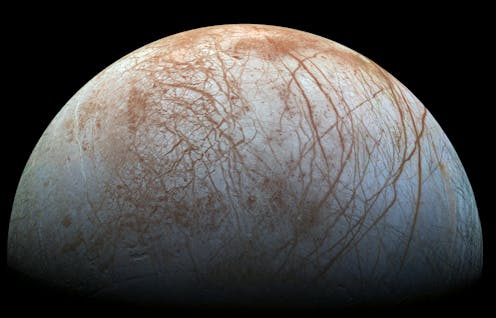
The surface of Europa – one of Jupiter's moons – is a thick layer of solid ice. NASA/JPL-Caltech/SETI Institute, CC BY-SA

On April 13, 2023, the European Space Agency is scheduled to launch a rocket carrying a spacecraft destined for Jupiter. The Jupiter Icy Moons Explorer – or JUICE – will spend at least three years on Jupiter’s moons after it arrives in 2031. In October 2024, NASA is also planning to launch a robotic spacecraft named Europa Clipper to the Jovian moons, highlighting an increased interest in these distant, but fascinating, places in the solar system.

I’m a planetary scientist who studies the structure and evolution of solid planets and moons in the solar system.

Sign up to read this article
Read news from 100's of titles, curated specifically for you.
Already a member? Sign in here
Related Stories
Top stories on inkl right now
One subscription that gives you access to news from hundreds of sites
Already a member? Sign in here
Our Picks
Fourteen days free
Download the app
One app. One membership.
100+ trusted global sources.







