The ABS challenge system has officially come to Major League Baseball.
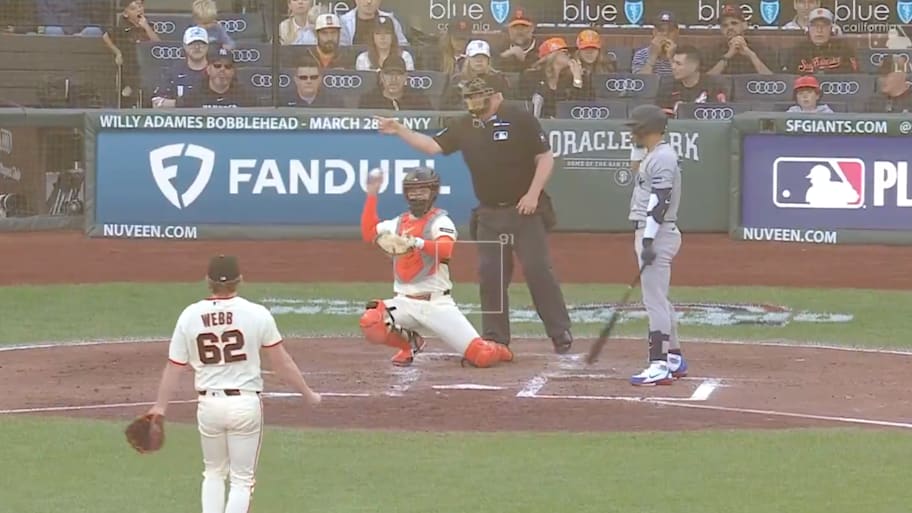
On Wednesday night, during the season’s opening game between the Giants and the Yankees, New York shortstop José Caballero became the first big leaguer to challenge a call at the plate in a regular season game. He lost.
The challenge came on the first pitch in the top of the fourth. Giants righty Logan Webb threw a 91 mph sinker on the inside corner that home plate umpire Bill Miller called a strike. Caballero immediately signaled for a challenge.
Unfortunately for fans watching on Netflix’s first MLB broadcast, an interview with Giants manager Tony Vitello was taking place during the challenge. The network didn’t show video of the pitch tracking and instead plowed on with Vitello. All viewers at home saw was Miller announcing that the challenge was unsuccessful.
Video is below:
Jose Caballero loses the first ABS challenge in Yankees and MLB history
— Talkin' Yanks (@TalkinYanks) March 26, 2026
Yankees have one incorrect challenge remaining pic.twitter.com/kSUFIqRSgD
That was fairly anti-climactic for what is genuinely a historic event for the game.
Caballero losing the challenge leaves the Yankees with one for the rest of the game. It may not matter, as they are up 5-0 early and starter Max Fried has looked locked in.
How MLB’s ABS Challenge system works
The ABS challenge system is being implemented by Major League Baseball for the first time in 2026. The system has been used in the minor leagues since 2019, and the league tried it out in some spring training last year.
The system uses Hawk-Eye technology to track pitches as they come in and see where they cross the plate relative to the strike zone. There are multiple high-speed cameras used to track the pitch and create a 3D model of the ball’s flight.
When pitches come, and there is a call the batter, catcher or pitcher doesn’t agree with, they signal for a challenge by tapping his cap or helmet. The umpire will then signal that a challenge has been issued, and the ball’s flight will be tracked on graphic shown on the video board and broadcast.
Teams are given two challenges per game, but if a challenge is successful, they retain it. If a team is out of challenges and the game goes to extra innings, it will be rewarded one for the 10th inning. Then another for the 11th and so on. A team with remaining challenges does not receive an extra one in those innings.
The ABS strike zone is 17 inches wide, the same as home plate. Meanwhile, the top end of the zone is set at 53.5% of the player’s height, while the bottom is 27% of his height. The zone will be different for every MLB player because of their height, so each had to be measured before the season.
During spring training this year, 2.6% of all pitches were challenged, and the success rate was 52.2%. At Triple A last season, the success rate was 50%. Catchers and pitchers were more successful during spring training (54.4%) than hitters (50.0%).
The system has worked well in the minors, we’ll see how it does in the big leagues.
More MLB from Sports Illustrated
- Barry Bonds Reveals He Refused to Sign With Yankees After Call With George Steinbrenner
- Padres’ Yu Darvish Decides to Forfeit $16 Million Salary for 2026 Season
- MLB Opening Night: Max Fried Dominates Giants as Yankees Cruise
- Gerrit Cole Injury: When Yankees Ace Could Return From Tommy John Surgery
This article was originally published on www.si.com as José Caballero Loses First ABS Challenge in MLB History.