Get all your news in one place.
100’s of premium titles.
One app.
Start reading
Cycling News
Cycling News
Sport
Philippa York

Jonas Vingegaard's margin for improvement ahead of Giro d'Italia, Ineos' tactical hiccup, and the riders who shone in a brutal Paris-Nice – Philippa York analysis

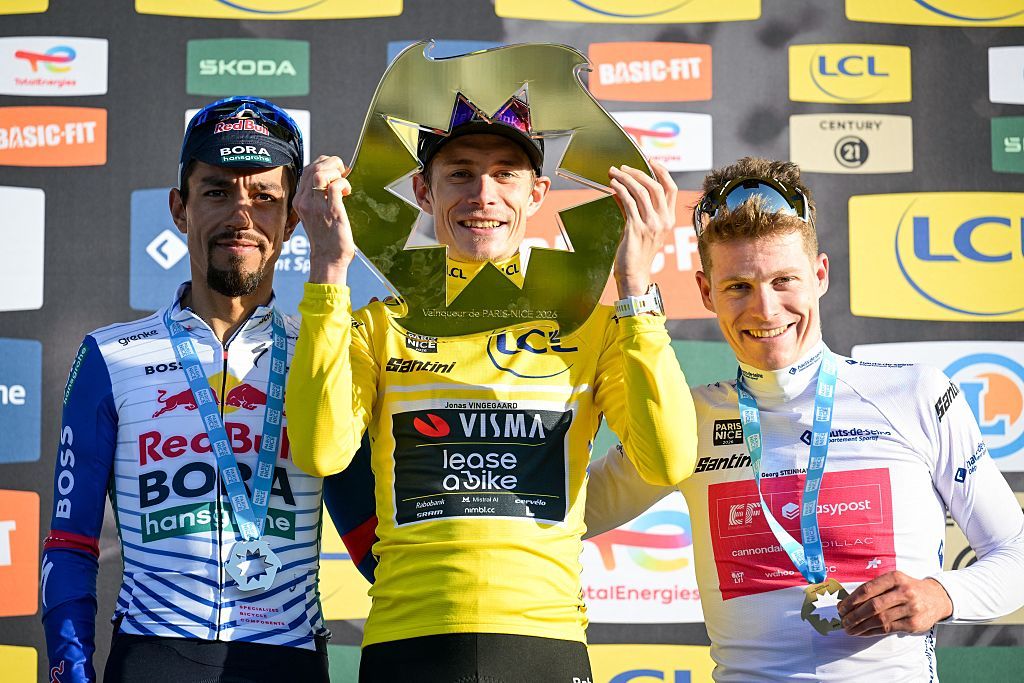
Colombian Daniel Felipe Martinez of Red Bull-BORA-hansgrohe, Danish Jonas Vingegaard of Team Visma-Lease a Bike and German Georg Steinhauser of EF Education-EasyPost pictured on the final podium after the final stage of 84th edition of the Paris-Nice cycling race, a race from Nice to Nice (129,2 km), on Sunday 15 March 2026. BELGA PHOTO DAVID PINTENS (Photo by DAVID PINTENS / BELGA MAG / Belga via AFP).

The dust, or rather the dirt, has settled on the 84th Paris-Nice and the first indications of the form of those who chose France over Tirreno-Adriatico are in.

Before even leaving Achères on the outskirts of the French capital to start stage 1, Jonas Vingegaard was the main favourite to win the Race to the Sun, and that he finished the week as the overall victor is no real surprise. However, his performance was probably more dominant than he could have imagined.
Two stages plus wins in the points, mountains and overall classifications showed there was a consistency that no one else came close to matching. Of course, the bad weather and the crashes affected the result but Visma-Lease a Bike guided their leader through most of the difficult moments with their usual efficiency, which makes getting the job done so much easier.

At 29, the Dane has experienced all the situations and obstacles that a bike race can throw at you, hence the clothing modifications of stage 4 and the killer attacks at just the right times that saw him more than four minutes ahead of Dani Martínez (Red Bull-Bora-Hansgrohe) in second place. The only faux pas was underestimating Lenny Martinez’s (Bahrain Victorious) sprinting capabilities on the last stage but in the grand scheme of things, Vingegaard and Visma had to have been very happy with the results.

The contest might have been closer if Juan Ayuso (Lidl-Trek) hadn’t crashed out on the fateful fourth stage to Uchon, but looking at how Vingegaard dispatched the Red Bull guys after they had ridden all day and then produced an even bigger blow the following day showed that it wasn’t just about staying focused and warm. Instincts, experience and recovery all combined to stamp his authority on his rivals.

The first of Vingegaard's two stage wins (Image credit: Szymon Gruchalski / Stringer)

This was Vingegaard in good form – that was evident – but worryingly for those going to the Giro d’Italia, I'd say there’s a margin of improvement to come. The inner strength is there and with his next outing being at the Volta a Catalunya, the plan will be for hopefully better temperatures to add the final touches to his form.

The clues behind that thinking are related to Lenny Martinez. He was the only one who really reacted to Vingegaard’s attacks, coming close to making it onto the race leader’s wheel on stage 5 and then being able to follow on the last day.

A top-level Vingegaard would have stayed out of the saddle for another 100 metres or more and the Frenchman would have been in real trouble. That’s not to say that the Bahrain team leader hasn’t progressed – he most certainly has – but he still has a way to go to match the pro peloton’s best climber on the biggest mountains.

Ineos' costly mistake

Overall the French had a promising race. Two stage wins, four riders in the top 10 and Decathlon CMA CGM were faster than Visma in a team time trial. However, other than another third place for Cees Bol, that was the only time any of the Decathlon squad appeared in the top 10 of a stage, so it does look like they need Paul Seixas more than ever.

The Ineos Grenadiers revival had a distinct Francophone tinge to it at this Paris-Nice. Their team trial victory was very impressive and on top of that Dorian Godon won the grim, shortened and ultimately pointless stage that finished in Isola after just missing out the day before. Their sprint options have expanded again but the main thing to note was the internal GC leadership contest between Oscar Onley and Kévin Vauquelin.

Both are new arrivals and both seem at a similar level, but the Frenchman staked his claim to being the sole leader with a more convincing performance after Onley abandoned. That he couldn’t make it onto the podium was as much down to bad luck as it was to a slight hiccup in the team’s tactics during the rain and wind blasted stage 4.

After the Ayuso crash split the front group, the race situation turned to chaos as the Red Bull quartet of Nico Denz, the two Van Dijke brothers and their leader Dani Martinez continued to ride flat out with Vingegaard as a passenger. Normal etiquette would have been to allow those affected by the crash to come back but there’s a get-out clause which is sometimes applied that if a team is riding on the front and an incident occurs, they can choose to continue at the same pace. It’s not a good excuse but it happens and Red Bull did initially hesitate and then a call must have been made and they decided to keep riding. That move would be repaid in kind when they found themselves on the wrong side of Martinez’s crash on the final day and the rival teams made the choice of not waiting either.

Already thinking that Vingegaard was going to be troubled by Martinez's tenacity was optimistic but bike racing is strange sometimes and this is where Ineos come into it. The Ayuso crash resulted in a Red Bull lead group plus Vingegaard, Lenny Martinez, David Gaudu and co. chasing but unable to close the 200 metres to the front, then another group with Marc Soler and those who managed to get up and continue after the crash chasing the next group.

Further behind them Josh Tarling was towing Oscar Onley after he had a bike change. Even further in arrears was Kevin Vauquelin, the main victim of the echelon racing earlier, trapped in a chase group where no one would or could help him.

The week ended up as an uphill battle for Vauquelin (Image credit: Anne-Christine POUJOULAT / AFP)

Vauquelin was clearly the strongest there but Ineos had Onley and Tarling in the lead group and all looked fine until the bike change and they couldn’t get back on. Already losing time, the Ayuso incident cost them further delay and suddenly they knew they were in trouble. They were then caught between hoping group three would catch group two and them all taking a breather that might allow Onley into the race again, or waiting for Vauquelin who was 30-odd seconds behind them. Then they could have combined their efforts to re-establish the situation with at least some energy left for the final climb rather than individually fighting through the wind and cold.

Onley was clearly struggling to hold onto Tarling but Vauquelin, despite his having chased most of the day, still looked good. Waiting for him was the call to make but much to the Frenchman’s frustration they didn’t so the result was by the time the various chase groups came together and Vauquelin finally found some friendly faces again, the podium places were gone.

Predictably, Vingegaard dispatched Martinez to take the race lead and – perhaps surprisingly – Georg Steinhauser (EF Education-EasyPost) escaped the clutches of the other GC guys to ride into third on GC with a margin on Vauquelin that ultimately proved impossible to close. There’s no doubt everyone finished the stage 4 GC race empty but some had to go deeper than others and it showed the following day when Vingegaard dropped everyone again and disappeared into the distance.

Behind the yellow jersey, it was a case of tired legs chasing tired legs, hoping to move up on GC in the final days but ultimately unable to make a difference. The only real change to the overall competition came from guys pulling out, so other than Gaudu on stage 5 and Onley on day six, the top 10 was already set halfway through the week.

'Individual brilliance' outside the GC story

The last three stages came down to moments of individual brilliance. Harold Tejada added to the XDS Astana account, already well filled by Max Kanter’s victory on the second day, by holding off the peloton for his first WorldTour win, then Dorian Godon gave Ineos a second stage win, and finally little Lenny Martinez outsmarted Vingegaard to round off a rather brutal eight days of racing.

That not one team finished with all their riders demonstrates how hard the racing conditions were on the roads from Paris down to Nice – Cofidis ended up with only a single rider, Ion Izagirre, completing the race, which won’t have gone unnoticed by the organisers ASO. Cofidis' direct rivals for the ProTeam invites next year, TotalEnergies, only lost one rider from their ranks, as did XDS Astana. These things matter in the long run when you haven’t earned the right to automatic entry but could for next year with enough points.

Conditions were poor once again – does the race need a rethink? (Image credit: Getty Images)

I could go through the list of teams and riders who were invisible during the week – some of them unlucky, some of them missing the quality needed to be competitive – but I’d rather note the good things that happened. Josh Tarling, for example, was outstanding, marking a shift for Ineos towards them becoming one of the super teams again. Victor Campenaerts played a similar role for Jonas Vingegaard but with slightly more focus on being the last available Visma helper.

EF Education-EasyPost had an excellent race, with Luke Lamperti in yellow for three days and Georg Steinhauser on the podium, results they will be more than happy with.

Red Bull-Bora-Hansgrohe blew the race apart on day four with the Van Dijke brothers and Nico Denz producing the kind of ride that will stick in the minds of those who were subjected to it for a long time, then there’s Dani Martinez who can be described in one word: grinta.

I know these things are subjective and I did read some adverse comments on Juan Ayuso not being able to continue after his crash as if the ability to survive race incidents is a thing of choice or character. It’s more complicated than just being hard or suffering.

From experience, falling when you are cold, wet and in miserable conditions tends to cause more injury because the body is stiff, limbs are frozen and flexibility is being sacrificed in the name of survival. In other words, you don’t bounce too well. Ayuso will be back.

Sign up to read this article
Read news from 100’s of titles, curated specifically for you.
Already a member? Sign in here
Related Stories
Top stories on inkl right now
One subscription that gives you access to news from hundreds of sites
Already a member? Sign in here
Our Picks
Fourteen days free
Download the app
One app. One membership.
100+ trusted global sources.