Get all your news in one place.
100's of premium titles.
One app.
Start reading
The Conversation
The Conversation
Flora Cassen, Senior Faculty, Hartman Institute and Associate Professor of History and Jewish Studies, Washington University in St. Louis

Jews were barred from Spain’s New World colonies − but that didn’t stop Jewish and converso writers from describing the Americas

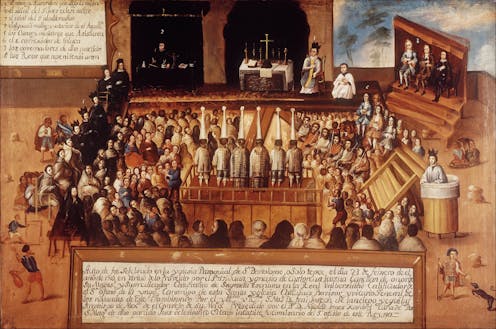
An auto-da-fé − a public punishment for heretics − in San Bartolome Otzolotepec, in present-day Mexico. Museo Nacional de Arte via Wikimedia Commons

Every few years, a story about Columbus resurfaces: Was the Genoese navigator who claimed the Americas for Spain secretly Jewish, from a Spanish family fleeing the Inquisition?

This tale became widespread around the late 19th century, when large numbers of Jews came from Russia and Eastern Europe to the United States. For these immigrants, 1492 held double significance: the year of Jews’ expulsion from Spain, as well as Columbus’ voyage of discovery. At a time when many Americans viewed the explorer as a hero, the idea that he might have been one of their own offered Jewish immigrants a link to the beginnings of their new country and the American story of freedom from Old World tyranny.

Sign up to read this article
Read news from 100's of titles, curated specifically for you.
Already a member? Sign in here
Related Stories
Top stories on inkl right now
One subscription that gives you access to news from hundreds of sites
Already a member? Sign in here
Our Picks
Fourteen days free
Download the app
One app. One membership.
100+ trusted global sources.