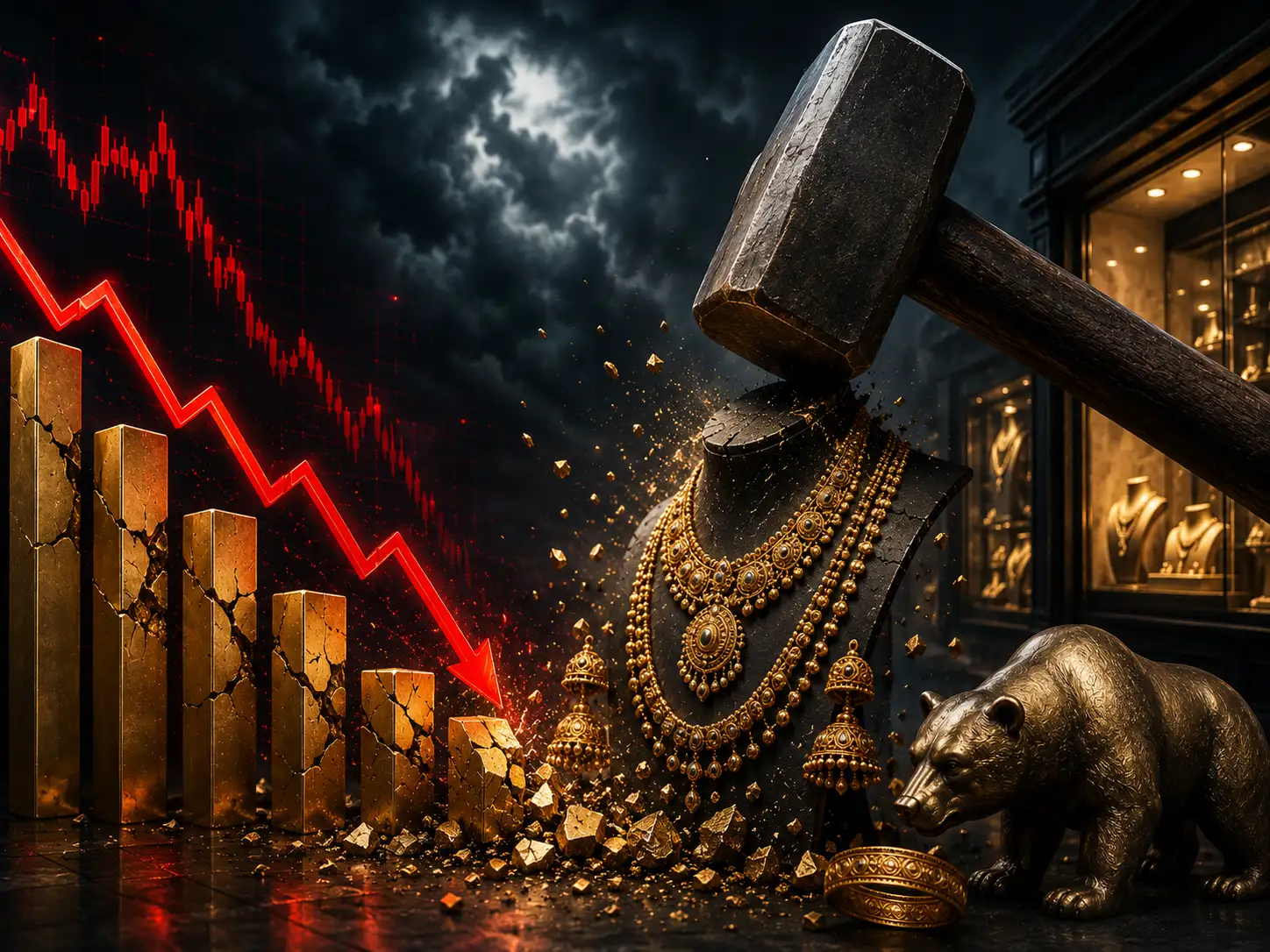
Jewellery stocks, including Titan Company, Kalyan Jewellers, Senco Gold and Thangamayil Jewellery, have witnessed a sharp selloff this week, tumbling as much as 20% in just three trading sessions. The free fall follows a double blow from the government: Prime Minister Narendra Modi’s appeal to defer gold purchases for a year and a steep hike in gold import duties aimed at stabilising the rapidly weakening Indian rupee.
Among the biggest losers, Kalyan Jewellers India has fallen nearly 20%, while Thangamayil Jewellery and Sky Gold have declined around 18% each. Senco Gold has dropped 14%, while Tata Group-backed Titan Company has slipped nearly 11%. Combined, the selloff has erased close to Rs 60,000 crore in investor wealth.

Viewed from a broader macroeconomic perspective, the Prime Minister’s remarks appear less like an attempt to discourage investment in gold and more like a signal aimed at protecting India’s foreign exchange reserves during a period of rising global uncertainty.
India imports the vast majority of the gold it consumes, and these imports are paid for largely in U.S. dollars. Every spike in gold demand, therefore, creates additional dollar demand in the currency market, as importers and banks purchase dollars to pay overseas suppliers. That, in turn, places further pressure on the rupee.
The government’s decision to raise the effective import duty on gold and silver to 15%, just a day after Modi’s comments, has further intensified concerns around the sector. Higher duties could weigh on demand in the world’s second-largest consumer of precious metals, although they may simultaneously help narrow India’s trade deficit and provide some support to the rupee, which remains among Asia’s weakest-performing currencies.
For jewellery companies, the immediate implications are clearly negative. Higher import duties raise domestic gold prices, potentially making jewellery purchases more expensive and prompting consumers, particularly in price-sensitive segments, to postpone discretionary buying.
Yet the pain may not be evenly distributed.
Larger, organised jewellers with stronger brands, better inventory management and higher consumer trust may continue to outperform smaller unorganised players even during a slowdown. Analysts believe that periods of market disruption often accelerate market share gains for organised retail chains.
According to Ponmudi R, CEO of Enrich Money, jewellery stocks could continue to face near-term sentiment pressure, especially if investors begin pricing in a temporary moderation in festive and wedding-related demand. However, he does not expect a deep structural slowdown in gold consumption.
Indian gold buying, particularly during weddings and festivals, has historically remained highly emotional and culturally entrenched. Ponmudi added that organised jewellery players may continue gaining market share as consumers increasingly gravitate toward trusted and transparent brands during uncertain times.
He also noted that the long-term structural outlook for organised jewellery companies remains strong. Investors are increasingly viewing gold not just as jewellery consumption, but as a strategic hedge against inflation, currency depreciation and geopolitical uncertainty. According to him, this behavioural shift itself is emerging as one of the most important long-term growth drivers for the broader gold ecosystem.
So what do the Prime Minister’s remarks ultimately mean for gold investors?
Jateen Trivedi, Vice President and Research Analyst for Commodity and Currency at LKP Securities, said the appeal is unlikely to materially alter India’s long-standing appetite for gold, given how deeply the metal remains embedded in household savings, investments and cultural buying habits.
However, he added that the comments could temporarily slow discretionary purchases, particularly in jewellery demand, while creating near-term caution across bullion-linked and jewellery-related businesses.
Sameer Dalal of Natverlal & Sons Stockbrokers told ETNOW that he does not expect Modi’s appeal to meaningfully change consumer behaviour in a country where gold purchases remain closely tied to weddings, traditions and family occasions. According to Dalal, consumers intending to buy gold jewellery are still likely to go ahead with purchases regardless of the appeal.
Also read: Why gold’s Rs 10,000 spike after import duty increase is a one-off move
For now, the Prime Minister’s comments appear less like a direct challenge to India’s centuries-old affinity for gold and more like a reflection of mounting economic pressures stemming from volatile oil prices, geopolitical tensions and rising import costs.
(Disclaimer: Recommendations, suggestions, views and opinions given by the experts are their own. These do not represent the views of The Economic Times)