
Get all your news in one place.
100's of premium titles.
One app.
Start reading
Tom’s Hardware
Tom’s Hardware
Technology
Jowi Morales

Jensen Huang slams 'stupid' analogy comparing GPUs to nuclear weapons — Nvidia CEO says government should allow selling GPUs to 'adversarial countries'

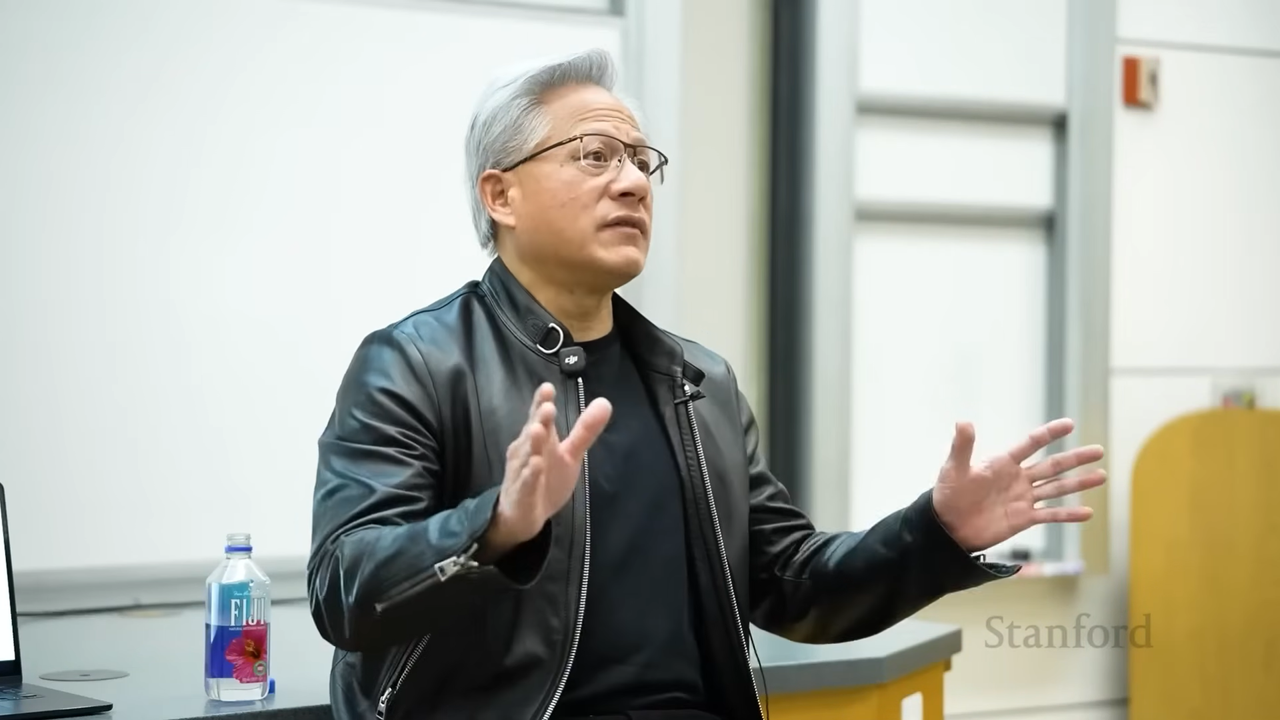
Jensen Huang at CS 153 Frontier Systems at Stanford.

Nvidia CEO Jensen Huang served as a guest speaker at Stanford’s CS 153 Frontier Systems course and discussed the hardware that powers AI systems today. One of the topics covered in the YouTube session is his stance on granting “adversarial countries” access to Nvidia chips. It’s widely known that the Nvidia chief is against export controls on AI chips, saying that it was a failure and has completely backfired.

Other industry leaders do not take a similar stance, with Anthropic's head, Dario Amodei, comparing selling advanced AI chips to China to selling nuclear weapons to North Korea. Jensen did not take this comparison too kindly, saying it does not make any sense.

“What I’m fundamentally against, and it makes no sense, it makes no sense in this moment, is to compare Nvidia GPUs to atomic bombs. There are a billion people with Nvidia GPUs; I advocate Nvidia GPUs to all of you, I advocate Nvidia GPUs to my family, my kids, to people I love — but I don’t advocate atomic bombs to anybody,” the Nvidia CEO said. “So that analogy is stupid. And so, so if you start from there, you can’t finish a thought — if you start from believing that, you can’t finish the rest of the thoughts.”

Jensen Huang is a firm believer that the world should use the American tech stack and that it would be detrimental to the U.S.’s advantage if it were to block a nation from accessing it. Nvidia has a global advantage in that it’s the largest and most popular manufacturer of AI chips, and its technologies, like the CUDA architecture, drive the progress of most of the world’s AI developers. Keeping this technology widely available to anyone would mean that most of the world's AI—whether developed in the U.S. or built in China — runs on American hardware.

However, critics point out that this could fuel the nation’s adversaries, enabling them to develop and train advanced artificial intelligence for military purposes using Nvidia chips. Jensen said that the Chinese military will avoid U.S. AI tech, much like how the Pentagon does not use Chinese systems. The company also denied providing technical assistance for DeepSeek to improve its training efficiency on models, which were later used by the People’s Liberation Army (PLA). However, public documents revealed that some Chinese universities with deep ties to China’s military-industrial complex acquired Super Micro servers configured with Nvidia A100 AI GPUs.

Unlike nuclear missiles and atomic bombs, AI GPUs aren’t strictly military systems designed for a specific mission. Artificial intelligence is a powerful tool that has applications in science, research, business, and many other industries. However, its flexibility also makes it a dual-use technology, meaning it can be used in civilian and military contexts. It is the latter application that has U.S. policymakers worried, in which the same hardware and AI models can be leveraged by armed forces for operational use, such as intelligence and threat analysis, autonomous systems, simulations, and more. This could erode the U.S.’s technological and military edge and give its adversaries a strategic advantage.

Both sides of the argument have valid points — America has the advantage as the key provider of AI technologies worldwide, and it makes sense to keep it that way. However, it also does not want its rivals to have access to advanced technologies that could accelerate their capabilities and narrow the United States’ lead in defense technologies. Unfortunately, we can only tell which approach proves to be more effective years, if not decades, from today.

Sign up to read this article
Read news from 100's of titles, curated specifically for you.
Already a member? Sign in here
Related Stories
Top stories on inkl right now
One subscription that gives you access to news from hundreds of sites
Already a member? Sign in here
Our Picks
Fourteen days free
Download the app
One app. One membership.
100+ trusted global sources.


