Get all your news in one place.
100's of premium titles.
One app.
Start reading
The Economic Times
The Economic Times

JD Vance calls ceasefire 'a little messy', says US has made 'great progress' in Iran nuclear talks

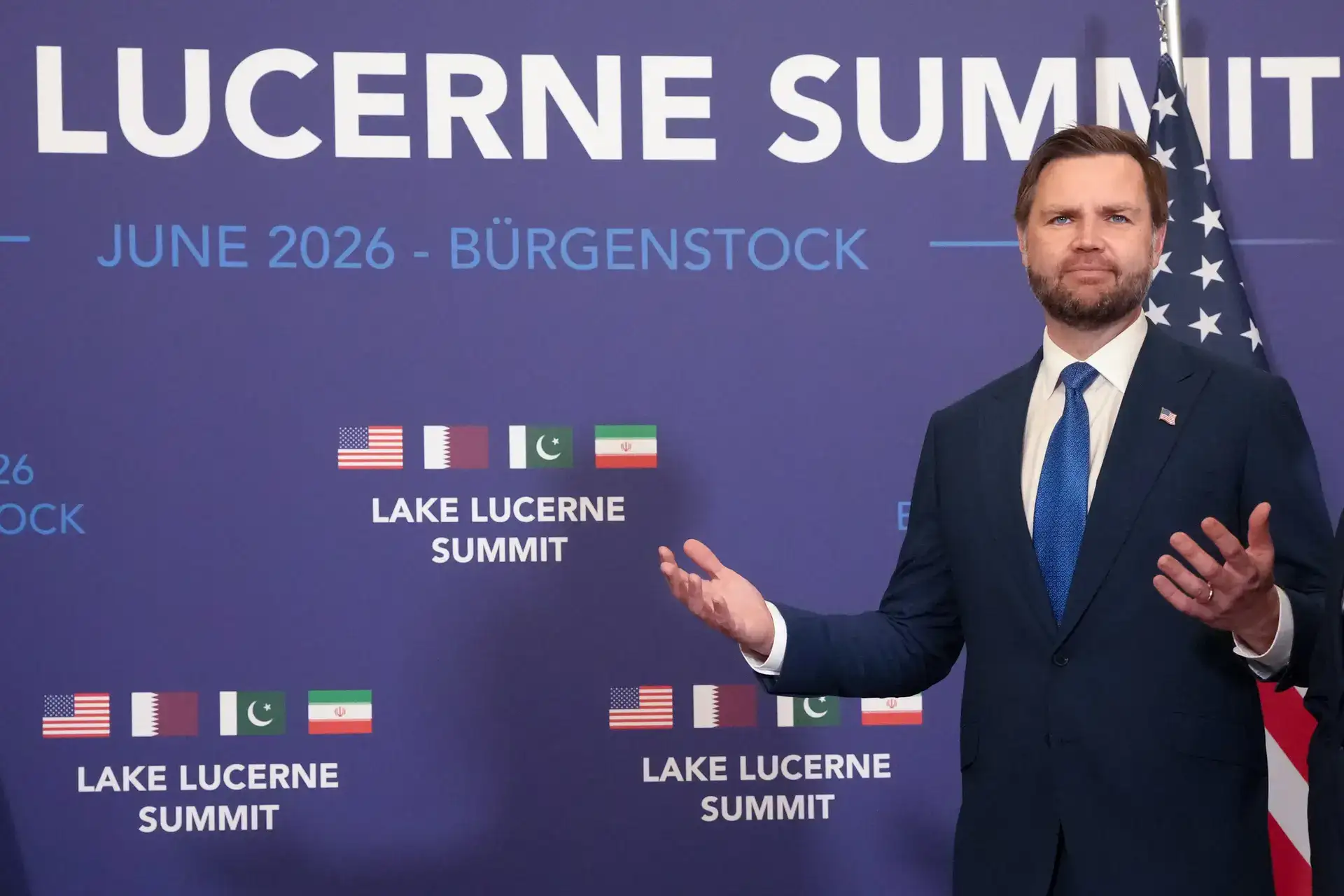
US Vice President JD Vance said on Sunday that President Donald Trump was committed to securing a full regional ceasefire, as American and Iranian negotiators sat down for what he described as a landmark round of technical negotiations at the Bürgenstock resort near Lucerne, Switzerland.

Emphasising the unprecedented scale of the talks taking place at the Swiss resort, Vance declared, "Never before has the Iranian and American leadership met at such a high level."
The Vice President explicitly outlined a conditional yet sweeping roadmap authorised by the White House, charting a path toward comprehensive reconciliation if Tehran addresses core international security concerns.

"Trump is committed to see a full regional ceasefire," Vance said, adding that the president had "empowered us to find a diplomatic solution to a host of issues" and had asked the team to "turn over a new leaf" in Washington's relationship with the Iranian people.

Also read: Indian refiners increase Russian and UAE oil imports ahead of Hormuz recovery

Vance said the talks, which also included Qatari mediators in a trilateral format, marked an unprecedented moment in the two countries' diplomatic history. "The technical negotiations may not solve every disagreement, but it will allow us to sit together as teams for the first time in history," he said.

"What we're trying to accomplish is through diplomacy to work together to transform the Middle East," Vance said, describing the central question as "whether we can change relations in the Middle East permanently." He added that the US now saw "a future together where everyone can work together to promote peace and prosperity," while noting that Washington still viewed Iran as "a driver of regional instability."

Despite the optimism, Vance struck a measured note. "These kinds of ceasefires are always a little bit messy," he said, even as he confirmed that the two sides had made "great progress in the last few hours."

The framework underpinning the current talks was signed last week, and both sides are now in a 60-day window to hammer out technical details that carry significant implications for global energy markets and international security.

Vance's arrival had originally been scheduled for Friday but was delayed after fighting escalated in Lebanon between Israel and Hezbollah, and Iran announced it had closed the Strait of Hormuz, a waterway through which roughly a fifth of the world's traded oil and gas transits.

Also read: Oil keeps flowing through Hormuz despite Iran saying it’s shut

Beyond immediate territorial concerns, a primary objective behind these urgent negotiations is securing critical global energy corridors. The initial finalisation of the MoU had prompted the reopening of the strategic Strait of Hormuz maritime route, which handles nearly 20 per cent of global energy supplies under normal conditions. The vital waterway had been blocked since February 28 following joint military strikes by the US and Israel on Iran, which provoked retaliatory actions from Tehran.

However, as the afternoon negotiations are underway, the maritime situation remains highly fluid and contradictory. Tehran claimed on Saturday that it had shut down the waterway once again following an Israeli strike in Lebanon, whereas the United States firmly maintained that the maritime route remains open, adding a critical layer of economic stakes to the ongoing dialogue.

The US delegation also includes special envoy Steve Witkoff and Jared Kushner, who had already been on the ground ahead of Vance to begin working through the nuclear specifics. Iran's delegation is led by parliamentary speaker Mohammad Bagher Qalibaf and Foreign Minister Abbas Araghchi, along with central bank and oil officials. Pakistani Prime Minister Shehbaz Sharif and army chief Field Marshal Asim Munir are also part of the broader talks, alongside Qatari mediators.

Iranian President Masoud Pezeshkian said on Sunday that Tehran would not give up its right to enrich uranium, stating the other side was "forced to accept it." The deal signed by Trump and Pezeshkian allows Iran to sell oil freely and would unlock billions in currently frozen Iranian assets, while also requiring Tehran to dilute its stockpile of highly enriched uranium.

Sign up to read this article
Read news from 100's of titles, curated specifically for you.
Already a member? Sign in here
Related Stories
Top stories on inkl right now
One subscription that gives you access to news from hundreds of sites
Already a member? Sign in here
Our Picks
Fourteen days free
Download the app
One app. One membership.
100+ trusted global sources.