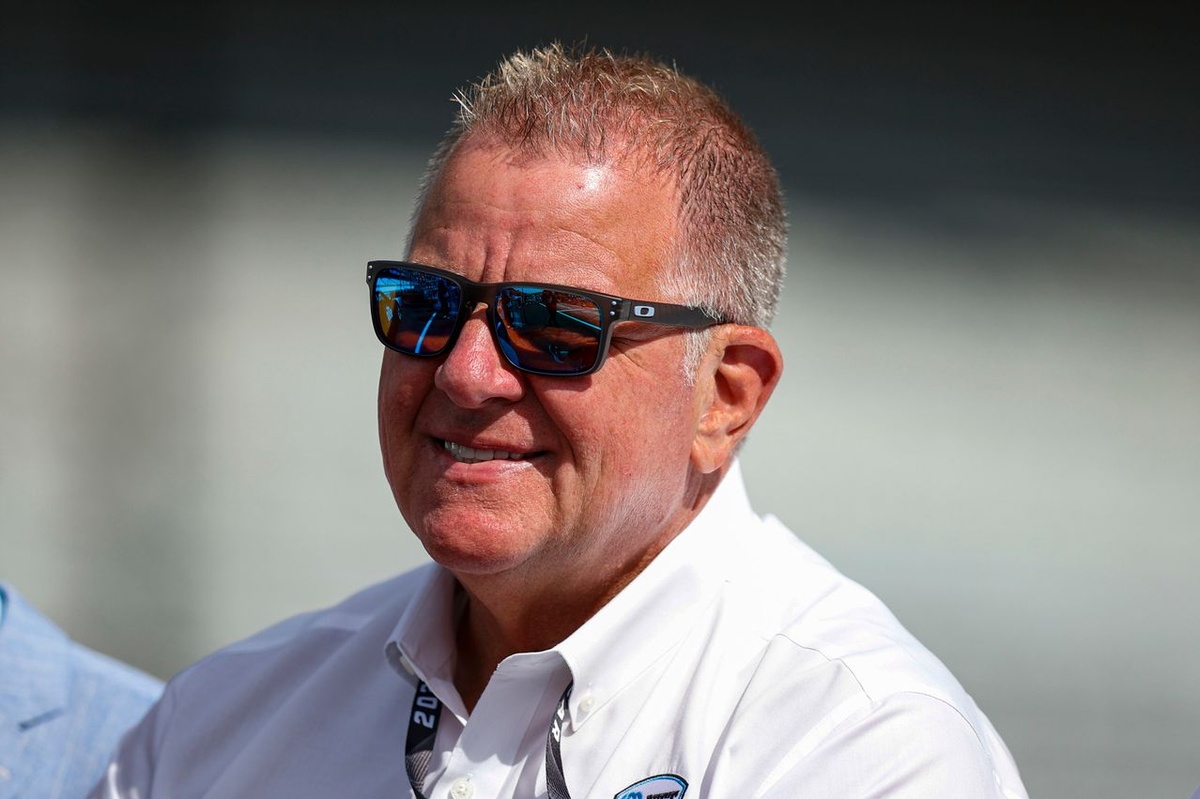
It’s hard to believe a year has passed since Jay Frye departed his role as IndyCar President.
Feb. 11, 2025.
It’s a date that ended a pivotal tenure in the history of North America’s Premier open-wheel championship. Upon Frye’s exit, Penske Entertainment appointed Doug Boles as his replacement and increased responsibilities for the Indianapolis Motor Speedway President. Less than two months later, on April 1, Frye was named as President of Rahal Letterman Lanigan Racing (RLL).
“It has been a whirlwind year,” Frye told Motorsport.com.
“It's one of those things that in sports and in business and whatever, you have different times. I call them runs. So we had a really good 10-year run at IndyCar, very proud of all we accomplished. There's a lot of things that I think changed the sport in a really positive way that happened in that 10-year period. Lots of great people were involved.”
After joining the sport as its Chief Revenue Officer in 2013, Frye was promoted two years later as IndyCar’s President of Competition and Operations. He was promoted to IndyCar President at the end of 2018 and held the role during multiple ownerships - Hulman & Company and Roger Penske - for the sport.
There were plenty of changes throughout Frye’s decade-long tenure, with some that stand out more than others.
“I think the consensus in the paddock and the relationship with the paddock is something I'm really most proud of,” Frye said. “It's hard to put that on a resume, per se. But I felt like we were all in it together, and I felt like ultimately we had to decide things.
“That was our job; building a consensus, getting their opinions, we called it harnessing the power of the paddock. When you're dealing with a lot of really smart people that have equity in what we're doing and want this thing to be successful, why would you not talk to them, right? That was always kind of my approach.”

From a technical aspect, though, Frye was quick to point to the aeroscreen.
The aeroscreen proved to be a significant overtaking but came together through a collaborated effort with Red Bull Advanced Technologies, PPG, Pankl, and Dallara, along with the teams.
“That's something I felt a lot better going to the racetrack after the aeroscreens were on the cars,” Frye said.
“I remember how quickly we did that. We called Red Bull in March of 2019 and then at the COTA Open Test in February of 2020, right before COVID, we had all 26 cars that were participating that had aeroscreens on.
“Eight months. We completely designed it, engineered it, built it, implemented it in an eight-month period, which is just spectacular.
"The Red Bull guys were amazing, and that was dealing with Jonathan Wheatley, Christian Horner. From the Pankl guys, the PPG guys, to our guys, to Dallara, to the teams, that was a monumental thing to get done as quickly as we got it done, and that's something we should all be proud of. Once we started having it on all the cars, it was a total driver cockpit safety solution. The drivers and their safety meant more to me than anything. That was something that I thought was a game-changer for the sport.”
Frye mentioned the aeroscreen potentially enticed seven-time NASCAR Cup Series champion Jimmie Johnson and ex-Formula 1 driver Romain Grosjean, among others, coming over to race in IndyCar.
“As you look at it, Jimmie Johnson and other people that came into the sport, Romain Grosjean, there were drivers that came in after that was implemented that might not have if we didn't have it on the car,” Frye said. “So I think that was something that was a good thing actually to help grow the sport.
“I also talked to a lot of kids about the car. They thought the car looked really cool, like a fighter jet. That was just a little byproduct of the safety device.
“We had the same kind of thing when we did the aero kits in 2018. It was a paddock-wide effort. We spun that around pretty quick. We got the identity of the Indy car back, an open-wheel car. Where before with the manufacturer kits, the rear wheels were not open.
“We got the look of the sport back, which was a key part of growing it.”

Another unique item that happened under Frye’s supervision was the drama surrounding the title sponsorship of the series when Verizon’s five-year run ended following the 2018 season. There was plenty of pressure to secure a deal heading into that year’s season finale at Sonoma Raceway, and fortunately, the stars aligned with NTT Data.
“NTT, that was a big deal,” Frye said. “We talked to NTT in Sonoma; it was the first time we even talked to them. We had nothing going into the next season. And between Sonoma in September until Christmas, we turned around a league entitlement, which, those are very complicated. That was something we got done pretty quick, and we're really proud of.
“You always want to leave something better after you're gone than when you got there. Hopefully, people think it's better now than what it was 10 years ago.”
It was an interesting time for Frye when his tenure with IndyCar came to an end, and that’s where his abilities to help enhance the paddock’s cohesiveness came to the forefront.
“It took a couple of months to just figure out what's next,” Frye said.
“When I talked about consensus in the paddock, well, here's Bobby Rahal, a former driver, somebody that ran a league, somebody that ran a team in F1, has his own team. A plethora of knowledge about all kinds of different things. Bobby was always one of the ones I would go bounce things off of. So, I obviously developed a great relationship with him, as I tried to or did with all the owners.”
“Once this went down, he was one of the first calls I got. And we started talking, and I wasn't sure exactly what I wanted to do.”

As more discussions took place, though, Frye recognized the commitment by RLL’s co-owners Mike Lanigan, David Letterman and Rahal, and also developed a deeper connection to help the cause.
“It was something that I really felt,” Frye said. “It started off being like, 'Yeah, I just want to go help one of my friends. What can we do to help get the thing turned around, get it pointed back in the right direction,’ to where now there's some really good things going on here, and we're building something for the future.”
This offseason, in particular, has seen a number of new faces come to RLL.
There is the obvious in Mick Schumacher, son of seven-time Formula One World Champion Michael Schumacher who, himself, spent the last handful of years winning the 2020 Formula 2 championship before racing in both F1 and the FIA World Endurance Championship.
The team also added Brian Barnhart, a well-respected paddock veteran of many roles who takes over as Senior Vice President of Operations and will also be Graham Rahal’s strategist. Among other key hires is the addition of Gavin Ward, a former Team Principal for Arrow McLaren and championship-winning engineer with Team Penske that was also previously with Red Bull Racing, taking on an advisory role.
“We've got a lot of new people in, really, really good people, key people that we basically targeted to go get,” Frye said. “And there's a lot of really good people that are already here.
“Part of it's just changing the culture. We try to do that 'MSH/GSD' thing here. Seems to be working, and just excited about where we're going and what's happening.”