Get all your news in one place.
100's of premium titles.
One app.
Start reading
Tom’s Hardware
Tom’s Hardware
Technology
Luke James

Jay Forrester filed the first practical computer RAM patent 75 years ago this week — his Magnetic Core Memory patent would be granted five years later

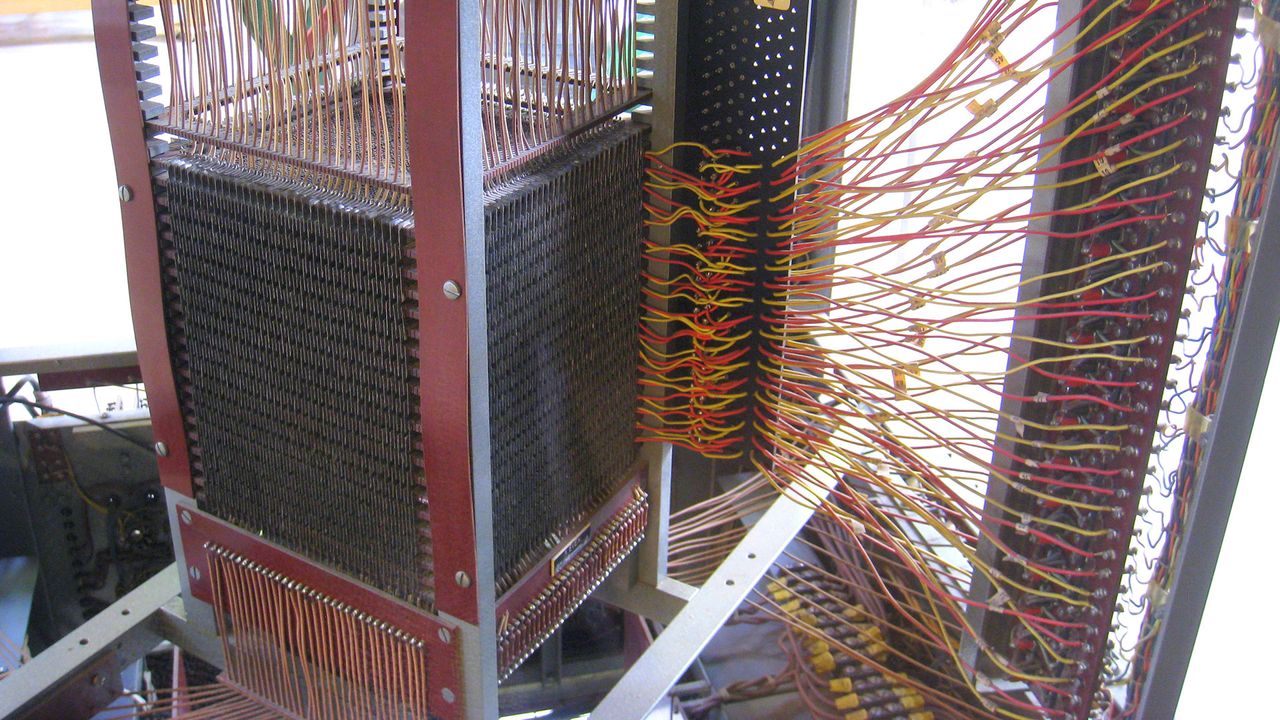
Project Whirlwind - core memory, circa 1951, developed at MIT Lincoln Laboratory, Massachusetts, USA. Museum sign describes capacity as 2Kb.

75 years ago this week, on May 11th, 1951, MIT electrical engineer Jay Forrester filed the patent application for coincident-current magnetic core memory, a technology that became the dominant form of random-access storage in digital computers for two decades.

Granted as U.S. Patent 2736880 in February 1956, Forrester's invention evolved from MIT's Project Whirlwind, where unreliable vacuum-tube memory was failing to meet the demands of real-time Cold War air defense.
Whirlwind began in the mid-1940s as a U.S. Navy flight simulator project but pivoted toward real-time digital computing. The machine needed to track aircraft in flight, and the electrostatic storage tubes Forrester initially used broke down constantly.

Forrester's solution used tiny rings of ferrite material, each about the diameter of a pencil lead, strung on a grid of copper wires. Sending current through two intersecting wires simultaneously magnetized a specific ring in one direction for a "1" or the other for a "0." The coincident-current technique allowed a small number of wires to address millions of bits in three-dimensional arrays. His graduate student, William Papian, built the first prototype in October 1950, and the first full core memory bank went into Whirlwind on August 8th, 1953.

This demonstrated that the underlying tech worked, and Whirlwind subsequently became the prototype for the SAGE air defense network, which operated 23 computer-controlled radar installations across the United States and one in Canada, and remained operational into the 1980s.

A screenshot from Jay Forrester's patent application. (Image credit: United States Patent Office)

While Forrester applied for the patent in 1951, it took five years for it to be granted, and a series of legal battles soon followed. RCA engineer Jan Rajchman had filed a similar application eight months earlier, and Harvard researcher An Wang had separately patented a different core memory technique that IBM purchased in 1955 for $500,000. Wang used the proceeds to expand Wang Laboratories.

IBM then spent years challenging Forrester's broader patent. MIT responded with forensic thoroughness, according to its archival records, tracing purchase orders, examining telephone bills and travel vouchers, and analyzing lab notebooks to establish Forrester's priority. RCA eventually withdrew its claims, and in 1964, IBM settled for $13 million, the largest patent payout in history at the time. Forrester personally received $1.5 million.

Forrester left digital computing in 1956, the same year his patent was granted, joining MIT's Sloan School of Management, where he founded the field of system dynamics. He died on November 16th, 2016, at 98.

Sign up to read this article
Read news from 100's of titles, curated specifically for you.
Already a member? Sign in here
Related Stories
Top stories on inkl right now
One subscription that gives you access to news from hundreds of sites
Already a member? Sign in here
Our Picks
Fourteen days free
Download the app
One app. One membership.
100+ trusted global sources.