A 10cm cube that unfolds to a 2.5-metre array has launched to space in a successful demonstration of next-generation “origami” satellites.
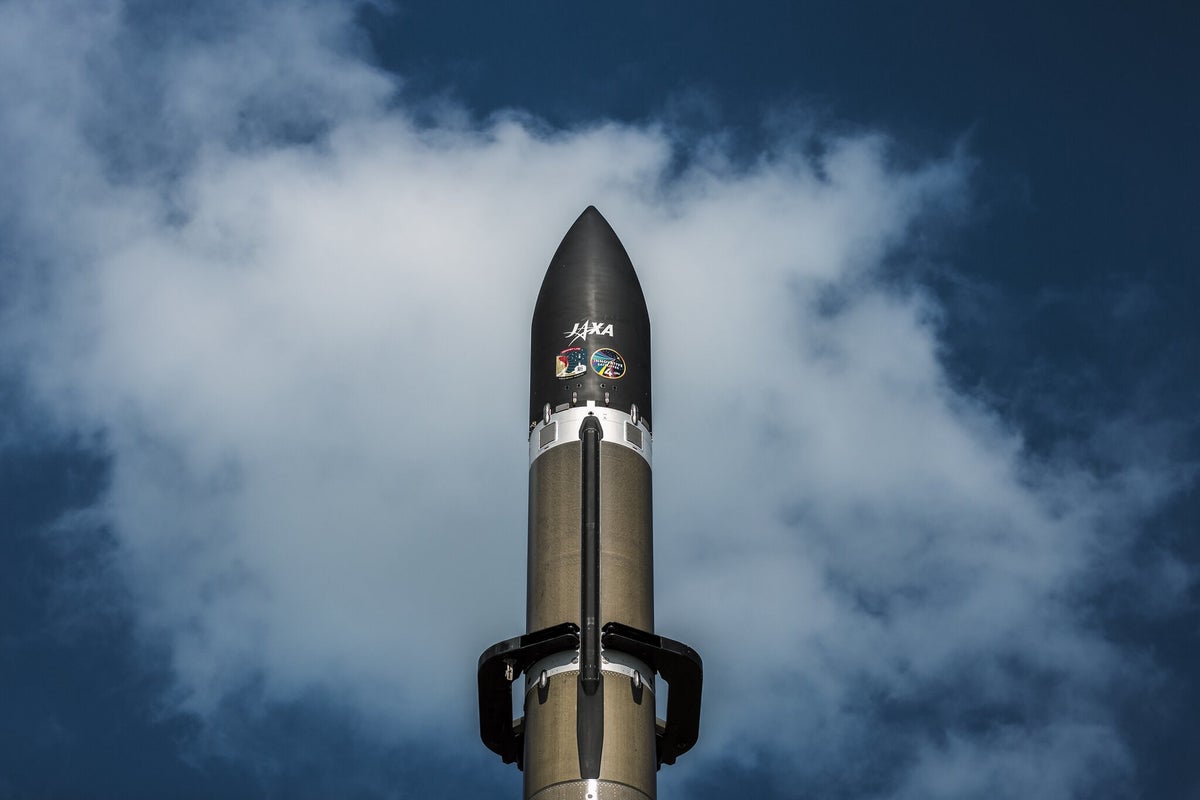
The cubesat was one of eight satellites on Japanese space agency JAXA’s Innovative Satellite Technology Demonstration-4 mission, which aims to test advanced space tech developed by startups and universities.

It lifted off just after 3pm local time on Thursday from New Zealand’s North Island aboard a Rocket Lab Electron spacecraft, with the payload reaching orbit around an hour later.
Rocket Lab’s description for the mission, named ‘Kakushin Rising’, stated that it featured “a deployable antenna that can be packed tightly using origami folding techniques and unfurled to 25 times its size.”
It also included “educational small sats, an ocean monitoring satellite, [and] a demonstration satellite for ultra-small multispectral cameras.”
JAXA describes the 10cm cube as “an unprecedentedly lightweight and highly packable deployable array antenna for space, with antenna elements attached to a two-layer deployable membrane that can be folded using origami techniques.”
MISSION SUCCESS! Payload deployment confirmed for "Kakushin Rising" on our 87th Electron launch.
— Rocket Lab (@RocketLab) April 23, 2026
Congratulations @JAXA_en and welcome to orbit once again 🛰️ pic.twitter.com/JzGc037OoL
The space agency has been testing different origami techniques for satellite deployments in recent years, including the popular Miura fold.
First devised in 1970, the Miura folding technique has become a popular way to pack large paper maps.
The first satellite to use this origami technique launched in 1995, with researchers now experimenting with more ambitious origami folds.
For the latest JAXA mission, the satellite is folded into a flasher pattern, which stows and deploys in a spiral manner.
It was the second of two Electron launches sponsored by JAXA, with the first taking place in December 2025.
“Two successful missions in a matter of months, deployed precisely where they needed to be on orbit, shows exactly why Electron is the preferred small launcher for national space agencies,” Rocket Lab CEO Peter Beck said in a statement following the launch.
“JAXA is a world leader in space and it’s been an honor to be trusted with these back-to-back missions growing Japan’s aerospace economy.”
Astronomers discover Jupiter-like planet with a distinct urine smell
Scientists trace 11 billion year old comet’s home to a mystery cold corner of space
Your organ donation could be delivered by a NASA drone one day
How to watch the Lyrid meteor shower from the UK and US tonight
NASA’s Curiosity rover makes never before seen discovery
NASA’s moon landing could face major delay if this critical equipment isn’t ready