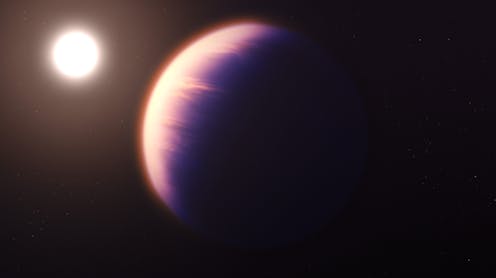
Since the first planet orbiting a star other than the Sun was discovered in 1995, we have realised that planets and planetary systems are more diverse than we ever imagined. Such distant worlds – exoplanets – give us the opportunity to study how planets behave in different situations. And learning about their atmospheres is a crucial piece of the puzzle.
Nasa’s James Webb space telescope (JWST) is the largest telescope in space. Launched on Christmas Day 2021, it is the perfect tool for investigating these worlds. Now my colleagues and I have used the telescope for the first time to unveil the chemical make-up of an exoplanet. And the data, released in preprint form (meaning it has yet to be published in a peer-reviewed journal), suggests some surprising results.