
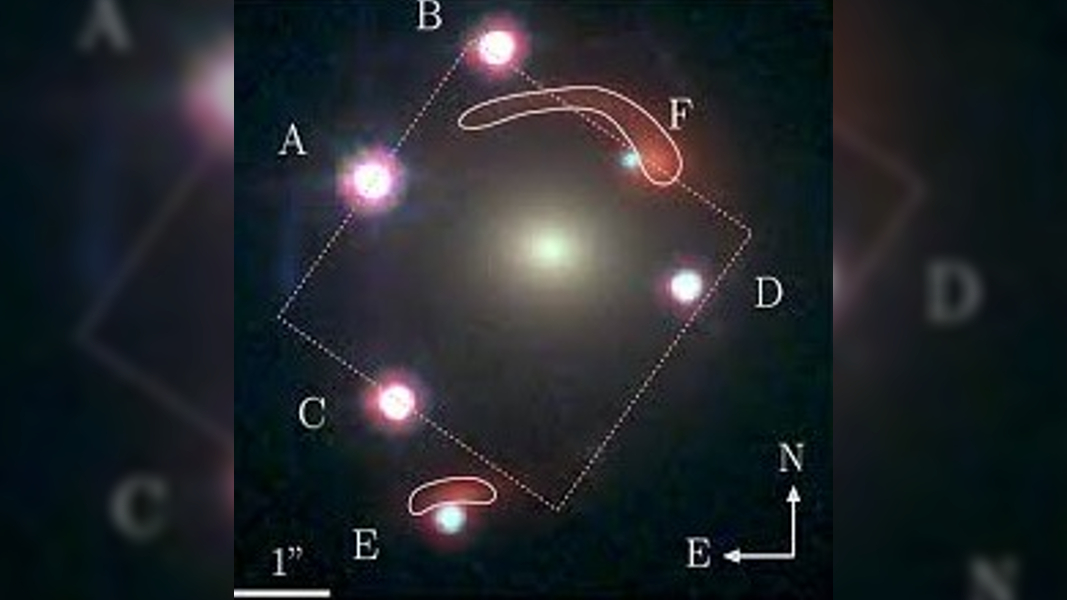
For the first time, researchers have used data from the James Webb Space Telescope (JWST) to uncover an example of a previously hypothetical phenomenon known as an "Einstein zig-zag" — where light from an object in the distant cosmos passes through two different regions of warped space-time. The newly confirmed effect, which was discovered among six identical copies of a luminous quasar, could shed light on an issue that is beginning to plague cosmology, experts say.
In 2018, astronomers discovered a quartet of identical bright points billions of light-years from Earth, later named J1721+8842. Initially, the scientists assumed that the four lights were mirror images of a single quasar — a luminous galactic core powered by a feeding black hole — that had been duplicated through a phenomenon known as "gravitational lensing."














