
Get all your news in one place.
100’s of premium titles.
One app.
Start reading
LiveScience
LiveScience
Elizabeth Howell

James Webb telescope spots giant auroras rolling through Uranus' atmosphere

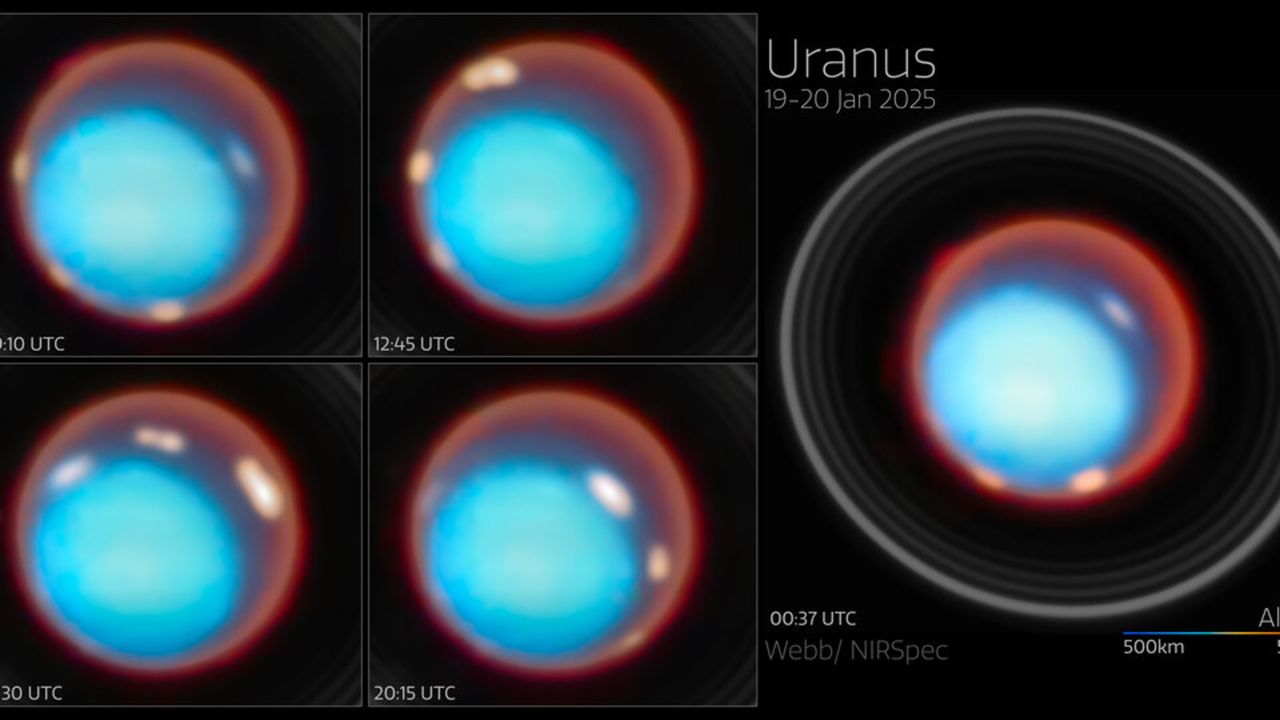
A series of four small boxes on the left of the image and one large box on the right, each showing a circle with blue in the bottom left of the circle and a ring of glowing red around it, representing Uranus' atmosphere.

Scientists using the James Webb Space Telescope just mapped the mysterious upper atmosphere of Uranus for the first time, revealing strange new features of the planet's mysterious magnetic field and glowing auroras.

The James Webb Space Telescope (JWST) observed Uranus rotating for 15 hours (nearly a full Uranian day) to learn more about how ice giants distribute energy in the upper layers of their atmospheres and to investigate how the planet's auroras operate.

Uranus' magnetic field is unique among the big planets of our solar system in that its magnetic pole is tilted by 60 degrees relative to its geographic pole. That tilt produces auroras that extend far beyond the poles of Uranus, unlike auroras on Earth.

To learn more, scientists used JWST to study Uranus' magnetosphere — the region of space around Uranus that's dominated by the planet's magnetic field.

"Uranus's magnetosphere is one of the strangest in the solar system," study lead author Paola Tiranti, a doctoral student at Northumbria University in the U.K., said in a European Space Agency (ESA) statement. "Webb has now shown us how deeply those effects reach into the atmosphere."

Strange lights on Uranus

JWST charted "the most detailed portrait yet" of how particles in Uranus' upper atmosphere are energized (ionized) by interactions with the sun, ESA officials said in the statement. The study, published Feb. 19 in the journal Geophysical Research Letters, aimed to measure ion temperature and density as far as 3,100 miles (5,000 kilometers) above the cloud tops of Uranus.

Temperature and density do not peak at the same altitude, JWST showed. Ions were the warmest between roughly 2,500 and 3,100 miles (4,000 and 5,000 km) but the densest at about 600 miles (1,000 km). This is because of the "complex geometry" of the planet's magnetic field, ESA officials said in the statement.

That geometry also produced two bright bands of auroras near Uranus' magnetic poles. In between the aurora belts, however, there is a "depletion" in both ion density and auroral emissions — an effect likely produced by transitions between the planet's magnetic-field lines, the scientists said. Observations at Jupiter's upper atmosphere have shown similar transition regions.

In addition to charting Uranus' upper atmosphere in three dimensions for the first time, JWST confirmed findings from previous studies that suggested the planet's upper atmosphere has been cooling steadily since the early 1990s. The telescope showed the average temperature of Uranus' atmosphere is about 307 degrees Fahrenheit (153 degrees Celsius), which is lower than the temperature measurements from other spacecraft and ground-based telescopes.

"By revealing Uranus's vertical structure in such detail, Webb is helping us understand the energy balance of the ice giants," Tiranti said. "This is a crucial step towards characterizing giant planets beyond our solar system."


James Webb Space Telescope quiz: How well do you know the world's most powerful telescope?

Sign up to read this article
Read news from 100’s of titles, curated specifically for you.
Already a member? Sign in here
Related Stories
Top stories on inkl right now
One subscription that gives you access to news from hundreds of sites
Already a member? Sign in here
Our Picks
Fourteen days free
Download the app
One app. One membership.
100+ trusted global sources.