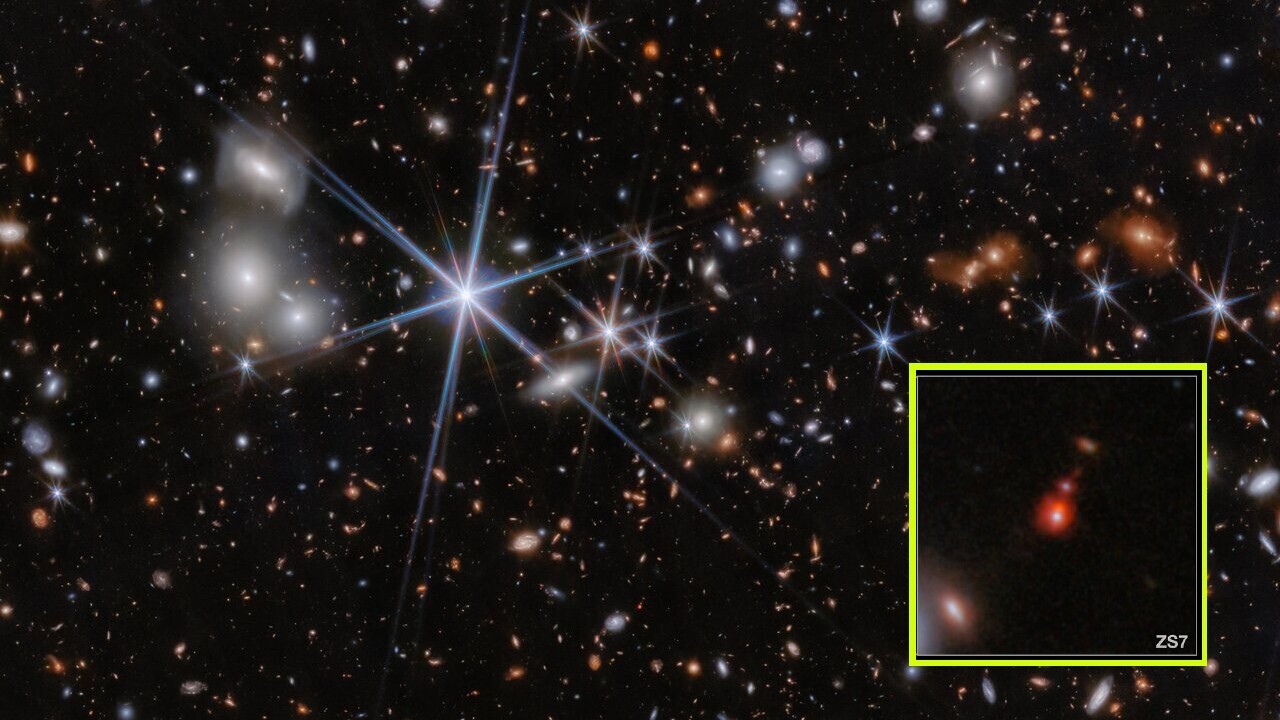
Astronomers have used the James Webb Space Telescope (JWST) to detect the most distant pair of colliding black holes in the known universe. The cosmic monsters — each estimated to be as massive as 50 million suns — have been detected more than 13 billion light-years away, at a time just 740 million years after the Big Bang.
While not the biggest or oldest black holes ever detected, the merging pair have still managed to grow bafflingly large for such an early time in the universe's history, the study authors said in a European Space Agency (ESA) statement. This discovery further challenges leading theories of cosmology, which fail to explain how objects in the universe's infancy could grow so large, so fast.
"Our findings suggest that merging is an important route through which black holes can rapidly grow, even at cosmic dawn," the study’s lead author Hannah Übler, a researcher at the University of Cambridge, said in the statement. "Together with other Webb findings of active, massive black holes in the distant Universe, our results also show that massive black holes have been shaping the evolution of galaxies from the very beginning."