
Get all your news in one place.
100's of premium titles.
One app.
Start reading
LiveScience
LiveScience
Ivan Paul

James Webb telescope measures the starlight around the universe's biggest, oldest black holes for 1st time ever

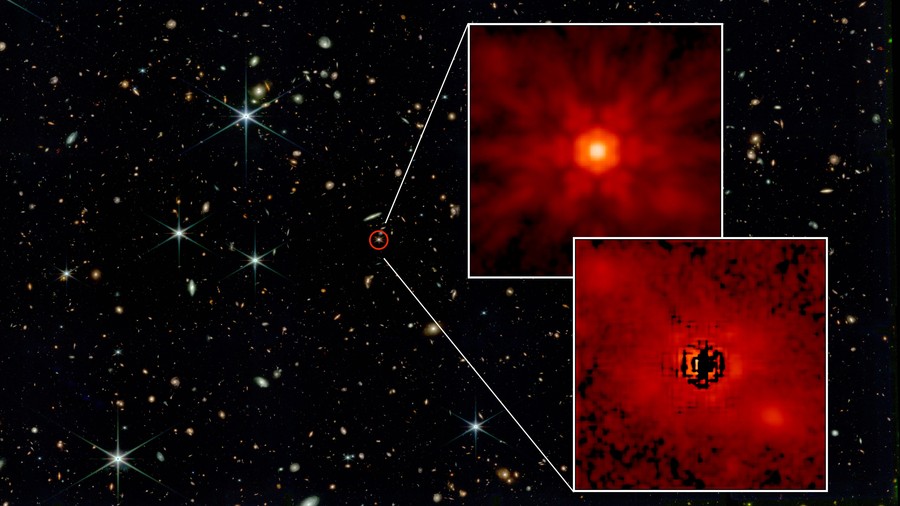
A James Webb Telescope image shows the J0148 quasar circled in red. Two insets show, on top, the central black hole, and on bottom, the stellar emission from the host galaxy.

Using the James Webb Space Telescope (JWST), astronomers have gotten the first-ever look at the light of ancient stars shining around some of the biggest, brightest and oldest black holes in the universe.

Quasars — galactic cores containing active supermassive black holes — are among the most ancient things in the universe. As dust and gas accelerate toward the quasar's central black hole, the quasar emits such bright radiation — typically a thousand times brighter than the entire Milky Way — that astronomers have a hard time observing the fainter light of stars in the quasar's galaxy. This makes it challenging to study the galaxy's shape and mass.

Sign up to read this article
Read news from 100's of titles, curated specifically for you.
Already a member? Sign in here
Related Stories
Top stories on inkl right now
One subscription that gives you access to news from hundreds of sites
Already a member? Sign in here
Our Picks
Fourteen days free
Download the app
One app. One membership.
100+ trusted global sources.