
Get all your news in one place.
100’s of premium titles.
One app.
Start reading
Space
Space
Science
Robert Lea

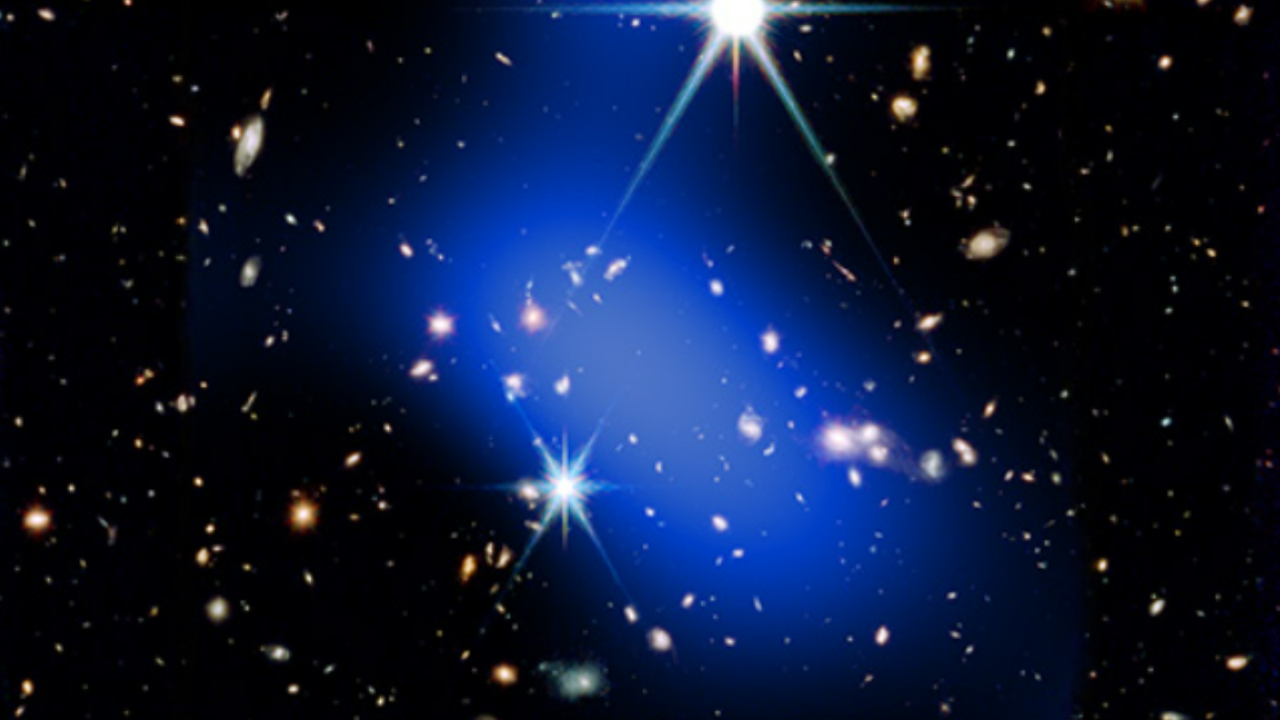
James Webb Space Telescope watches distant galaxies form farthest cluster ever seen in the ancient universe (image)

The JADES-ID1 protocluster seen as it was just 1 billion years after the Big Bang by the JWST and Chandra.

Using the James Webb Space Telescope and NASA's Chandra X-ray space telescope, scientists have observed the most distant and thus earliest galaxy cluster ever seen coming together. The infant cluster, or protocluster, was assembling itself just 1 billion years after the Big Bang, far earlier in the history of the cosmos than previously thought possible.

Light from this protocluster, designated JADES-ID1, has been travelling to Earth for 12.7 billion years, meaning it is seen undergoing an early, violent phase of formation between 1 billion and 2 billion years earlier than expected. This discovery represents a new mystery for scientists to investigate: How did galaxy clusters, the largest gravitationally bound structures in the cosmos, grow so quickly?

"This may be the most distant confirmed protocluster ever seen," team leader Akos Bogdan of the Center for Astrophysics | Harvard & Smithsonian (CfA) said in a statement. "JADES-ID1 is giving us new evidence that the universe was in a huge hurry to grow up."

The JADES-ID1 protocluster seen as it was just 1 billion years after the Big Bang by the JWST and Chandra. (Image credit: X-ray: NASA/CXC/CfA/Á Bogdán; JWST: NASA/ESA/CSA/STScI; Image Processing: NASA/CXC/SAO/P. Edmonds and L. Frattare)
The protocluster JADES-ID1 as seen in X-rays and infrared by Chandra and the JWST. (Image credit: X-ray: NASA/CXC/CfA/Á Bogdán; JWST: NASA/ESA/CSA/STScI; Image Processing: NASA/CXC/SAO/P. Edmonds and L. Frattare)

An expanding problem

Galaxy clusters are composed of thousands of galaxies, vast clouds of hot gas, and a huge framework of dark matter, the effectively invisible "stuff" around which galaxies and clusters gather and grow. Not only can such clusters be used to determine the dark matter content of the universe, but they can also help astronomers better calculate the rate at which the universe expands.

"It's very important to actually see when and how galaxy clusters grow," team member Gerrit Schellenberger, also of CfA, said in the statement. "It's like watching an assembly line make a car, rather than just trying to figure out how a car works by looking at the finished product."

The James Webb Space Telescope (JWST)/Chandra observations revealed JADES-ID1 as a protocluster thanks to two main properties: many galaxies bound by gravity, as seen by the JWST, and a huge surrounding cloud of hot gas seen via their X-ray emissions by Chandra. This gas is falling into the protocluster, and as it does, it is intensely heated, generating X-rays.

Thus far, models of galaxy cluster formation have predicted that the density of galaxies seen in JADES-ID1 wouldn't be possible to reach just 1 billion years after the Big Bang. The previous earliest protocluster seen by astronomers existed around 3 billion years after the universe's origin.

In the billions of years that followed the period during which the JWST and Chandra observed JADES-ID1, this protocluster would have gone on to form a galaxy cluster similar to those seen in the local universe.

"We thought we'd find a protocluster like this two or three billion years after the Big Bang — not just one billion," team member Qiong Li from the University of Manchester, UK, said. "Before, astronomers found surprisingly large galaxies and black holes not long after the Big Bang, and now we're finding that clusters of galaxies can also grow rapidly."

The team's results were published on Wednesday (Jan. 28) in the journal Nature.

Sign up to read this article
Read news from 100’s of titles, curated specifically for you.
Already a member? Sign in here
Related Stories
Top stories on inkl right now
One subscription that gives you access to news from hundreds of sites
Already a member? Sign in here
Our Picks
Fourteen days free
Download the app
One app. One membership.
100+ trusted global sources.