Get all your news in one place.
100's of premium titles.
One app.
Start reading
Space
Space
Science
Robert Lea

James Webb Space Telescope spots rapidly feeding supermassive black hole in the infant universe: 'This discovery is truly remarkable.'

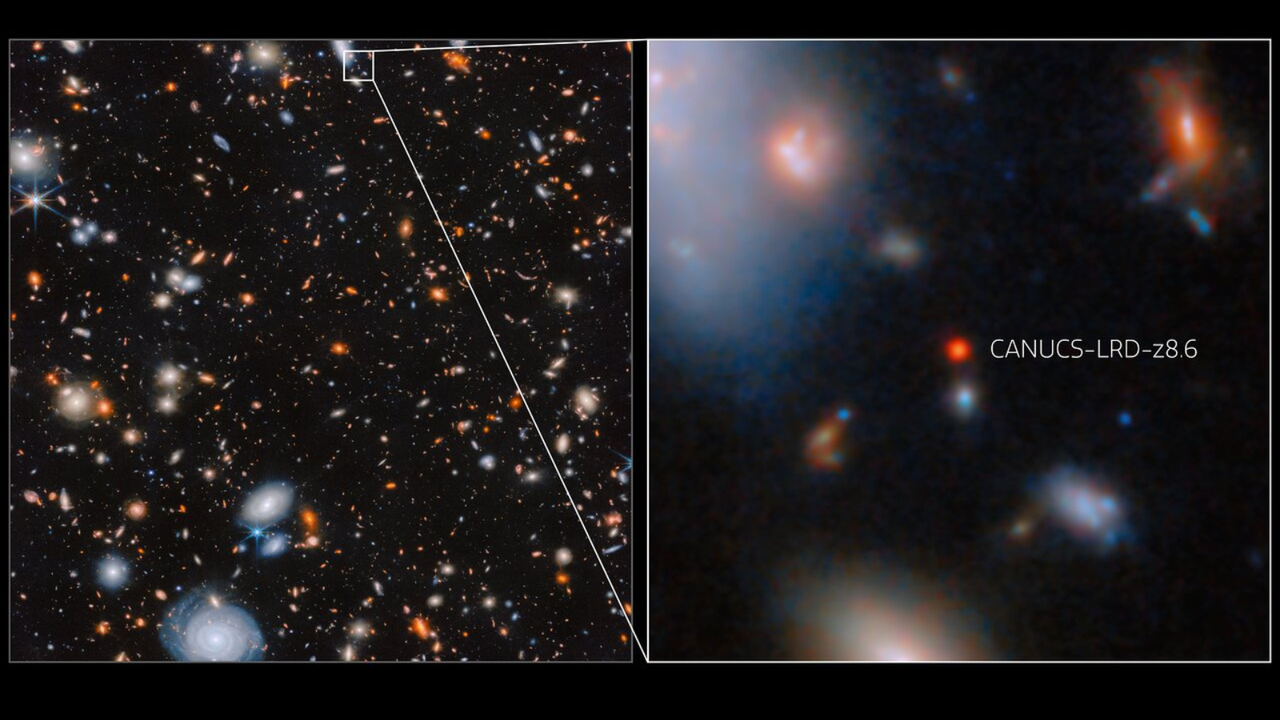
(Left) an image of many glowing galaxies in various shapes and colours, including spiral and elliptical galaxies, on a black background. A small box near the top of this image highlights a small collection of galaxies. (Right) the same area zoomed in to reveal its details up close. This region shows a small circular red galaxy in the centre, which is labelled “CANUCS-LRD-z8.6”.

Using the James Webb Space Telescope (JWST), astronomers have uncovered a voraciously feeding and rapidly growing supermassive black hole in the infant universe. Existing just 570 million years after the Big Bang, this black hole sits at the heart of the galaxy CANUCS-LRD-z8.6.

CANUCS-LRD-z8.6 is an example of the class of galaxies in the early universe called "Little Red Dots." These small, bright, and extremely distant objects have been routinely discovered by the JWST since it began observations in 2022. Little Red Dots have mystified astronomers because they don't seem to conform to our understanding of how galaxies evolve in step with their central supermassive black holes, leading some scientists to dub them "universe-breaking" galaxies. That's because Little Red Dots are either way too dense to account for the masses of their stars or host a supermassive black hole that is way too massive to sit in such a small galaxy.

Sign up to read this article
Read news from 100's of titles, curated specifically for you.
Already a member? Sign in here
Related Stories
Top stories on inkl right now
One subscription that gives you access to news from hundreds of sites
Already a member? Sign in here
Our Picks
Fourteen days free
Download the app
One app. One membership.
100+ trusted global sources.