Get all your news in one place.
100’s of premium titles.
One app.
Start reading
Space
Space
Science
Paul Sutter

James Webb Space Telescope spots a gassy baby galaxy throwing a tantrum in the early universe

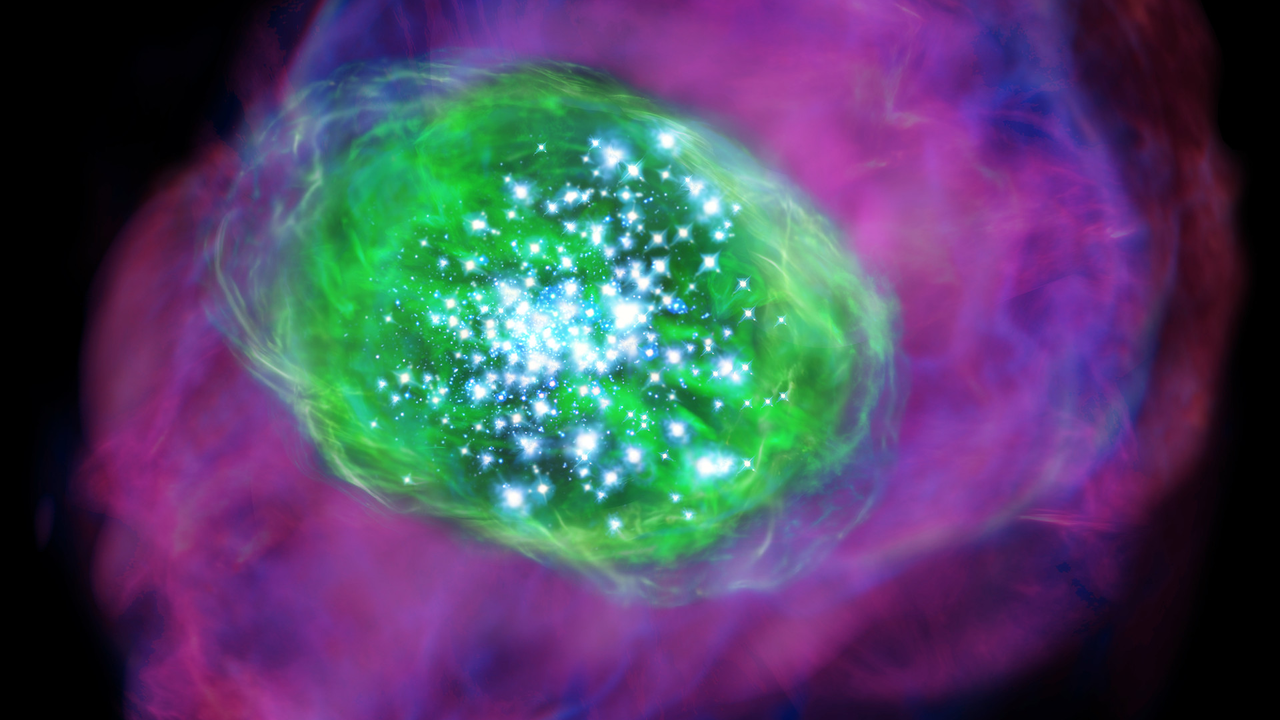
A swirl of green light around a series of white dots shows a young galaxy, with purple around the green lit bubble.

A baby galaxy is throwing one heck of a tantrum, and it's shaking up our understanding of the earliest galaxies.

Recently, an international team of astronomers used the James Webb Space Telescope (JWST) to uncover a bright, young galaxy in the early universe. Although it's not the earliest galaxy ever found, it is among the first generation of large galaxies to appear after the Big Bang. In particular, this galaxy arose when the universe was less than 500 million years old.

Because the galaxy, SXDF-NB1006-2, is so far away, we're seeing it as it existed when it was only 1 million to 2 million years old. And this toddler galaxy is throwing quite the tantrum. It's forming stars at a rate of around 165 solar masses per year, the astronomers reported in a paper published in October in the journal Monthly Notices of the Royal Astronomical Society. That's over 16 times the star formation rate of the Milky Way, making SXDF-NB1006-2 appear much brighter and bluer than a more modern, sedate galaxy like our own.

But that's not all. When galaxies undergo rounds of intense star formation like this, they produce a lot of large, bright stars. These stars do two things. One, they have tremendous outflows of particles and radiation, like the solar wind on steroids. And two, they die. A lot. They explode as tremendous supernovas almost as soon as they're born.

All of this activity raises the temperature of the galaxy and causes huge plumes of gas to race outward. In the case of SXDF-NB1006-2, the astronomers measured outflows of a speed of over 310 miles per second (500 kilometers per second), which is three times faster than the escape velocity of the galaxy. In other words, that gas is never coming back.

Interestingly, although the galaxy was chock-full of young, bright stars, there were more heavy elements in the galaxy than should have been there given the stellar ages. Because heavy elements can come only from previous generations of stars, the astronomers suspect a population of older stars is tucked behind the bright lights of their younger siblings.

But all of those outflows are not good for the galaxy. Once the gas leaves, it never comes back. And without gas, the galaxy can't keep making stars. The astronomers estimate that this galaxy will deplete itself of gas in only a few hundred million years. It won't die completely; as long as there's some gas, stars can still form, but they will do so at a much slower rate. And small, long-lived stars can hang on for a really long time.

But the astronomers suspect this kind of bursty young galaxy in the early universe may someday evolve into what's known as a massive quiescent galaxy in the modern-day cosmos. These galaxies have accumulated a lot of gas but have converted most of the gas into stars. Burning the candle at both ends, they run out of fuel, while more slow-paced galaxies, like the Milky Way, keep churning out new stellar generations.

In general, JWST is finding early galaxies that tend to be brighter and larger than our naïve predictions of galaxy growth suggested. It's like finding teenagers sitting in a kindergarten class. It doesn't break our understanding of the basic Big Bang picture, but it does mean we have a lot more to learn about how the early universe worked.

Sign up to read this article
Read news from 100’s of titles, curated specifically for you.
Already a member? Sign in here
Related Stories
Top stories on inkl right now
One subscription that gives you access to news from hundreds of sites
Already a member? Sign in here
Our Picks
Fourteen days free
Download the app
One app. One membership.
100+ trusted global sources.