
Get all your news in one place.
100's of premium titles.
One app.
Start reading
Space
Space
Science
Robert Lea

James Webb Space Telescope investigates the origins of 'failed stars' in the Flame Nebula

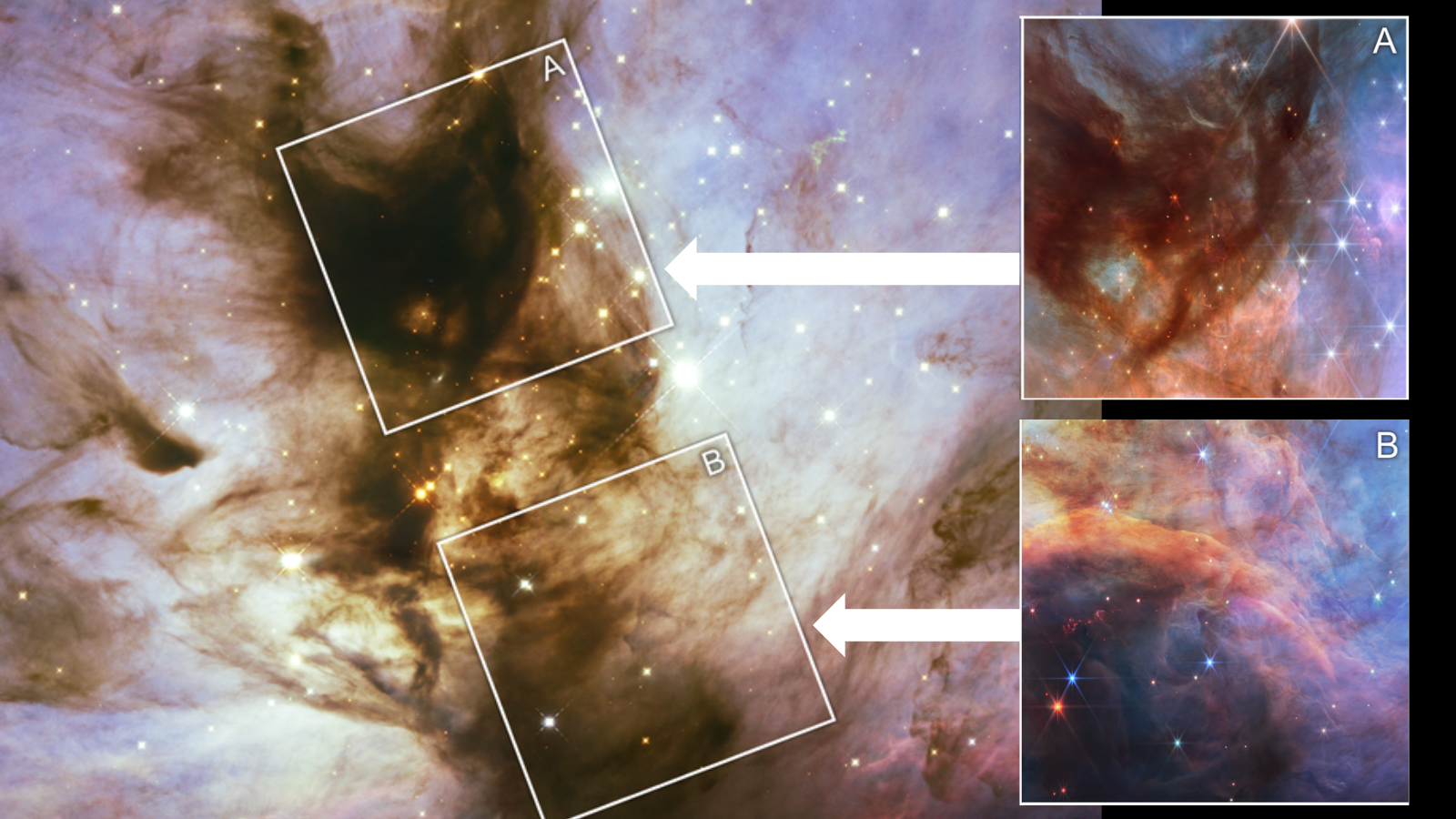
This collage of images from the Flame Nebula shows a near-infrared light view from NASA’s Hubble Space Telescope on the left, while the two insets at the right show the near-infrared view taken by NASA’s James Webb Space Telescope.

The James Webb Space Telescope (JWST) has probed deep into the dusty shroud of a young nebula alight with star formation on the hunt for "failed star" brown dwarfs.

Brown dwarfs are stellar objects that are born like stars but fail to gather enough matter to reach the masses needed to trigger the fusion of hydrogen to helium in their cores. These bodies with masses between 13 and 75 times the mass of Jupiter (or 1.3% to 7.5% the mass of the sun) are, therefore, much fainter than regular main sequence stars, despite the fact that some nuclear fusion does happen within them.

Sign up to read this article
Read news from 100's of titles, curated specifically for you.
Already a member? Sign in here
Related Stories
Top stories on inkl right now
One subscription that gives you access to news from hundreds of sites
Already a member? Sign in here
Our Picks
Fourteen days free
Download the app
One app. One membership.
100+ trusted global sources.