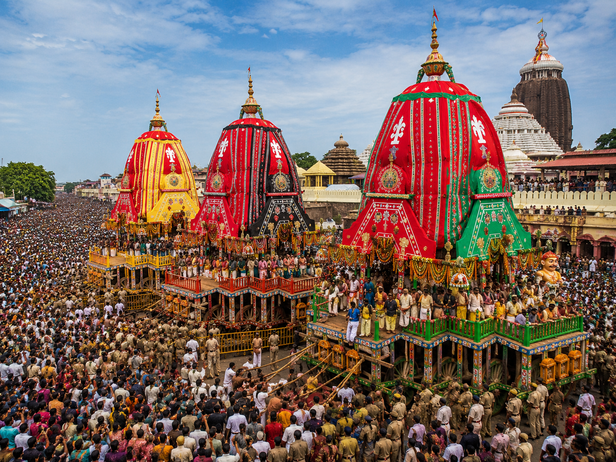
Every year in July, Puri in Odisha files with millions of devotees. Devotees from different parts of India come to Puri to watch the three large wooden chariots of Lord Jagannath,Lord Balabhadra, and Lord Subhadra move along the Bada Danda.

When Does Jagannath Rath Yatra 2026 start?
Devotees carry Lord Balabhadra to the chariot as they participate in Mahaprabhu Jagannath Rath Yatra at Puri Jagannath temple, in Puri on Thursday.
The Jagannath Rath Yatra 2026 begins on July 16, which is a Thursday. On this day, Lord Jagannath, his brother Lord Balabhadra, and his sister Goddess Subhadra come out of their temple in Puri. They are placed on three large wooden chariots, which are pulled by thousands of devotees through the streets of the city.
This Rath Yatra is one of the oldest and biggest chariot festivals. Every year in July Puri celebrates a grand celebration. Before the devotees start pulling the chariot an important ritual gets performed. The king of Puri sweeps the chariot with a golden broom. This ritual is Chhera Pahanra. This ritual is performed to show that everyone in front of the god is equal either the king or normal person. After this ritual the chariot is pulled towards the temple.
When Does the Festival End?
The festival does not end on the first day. After reaching the Gundicha Temple, the deities stay there for about a week then begin their return journey to the main Jagannath Temple. This return journey of the Lord's is called the Bahuda Yatra, which takes place around July 24 in 2026.
The last ritual of this whole festival is called Niladri Bijay. It will be held on July 28, when Lord Jagannath, Lord Balabhadra, and Goddess Subhadra come back to the main temple.
Why Does The Chariot Stop at a Dargah?
Devotees carry Lord Balabhadra to the Taladhwaja Ratha during Mahaprabhu Jagannath Rath Yatra at Puri Jagannath temple, in Puri on Thursday.
One of the most special parts of the whole rath yatra is that the chariot stops for a few minutes in front of the shrine of Salabega. Salabega was born into a Muslim family but he has deep faith in Lord Jagannath. He was a great devotee of Lord Jagannath.
There is also a very popular story on this. Salabega could not reach Puri in time to see the Rath Yatra. It is believed that Lord Jagannath’s chariot stopped on its own and did not move until he arrived and offered his prayer. Since then, every year the chariot has stopped at the same place to continue the tradition.
If you are also planning to watch the Puri Rath Yatra 2026, check the halt near Salabega's Shrine.
This article is based on spiritual beliefs and is intended for informational purposes only. It does not constitute financial, medical, or professional advice.
Unlock insightful tips and inspiration on personal growth, productivity, and well-being. Stay motivated and updated with the latest at My Life XP.
Frequently Asked Questions[FAQs]
-
Why is Lord Jagannath's idol made of wood and not stone?
The idols of Jagannath, Balabhadra, and Subhadra are carved from a special neem tree, believed to be selected through divine signs. This wooden form is called Daru Brahma, and it is chosen because wood, unlike stone or metal, can be renewed, which fits the belief that the deity is a living, breathing presence rather than a fixed statue.
-
Why do the idols get replaced every few years?
This ritual is called Nabakalebara, meaning "new body." It usually happens every 12 to 19 years, based on a special calendar calculation. The old wooden idols are ceremonially buried, and new ones are carved from freshly chosen neem trees.
-
Why do the deities "fall ill" before the yatra?
After a ritual bath with 108 pots of water on Snana Purnima, the deities are believed to catch a fever and are kept out of public view for about two weeks. This resting period is called Anavasara, and devotees wait eagerly for the deities to "recover" and reappear for the yatra.
-
Who is allowed to pull the Jagannath chariot?
Traditionally, people from every background are welcome to pull the ropes, regardless of caste or religion. This is one of the reasons the festival is often described as a symbol of equality.