
Get all your news in one place.
100's of premium titles.
One app.
Start reading
Digital Camera World
Gareth Bevan

I’ve always exclusively bought first-party lenses – but that might be about to change

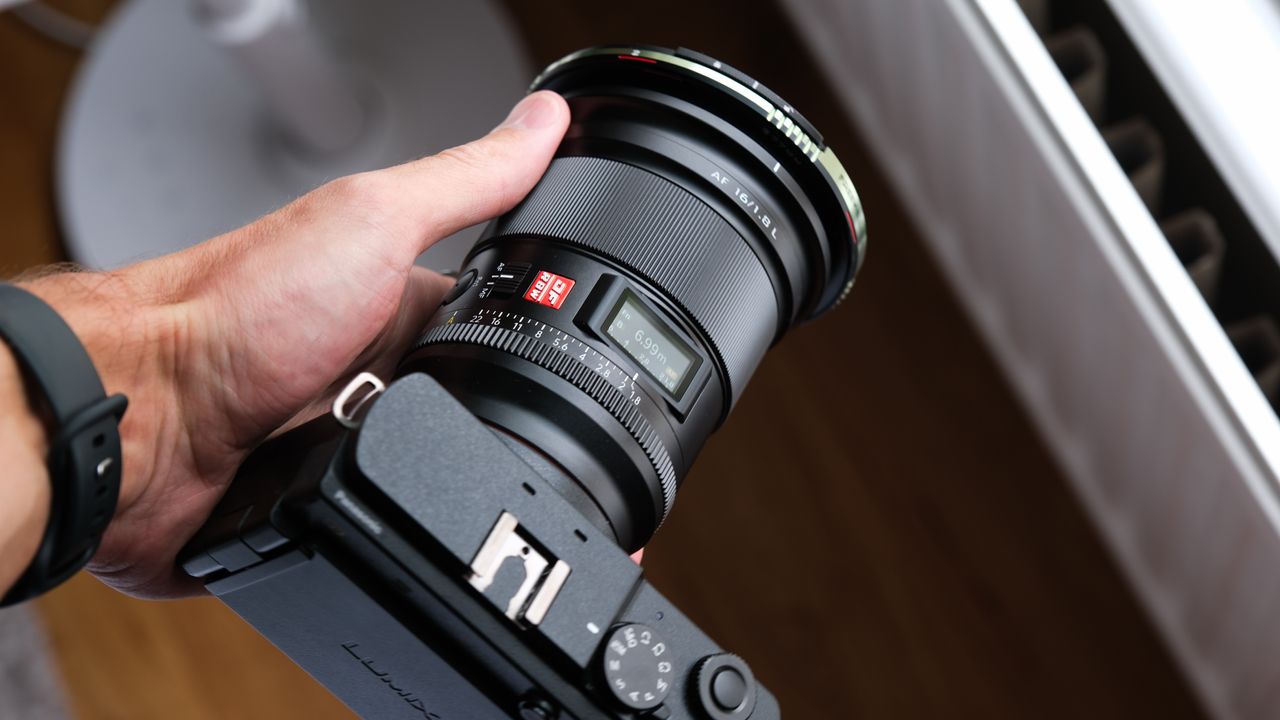
Viltrox AF 16mm F1.8 camera lens on a Lumix S9 camera.

I have always been a bit of a lens snob. Not necessarily a red-ring, G Master absolutist, but I've always had a preference for first-party lenses.

Up until now, all my Canon cameras have had Canon glass and my Fujifilm cameras have Fujinon optics. My logic followed the consensus that first-party lenses offered the best autofocus, the cleanest compatibility and, supposedly, the fewest compromises.

However, recently I purchased a Panasonic Lumix S9 – and had the world of L-Mount lenses opened up to me. Panasonic makes its own fantastic glass, but there are 11 players currently in the L-mount Alliance including big hitters like Leica and Sigma – as well as rising stars like Viltrox.

I had played around with some super-cheap Viltrox lenses several years back, and optically I thought they were good but I wasn’t sold on the excessively “budget” feeling of the lenses.

However, I was recently sent the Viltrox AF 16mm f/1.8 to test for DCW – and honestly, this lens has shifted my opinion of the brand dramatically.

(Image credit: Gareth Bevan / Digital Camera World)

The AF 16mm f/1.8 is a full-frame autofocus ultra-wide prime available for L-Mount (as well as Sony E and Nikon Z mounts). Outside, it’s built with a solid metal barrel, aperture ring, customizable buttons, dust-resistant sealing and even a small color display showing focus information.

This certainly does not feel like a “budget” lens – despite costing far less than many first-party equivalents. More importantly, it does not shoot like a budget lens either.

It has a fast f/1.8 aperture and a 105.6° angle of view. Inside are 15 elements arranged in 12 groups, including 4 ED and 3 aspherical elements. It is impressively sharp in the center at f/1.8, performs strongly toward the edges when stopped down and controls distortion remarkably well for such a wide lens.

(Image credit: Gareth Bevan / Digital Camera World)

There are still some compromises. At 550g, the Viltrox is hardly featherweight and its autofocus is not quite as polished as the very best first-party motors. Wide-open vignetting is also noticeable.

Yet none of that feels as important when the lens costs around $580 / £530. Meanwhile, Panasonic’s narrower Lumix S 18mm f/1.8 costs $1,099 / £799 and, for Sony shooters, Sony’s own FE 16mm f/1.8 G is $899 / £849.

The bigger story is what this says about Chinese lens makers. Brands such as Viltrox are going from cheap curiosities to genuinely compelling alternatives.

I still understand the appeal of first-party glass, but I am no longer convinced that the logo on the barrel deserves quite such a large portion of my budget.

Sign up to read this article
Read news from 100's of titles, curated specifically for you.
Already a member? Sign in here
Related Stories
Top stories on inkl right now
One subscription that gives you access to news from hundreds of sites
Already a member? Sign in here
Our Picks
Fourteen days free
Download the app
One app. One membership.
100+ trusted global sources.