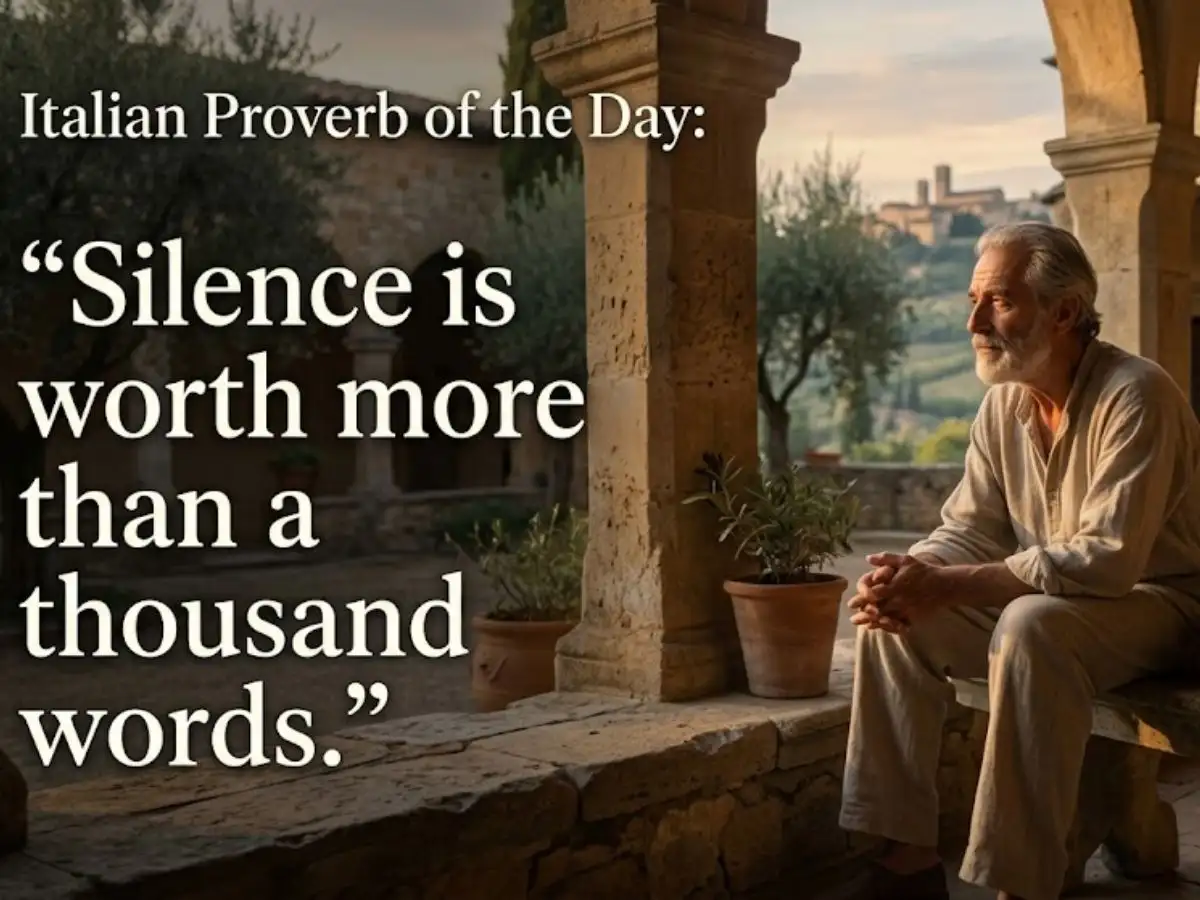
Italian Proverb of the Day: “Il silenzio vale più di mille parole,” translated as “Silence is worth more than a thousand words,” is an established Italian proverbial saying that highlights the communicative power of silence. Italian linguistic and literary sources document the phrase as a proverbial formulation, while its meaning centres on the idea that silence can sometimes convey emotions, understanding or restraint more effectively than speech.
The meaning behind “Silence is worth more than a thousand words”
“Silence is worth more than a thousand words” suggests that communication does not always require an explanation.
There are moments when words can clarify a situation, but there are others when speaking may add little. Silence can express respect, grief, disagreement, thoughtfulness or emotional understanding without requiring a lengthy explanation.
The proverb therefore does not suggest that words have no value. Instead, it points to the importance of recognising when words are necessary and when they are not.
The origins and use of the proverb
The exact origin of the Italian wording is difficult to establish with certainty. However, the phrase is clearly documented in Italian as a proverbial formulation. An academic study of Italian language and figurative usage specifically identifies “il silenzio vale più di mille parole” among Italian proverbial expressions.
The saying also appears in Italian literary and cultural works, demonstrating how naturally the idea has entered everyday language. One modern literary text uses the phrase while exploring silence as a form of communication, reinforcing the notion that remaining quiet can itself convey meaning.
When silence communicates more than speech
There are situations in which words can become inadequate.
A person experiencing grief may not need an elaborate explanation from someone sitting beside them. A quiet presence can sometimes communicate sympathy more effectively than a long speech.
Similarly, after an argument, immediately responding in anger can make matters worse. Remaining silent for a moment can create the space needed to think before speaking.
In these situations, silence is not emptiness. It is a deliberate choice.
Why saying less can sometimes say more
People often feel pressure to respond to everything.
A difficult question can make silence uncomfortable. An accusation may provoke an immediate defence. A disagreement can encourage people to keep explaining themselves even after their position is already clear.
But continuing to speak does not always strengthen an argument.
Sometimes additional words create confusion, reveal more than intended or turn a manageable disagreement into a larger conflict. Knowing when to stop can therefore be a form of communication in itself.
Silence requires judgment
The proverb should not be interpreted as an instruction to remain silent in every difficult situation.
There are circumstances in which speaking up is essential. Problems need to be addressed, misunderstandings need clarification and important concerns cannot simply be ignored.
The value of silence depends on the situation.
Choosing silence because there is nothing useful to add is very different from remaining silent out of fear or refusing to communicate when a conversation is necessary.
The wisdom lies in knowing the difference.
The relevance of the proverb today
The lesson has particular relevance in an age of constant communication.
Messages can be sent instantly, opinions can be shared publicly and conversations can continue without pause. The ease of speaking can sometimes make restraint more difficult.
In such an environment, choosing not to respond immediately can be valuable. A pause can prevent an emotional reaction from becoming a permanent statement.
Silence can provide time to listen, reflect and decide whether a response is actually necessary.
The timeless lesson
“Silence is worth more than a thousand words” offers a reminder that effective communication is not measured simply by how much a person says.
Words can explain, persuade and comfort, but silence can also carry meaning. It can show restraint when anger would be easier, respect when explanations are unnecessary and understanding when another person simply needs someone present.
The proverb ultimately encourages discernment rather than silence for its own sake.
Sometimes the wisest response is not finding more words, but recognising when no words are needed.