
Get all your news in one place.
100’s of premium titles.
One app.
Start reading
Euronews
Euronews
Derek Gatopoulos

‘It used to rain a lot more’: Greece's Epiphany events highlight concerns about water scarcity

As Orthodox Christians around the world attended Epiphany ceremonies on Tuesday to commemorate the baptism of Christ, worried officials in Greece used the moment to highlight growing water scarcity.

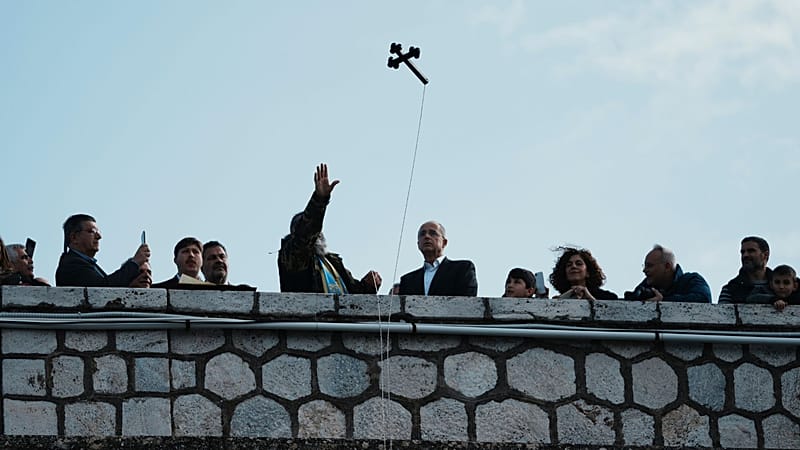
A priest cast a wooden cross into the visibly depleted waters of Lake Marathon, an artificial reservoir north of Athens. Water stored there and in the other three reservoirs supplying Athens has dropped from more than 1 billion cubic metres in 2022 to about 390 million cubic metres.

The dramatic decline prompted authorities in November to declare a water emergency in the capital.

An islet that recently emerged is seen at Lake Marathon near Athens, Greece, on Jan. 6, 2026, as receding water levels reflect years of low rainfall. (An islet that recently emerged is seen at Lake Marathon near Athens, Greece, on Jan. 6, 2026, as receding water levels reflect years of low rainfall.)

Prolonged droughts are becoming more frequent in Athens

“This is the third consecutive year of a significant drop in reservoir levels. This means that the problem is right in front of us,” George Stergiou, chairman of the greater Athens water utility, EYDAP, said after attending the Marathon ceremony.

Stergiou warned that prolonged droughts are becoming more frequent and are often followed by intense rainfall that does little to replenish supplies.

The state-run utility has announced a €2.5 billion, decade-long investment program to reduce water losses and boost water security, including pipe replacements, smart meters and expanded wastewater reuse.

“What we want to do, as a first step, is replace all those uses that today could be met with non-potable water by recycled water,” Stergiou said.

Reservoir manager Sofia Nalpantidou said Marathon’s low level should be viewed in context, noting the lake is connected with the wider system and partly managed for seasonal flood control.

“We usually keep it lower in winter because we want to maintain a buffer,” Nalpantidou said.

Residents have noted the changes.

“In the past, it used to rain a lot more, sometimes daily. That doesn’t happen anymore,” said Antonis Stamou, a 78-year-old retiree who attended Tuesday’s service.

Sign up to read this article
Read news from 100’s of titles, curated specifically for you.
Already a member? Sign in here
Related Stories
Top stories on inkl right now
One subscription that gives you access to news from hundreds of sites
Already a member? Sign in here
Our Picks
Fourteen days free
Download the app
One app. One membership.
100+ trusted global sources.