Following on from The Masters, which Rory McIlroy won in historic fashion, the PGA Tour returns to our screens with its fourth Signature Event of the year.
Already, we've had the AT&T Pebble Beach Pro-Am, Genesis Invitational and Arnold Palmer Invitational, with the RBC Heritage taking place a week after the first men's Major of 2026.

Certainly, the positioning of a Signature Event following The Masters has raised eyebrows, especially as there are a further two more $20 million tournaments between now and the second men's Major, the PGA Championship, in four weeks.

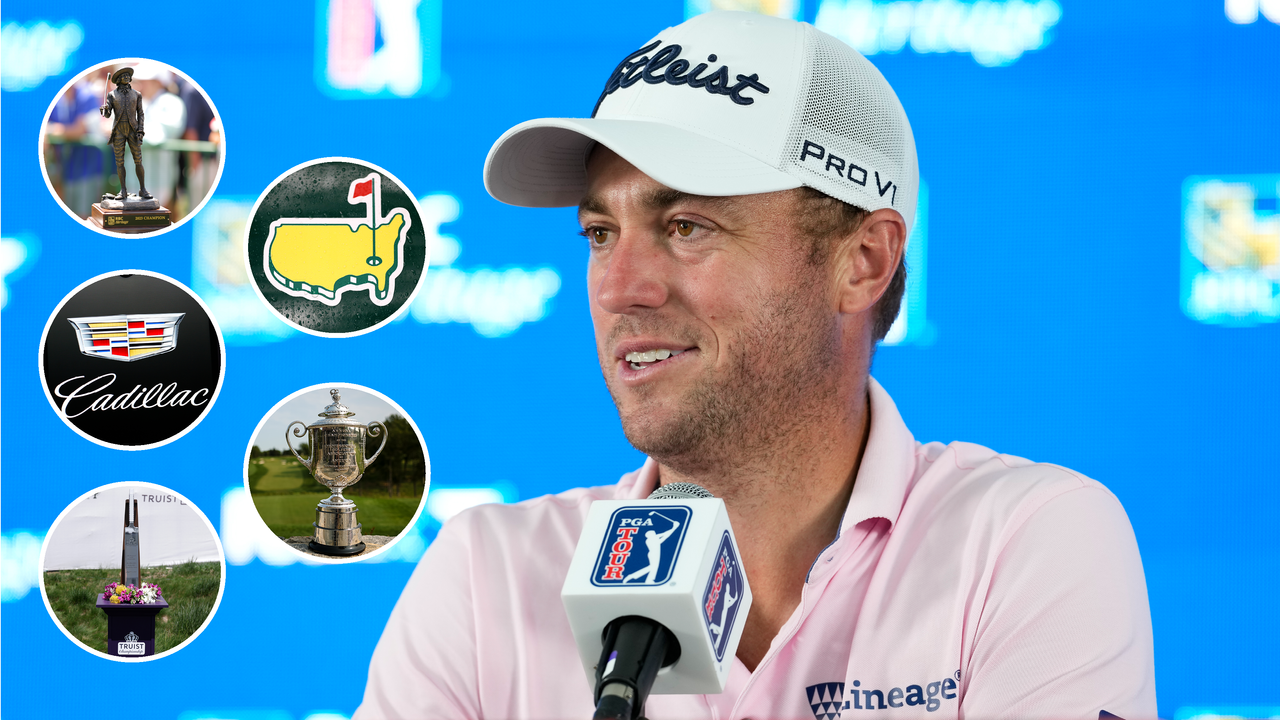
The PGA Tour's scheduling of events has been a topic of conversation for a number of years since Signature Events were introduced and, speaking ahead of his RBC Heritage defense, Justin Thomas gave his thoughts.
Speaking about two Majors and three Signature Events taking place in a six-week stretch, Thomas stated: "It's tough. I mean, it's not how I would prefer to draw it up, I would say.
"I think especially when it comes to Majors, because the season is important. Obviously it's very important for your FedEx Cup standing, how your season is going, getting into events, not in events, whatever it may be.
"Majors are kind of what guys will generally build their schedule off of, in a sense, of what they need to do to prepare for a Major, and it's also how kind of your legacy in the game is remembered for a lot of people.
"Going to very difficult courses into a Major I don't think is probably how it would be drawn up for a lot of guys.
"It's one of those things that it's obviously, we've had some changes and probably will continue to see some in the next, I don't know, couple years. It'll never be perfect, but at least something that's maybe a little more ideal for guys in their eyes."

He's not the only player who has spoken negatively about the positioning of the Signature Events, either.
Matt Fitzpatrick, who claimed the Valspar Championship in his last start before The Masters, discussed how the Cognizant Classic (formerly Honda Classic), had lost its strength of field.
Taking place after two Signature Events, as well as before the Arnold Palmer Invitational and The Players Championship, the Cognizant Classic was seen as week off for most of the PGA Tour's strongest players, who instead opted to tee it up in the other four events.
Speaking at the Valspar Championship, Fitzpatrick stated: "I think the golf course (at the Valspar Championship) is obviously great. It’s a great test.
"Guys want to play good golf courses, tough golf courses, I think. I also think the big thing is the schedule.
"The way it is, you know, I think if you swap this one for Cognizant this week you would probably get the same strength field.
"You would get a stronger field at Cognizant. I know that’s been a bit of a gripe by a lot of people that – you know, I really wanted to play the Cognizant this year, but if I play that, it’s then seven in a row if I’m playing this one as well. It just becomes a lot.
"When you look at the best golfers in the world, they’re not playing seven in a row, the majority of them. So you really have to manage that really well."

The Signature Event model was introduced when Jay Monahan was Commissioner of the PGA Tour but, with Brian Rolapp taking over the CEO duties in June 2025, notable changes appear to be on the horizon already.
Speaking at The Players Championship in March, just nine months on from his appointment, Rolapp laid out plenty of possible changes to a new PGA Tour, with one of those being around its schedule.
In the press conference, Rolapp stated: "While no decisions have been made, I want to walk you through six themes that are beginning to emerge. This remains a work in progress, and it is by no means a baked cake. These are simply areas we are starting to see a meaningful consensus.
"Number one, as we look at the calendar, there is an emphasis on playing our season from late January to early September.
"In terms of overall structure, inclusive of the Majors, The Players, and the post-season, we are looking at roughly 21 to 26 tournaments on a first track of elevated events with the best players competing for higher purses.

"Today we have eight Signature Events. We are effectively looking to at least double that number. Add the four Majors, The Players Championship, our post-season, and the Presidents Cup or Ryder Cup, and you get to the 21- to 26-event range.
"To be clear, we will have a second track of PGA Tour tournaments which will ladder up to those elevated events. I will touch on that shortly.
"Number two, a key consideration has been establishing more consistent fields to the PGA Tour. This means moving away from small fields and no-cut events.
"Our best events will have larger fields. Ideally, we are targeting something closer to 120-player fields with a cut. That consistently matters. It helps fans know who they will see and showcases who they want to see, the most competitive players.
"It helps partners know what they're investing in, and it helps players better understand the competitive landscape in their schedules, all while embracing meritocracy."

One gripe has also been around the no-cut, limited fields in the Signature Events, which has caused some players to speak out.
However, with the new Signature Event models that Rolapp has proposed, more emphasis would fall on performance.
"There has been a lot of discussion about scarcity. Ultimately, scarcity is not about the number of events we have, but rather scarcity is about making every event we have matter," continued Rolapp.
"This is why we are evaluating the role of promotion and relegation between these two tracks within our competitive model, an added element that we would bring to life in the second track of events I described earlier.
"What we envision is a merit-based system that leans into what makes professional golf so compelling, players earning their way to the top, with every event having greater meaning.
"You see this work powerfully elsewhere, including in English football, where clubs move between the premier and the championship based on their performance.
"Applying elements of that approach to the PGA Tour creates real consequence, lifting the competitive standard across the entire platform. For our members, the message is pretty simple: Play well and you earn the opportunity to compete in our biggest events and for more money."