
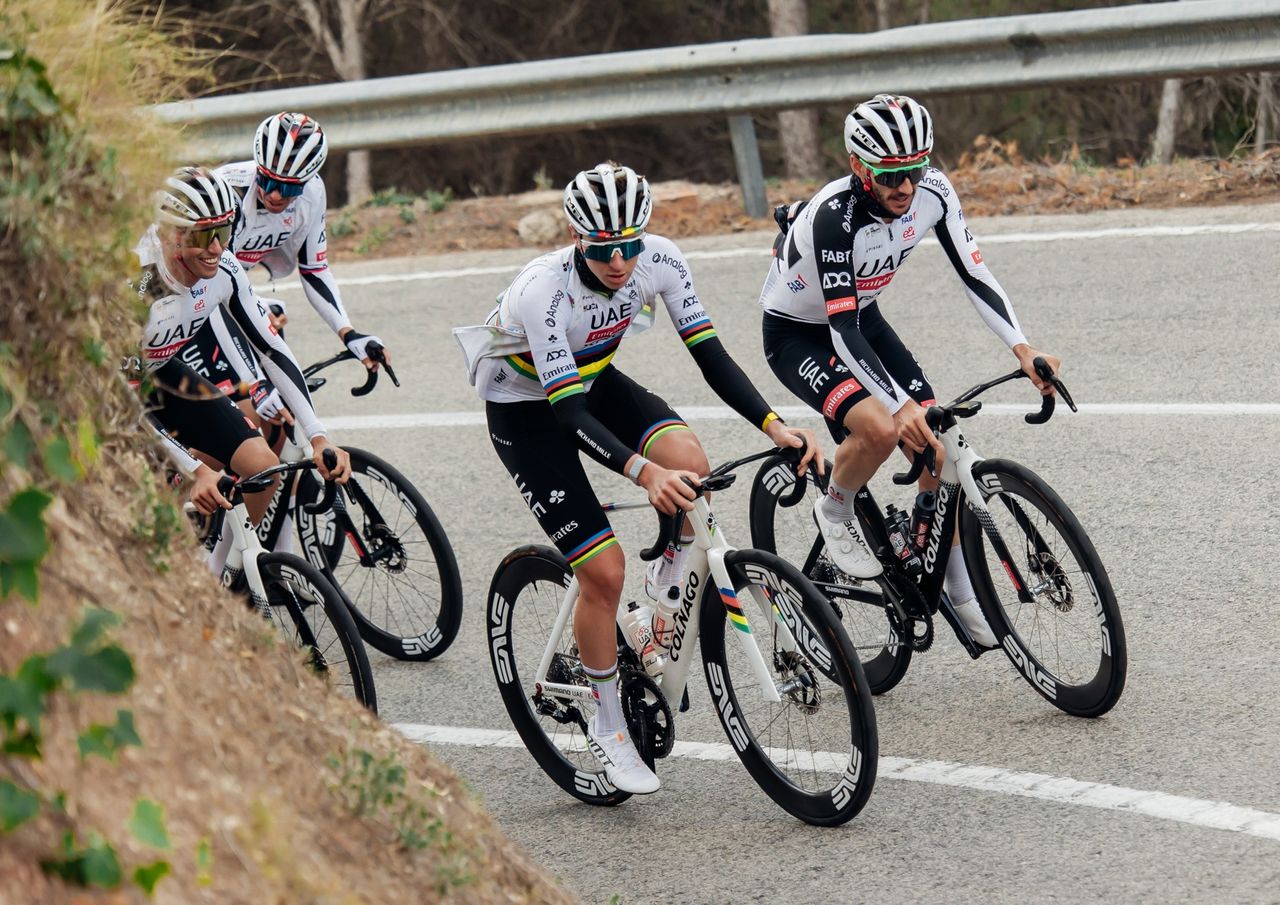
For the last two months the Coll de Rates has probably been the most popular climb in the cycling world. The 6.4km climb has been glowing white hot on heat maps, with hundreds of rides and different segment times logged on Strava.
The Coll de Rates is a popular winter playground and a symbolic crossroads for riders of different abilities. Most WorldTour teams hold training camps on the nearby Costa Blanca in December and January and ride inland to climb the Coll de Rates during long rides. Amateur riders from across Europe also travel to Spain for warm weather riding and like to go 'pro-spotting' and compare their rides on the Coll de Rates with the professionals.
"Sometimes you even see the occasional guy just sitting in a camping chair on the side of the road watching the riders go past," Larry Warbasse told Cyclingnews after we saw him riding the Coll de Rates a few hours before the Tudor media day in early January.
"Every cyclist who goes to the Costa Blanca wants to ride the climb that everyone talks about. If you go there in December between 10:30am and 1:00pm, you’re likely to see many of your cycling heroes and half of the peloton riding up it."
Though it's fun for fans, Jonas Vingegaard's recent crash near Malaga in the south of Spain after being followed by a local rider highlighted the dangers of amateur riders trying to follow and video pro riders in training. Pro riders are far more skilled than most of us and can ride much faster, so it can be tricky sharing the road with so many other riders. Vingegaard reportedly suffered cuts but was not seriously hurt but his Visma-Lease a Bike team urged fans to put safety first.
"For both your own and others’ wellbeing, please allow riders to train and give them as much space and peace as possible," the team said.
Pro riders usually quietly tolerate amateur riders sitting on their wheels and even some filming them from the side but they can be disturbing.
"They don't say hello, which is normal, they're focused on their own thing. And sports directors don't like you getting in their riders' way, I completely understand," French amateur rider Florent Jimenez told L'Equipe of his experience riding in Calpe.
"When I'm around pros, I keep my composure, I act like nothing's happening. One morning, I found myself at a red light next to Pogačar. It didn't even occur to me to bother him. It's a matter of respect."
The Coll de Rates

The Coll de Rates (pronounced 'ratesse' or 'rats' according to different local residents) is 6.43km long with an average and near constant gradient of 5.5%.
Cyclingnews visited the Coll de Rates during our trip to Calpe to visit Tudor Pro Cycling, Soudal-QuickStep and Picnic PostNL. We weren't able to ride the climb during our time on the Costa Blanca but we wanted to see it and better understand why the climb is so popular.
We drove there from Calpe and witnessed how groups of pro riders and amateurs formed along the valley road to Parcent. Fortunately local residents and car drivers seem patient and understanding, with no sign of road rage and a willingness to wait before overtaking the groups. The cyclists also appeared to be well behaved, riding in a double line and respecting stop signs and road crossings.
The climb itself begins after a left turn on the edge of Parcent. Road signs warn that the Colle de Rates is a 'Ruta Ciclista' and ask motorists to leave at least 1.5m when overtaking.
The Colle de Rates Strava segment officially starts outside Parcent on a flat section of road. It then climbs through some early hairpins under pine trees and cuts along the side of the hillside for two kilometres in a straight line. The road offers stunning views across the valley, with the Mediterranean sea visible some 35km away. The hillside protects riders from any winds from the south before a final hairpin leads towards the 896 metre high summit after an elevation gain of 275 metres.
The ascents ends in a slight cutting, with a wide junction on the right offering a place to stop. There is a sign detailing the gradient and profile, with a 'Coll de Rates' sign now completely covered in stickers. The road to the right leads up to a restaurant, with a narrow road and bike path leading to the actual summit of the hill. It has been dubbed 'Super Rates' by some, with Mathieu van der Poel and Thibau Nys amongst the pro riders to also venture to the top out of curiosity.

The climb from the other side is called the Coll de Tàrbena and is also often ridden in training, especially from riders based near Benidorm to the south. It also offers stunning views and is 5.5km long but is often exposed to the wind, making it less popular for testing.
The popularity of the Coll de Rates has led to a number of cycling cafes and bike businesses opening near the climb. Cyclingnews stopped for a cortado coffee at the Musette Café, where both Remco Evenepoel and Van der Poel have been seen.
We passed dozens of riders on the Coll de Rates, from local Spanish riders to unfit northern Europeans, from ambitious club and Continental team riders to WorldTour pros.
We saw several Tudor riders descending individually after doing a test ride, with a group of Soudal-QuickStep riders descending together after climbing from the Colle de Tàrbena side. We also saw some Visma-Lease a Bike riders, who had perhaps travelled out to Spain a few days before the official team training camp. In just an hour we also saw riders from Bahrain Victorious, Euskaltel, Picnic PostNL.
"It’s become sort of 'the' climb in the area because it’s the closest solid climb to Calpe," Warbasse explained.
"It’s a good gradient to do training and testing efforts on because there aren’t many flat sections and not a whole ton of corners."
'Tadej likes to conquer everything a bit mythical in cycling'
The Astana and QuickStep teams were some of the first WorldTour teams to hold training camps in the area, more than a decade ago. Many Belgians and Dutch, including Evenepoel and Van der Poel, own villas and apartments on the Costa Blanca and so base themselves there during winter breaks.
"Some teams used to do some training camp 'races' up the Coll de Rates, then Jonas Vingegaard took the record from the pros in 2018, then from there it just sort of became lore and things snowballed," Warbasse said.
Vingegaard set a time of 13:02 in 2018, while still a Continental level rider, with his Team ColoQuick teammates pacing him on part of the climb. The record time sparked interest from several pro teams, including Visma-Lease a Bike, who went on to sign the Dane. He has perhaps since gone quicker but is far more careful about publishing his training data.
Peter Øxenberg, who now rides for Ineos, set a time of 12:38 in early 2024 but then in December 2024 Tadej Pogačar and his UAE Team Emirates-XRG teammates decided to put on a show. Pogačar was given a well-drilled lead out and set a new record of 12:21.
Pogačar broke his own record last December, on the team's last day of training, setting a new time of 11:57 during a 226km ride. Again he was perfectly paced by the likes of Pavel Sivakov, Florian Vermeersch and others, climbing at an eye-watering average speed of 32.3kph.
Puck Pieterse is the official Strava Queen of the Mountain with an equally impressive time of 14:45.
This winter, an odd story hit the news when an account labelled as Jonas Vingegaard beat Pogačar's record, only to turn out to be an imposter likely using a motorbike or car to do so. The fact that this stunt happened on the Coll de Rates tells us a lot about where this climb stands in the cycling narrative.

"Tadej likes to conquer everything a bit mythical in cycling, both inside the races and out. I think he saw Rates as another opportunity to show the world that he really is another level above," Warbasse said.
"I still believe his Col de la Madone record outside of Nice is even more impressive, but damn, did they go quick up Rates!!!"
Not everyone is a fan of breaking records on climbs and posting about in Strava, and the popularity of the climb these days has taken the fun away for some rider.
"How can I put it? It's a highway, so everything I dislike, it's crowded just because it's crowded," French Tudor rider Mathys Rondel recently told L'Équipe. "People want to do what everyone else does."
Whether it's herd-following or genuine appreciation for the climb, this winter has proved again that the Coll de Rates is the place to be for pre-season training, for pros and amateurs alike. Ventoux and Finestre may rule the headlines in the summer, but in January, this is the climb to beat.