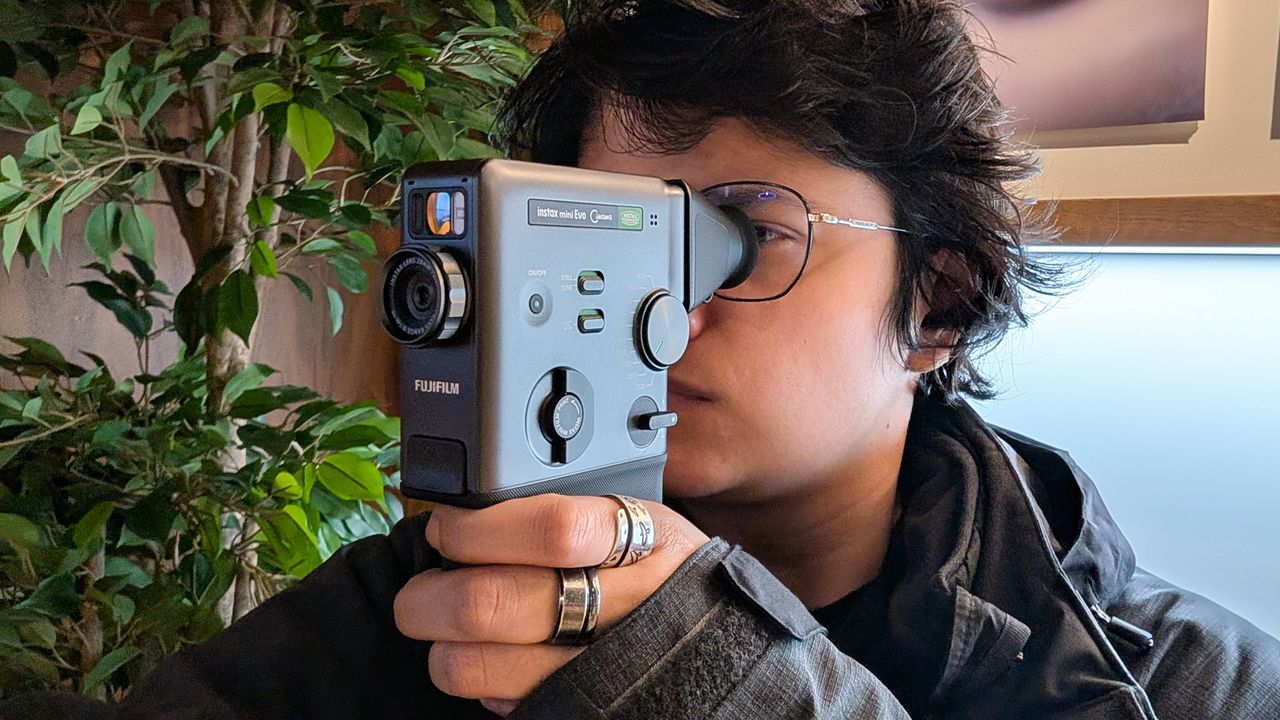
I review the best instant cameras here at Tom's Guide, and recently, I've been feeling like the evolution has plateaued. Most of them look and feel the same, and there isn't much of a difference in image quality either. So when Fujifilm announced the new Fujifilm Instax mini Evo Cinema this morning, it goes without saying that I was beyond excited to get my hands on it.
As part of Fuji's lineup of hybrid instant cameras, the Instax mini Evo Cinema is a 3-in-1 camera and printer, and for the first time, it can record 600 x 800 or 1080 x 1440 video. It's unlike any other I've seen as it looks like a Super 8 but is, in fact, an instant camera. Fujifilm invited me to the House of Photography in London, U.K., to try the camera for a couple of hours, and I have to say, I'm impressed already — and I think it's a strong contender for the best instant camera in 2026 (even though it's early days).

I'm yet to put the camera through its paces before publishing my full review, and that will happen in the near future, but my first impressions are very positive. This could be the instant camera for photography and video enthusiasts, and I know for a fact that Gen Z — with its love of compact cameras and retro tech — is going to adore the Instax mini Evo Cinema.
A quick rundown

- What is it? The Fujifilm Instax mini Evo Cinema is a 3-in-1 hybrid instant camera that can shoot stills and print them, record video that can be accessed via a QR code printed on film, and you can print directly from your smartphone too. Video can be recorded with audio as well, and there's a brand new 'Eras Dial' (or a Gen Dial) which lets you time travel from the 1930s to the 2020s by applying era-appropriate film effects to your photos and videos. It forms the third (and video-centric) arm of Instax's Evi lineup, joining its Instax mini Evo and the Instax Wide Evo stablemates.
- Who is it for? Anyone who wants a hybrid instant camera that can record videos and shoot (and print) instant photos with over 100 effect combinations should consider the Fujifilm Instax mini Evo Cinema. Gen Z is going to eat this up.
- How much does it cost? Quite a bit! The Fujifilm Instax mini Evo Cinema dethrones the Fujifilm Instax Wide Evo as Fuji's most expensive instant camera yet, costing $409 / £329 once it launches.
- When is it available to buy? Fujifilm hasn't yet confirmed the exact shipping date, but you can pre-order the Instax mini Evo Cinema at B&H Photo in the U.S. and London Camera Exchange in the U.K. with stock expected in late January.
Upgrade-worthy? Oh yes!

If you already own a Fujifilm Instax mini Evo (like I do) or a Fujifilm Instax Wide Evo, you might be wondering whether it's worth upgrading to the Fujifilm Instax mini Evo Cinema. After all, it costs a whopping $409 / £329! But the Instax mini Evo Cinema isn't like its stablemates. Yes, it can do everything they can, but there's the added benefit of being able to shoot 15-second long videos with audio.
The Instax mini Evo Cinema can shoot 600 x 800 or 1080 x 1440 (in 2020 era only) videos and print them in the form of a QR code on Instax mini film. This QR code can then be scanned with a smartphone, and you can view the clip from anywhere in the world (as it's automatically uploaded to the cloud when the camera is connected to your phone). Sound familiar? That's because it's the exact same thing the Fujifilm Instax mini LiPlay+ does for audio clips.

And it works like a charm. I recorded a few videos during my hands-on time in London, and the new Instax mini Evo app was quick to transfer the clips to my phone and upload them to the cloud. Video quality is great too, regardless of the filter and grain effect you've applied, which brings me to my next point...
Time traveling in style

Like I said, the Fujifilm Instax mini Evo Cinema can do everything its predecessors can, including adding effects and filters, so you still get 100+ effect combinations. But there's a new dial on the Instax mini Evo Cinema, and that's the Gen Dial, or the 'Eras Dial' as Instax kept calling it at the press event I attended. The 'Eras Dial" sounds catchier, in my opinion.
This dial, located on the left-hand side of the camera along with all other controls, lets you choose between 10 decade styles, ranging from grainy, black and white 1930s footage, YouTube-style 2010s, all the way through to vibrant, rich 2020s imagery. As a Fujifilm representative said today, "It's an instant camera that lets you time travel from the 1930s to the 2020s."
This is my favorite feature on the Instax mini Evo Cinema. I love playing with the different effects and filters on my Instax mini Evo, so I had a lot of fun trying the different style. 1930s footage resembles Fuji's Acros film simulation, and it looks fantastic. The Instax mini Evo Cinema lets you adjust the contrast too, and add varying levels of noise/grain with the Degree Control dial located around the lens on the front.
There's a zoom toggle on the left-hand side too, so you can zoom in and out while shooting, as you can see in the video above.
Before printing your video on Instax mini film, you can choose the exact frame you want to be printed via the camera itself, and you can print as many copies as you like — which is the point of Fuji's hybrid instant cameras. The shareability aspect makes the Instax mini Evo Cinema extremely fun, and you don't need to download the app to access the video via the QR code, making it more accessible.

Speaking of printing, the print lever on the Instax mini Evo Cinema is extremely fun. Again, located on the left-hand side, it's a tab that pulls out and turns, adding to the immersion. It's similar but a little different from the Instax Wide Evo's print crank (similar to the ones you find on film cameras to load and unload a film roll). I did find it a little finicky during my hands-on time as, at times, it took a couple turns to get the camera printing. It's a novel idea, and I can't wait to test it out properly.


Another thing I like is that the Instax mini Evo Cinema comes with a viewfinder attachment which easily clips on to cover the 1.54-inch hi-res LCD monitor. You can then look directly at the screen when you're out and about shooting. This attachment magnifies the image displayed on the screen and I found that it makes easier to shoot in bright conditions or direct sunlight when you can't view the monitor properly.
The perfect blend of retro and modern tech?

Retro tech is all the rage today, and we've seen that with many compact cameras making a comeback and new cameras being inspired by years past, such as the Camp Snap CS-8 and the Kodak Charmera. The Fujifilm Instax mini Evo Cinema is no different. It clearly looks like a Super 8 video camera, and it's directly inspired by a Fuji camera from the 1960s (and the 1960s era replicates the Super 8 quality).
But it's a camera made in 2026, so it's very modern, packing the same imaging tech you'll find in its stablemates. In my opinion, it's the perfect blend of nostalgia and modernity. It looks premium and is built far better than the likes of the plasticky Camp Snap CS-8. The Instax mini Evo Cinema has also got a price to match modern cameras. At $409 / £329, it's far more expensive than the aforementioned CS-8.
Is it worth the premium? It packs more tech and many, many features, yes, but I can't say for certain as I haven't tested all of its features yet, and that will happen when I get my review unit for in-depth testing. Fuji's banking on the nostalgia a camera like the Instax mini Evo Cinema can evoke, and this isn't something only the Japanese giant is hoping to capitalize on. We've seen it with Camp Snap and Kodak too. The resurgence of retro tech today is proof that there's a market for it, so the launch of the Instax mini Evo Cinema is definitely timely.
Fujifilm Instax mini Evo Cinema: Outlook

My first impressions of the Fujifilm Instax mini Evo Cinema have revealed a few things. First, it's a highly capable and versatile hybrid instant camera. The 5MP stills quality remains as good as on the Instax mini Evo and the Instax Wide Evo. The fact that you can record videos with audio and add a QR code to your print makes it the most versatile hybrid instant camera yet, and it's something no other brand — like Polaroid and Lomography — has done yet.
The Instax mini Evo Cinema is a joy to handle, and there's an additional, longer grip included in the box for more precise control. The dials and buttons themselves are laid out well, and anyone who picks up the camera will be able to get a hang of it quickly. The Gen Dial that lets you add filters from the 1930s through to 2020s is an awesome addition, and something I can't wait to test more when I review the camera.
First impressions aren't always everything, though, so it'll be interesting to see how the camera holds up when I conduct my usual battery of tests. For instance, I found the print button a little finicky during my hands-on time, so I'm looking forward to seeing if that issue persists. Keep an eye out for my full Fujifilm Instax mini Evo Cinema review!
The Fujifilm Instax mini Evo Cinema comes in black. Pre-orders are now open at B&H Photo in the U.S. and London Camera Exchange in the U.K. with stock expected in late January.

Follow Tom's Guide on Google News and add us as a preferred source to get our up-to-date news, analysis, and reviews in your feeds.
More from Tom's Guide
- I finally got my hands on the $30 camera that TikTok and Instagram are obsessed with: my first impressions of the Kodak Charmera
- 'It looks like a Super 8 but it’s a hybrid instant camera': the Fujifilm Instax mini Evo Cinema joins the party with a new 'Eras dial' and 'hundreds of effects'
- Best instant cameras in 2026