Get all your news in one place.
100’s of premium titles.
One app.
Start reading
Louder
Louder
Entertainment
Max Bell

"It reminded me of the politics of fear, like we're doing today": How the LA club scene in the 1960s shaped American rock then sparked a revolution

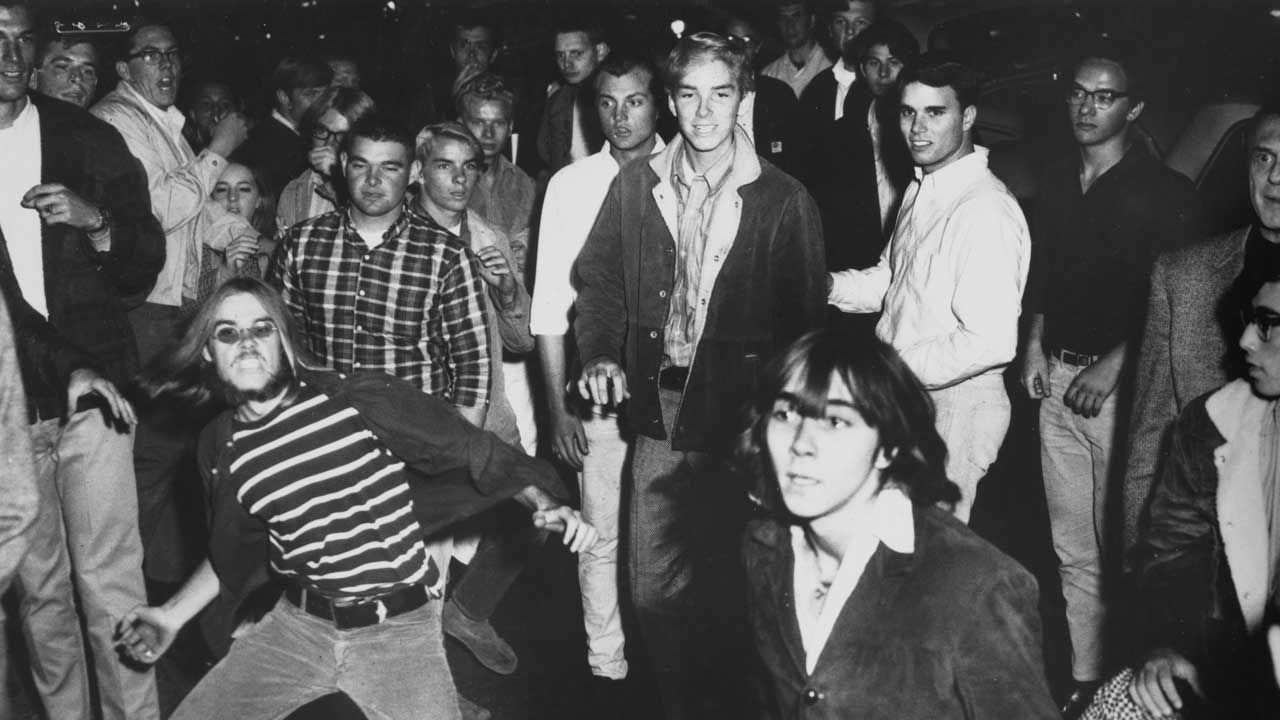
Approximately 1000 young music fans gathered at the Pandora's Box club on Sunset Strip to protest a 10pm curfew imposed by local residents during the "Sunset Strip Curfew Riots" aka "hippie riots" on November 12, 1966.

The last thing Jac Holzman wanted to do was go see a band he’d never heard of. It was May 1966, and the Elektra Records boss had just landed back in LA from New York on a late-night flight. Still, Arthur Lee was insistent and, as the much-respected leader of Love (the first rock act to sign to the label), Holzman valued his judgment.

Arriving at the Whisky A Go Go on the Sunset Strip, Holzman was confronted with The Doors, a four-piece band that Lee was going crazy over.
Holzman wasn’t convinced at all, but something kept drawing him back. On the fourth night he returned to the Whisky, it clicked. “Jim [Morrison] generated an enormous tension with his performance, like a black hole, sucking the energy of the room into himself,” he recalled in his book Follow The Music. “They weren’t consistent, and they needed some fine-tuning before they would be ready to record, but this was no ordinary rock’n’roll band.” Holzman duly signed them up.

The Doors (L-R Robby Krieger, John Densmore, Jim Morrison and Ray Manzarek, house band at the Whisky a Go Go pose for a portrait in May 1966 (Image credit: Earl Leaf/Michael Ochs Archives/Getty Images)

Perhaps more than any other band on the Strip, The Doors embodied the cultural transformation that was sweeping across Southern California in 1966. LA became the hub of an extraordinary rush of playing-live creativity, with hip clubs like the Trip, the Unicorn, Ciro’s, the Troubadour, the Cheetah and the Whisky frequented by artists such as Love, The Byrds, the Mamas And The Papas, The Association, Captain Beefheart and Frank Zappa’s Mothers Of Invention. A year layer, Cream would make

Buffalo Springfield had made their live debut at the Troubadour, on Santa Monica Boulevard, that April. Comprising three singer-guitarists in Neil Young, Stephen Stills and Richie Furay, the band then secured their own residency at the Whisky, with the help of The Byrds’ Chris Hillman. They were a sensation.

“What happened to Buffalo Springfield at the Whisky was similar to what happened to us at Ciro’s,” Hillman later told author Johnny Rogan. “Everybody wanted to be there. It became the place to be.”

On one memorable fortnight at the Whisky, in June ’66, The Doors opened for Them. The final night was historic, with both bands taking to the stage for a free-form encore of In The Midnight Hour and Gloria. Van Morrison’s wildcat antics left even The Doors’ singer in the shade. “It’s funny, because we never knew Van Morrison or what he was like until he came to the Whisky,” Doors guitarist Robby Krieger remembered. “And there he was, stomping around, throwing the mic just like Jim would… He had some real devils inside.”

Fans gathered at the Pandora's Box club on Sunset Strip to protest a 10pm curfew imposed by local residents during the "Sunset Strip Curfew Riots" aka "hippie riots" on November 12, 1966 (Image credit: Michael Ochs Archives/Getty Images)

The full force of the countercultural underground was felt in November that year, when disgruntled young club-goers were involved in what came to be known as the Hippie Riots. Irked by a Sunset Strip curfew of 10pm, brought in by uptight residents and local business owners, a mass protest was held outside Pandora’s Box, a venue at the corner of Sunset Boulevard and Crescent Heights. Frank Zappa, Peter Fonda and Jack Nicholson were supposedly among the 1,000-strong group of dissenters.

The subsequent fracas became the basis of Buffalo Springfield’s For What It’s Worth, recorded just weeks later, and the following year’s B-movie flick Riot On Sunset Strip.

"I'd seen all I needed to see, and I wrote For What It's Worth on the way back," said Stephen Stills. "It reminded me of the politics of fear, like we're doing today. Riot is a ridiculous name. It was a funeral for Pandora's Box. But it looked like a revolution."

Sign up to read this article
Read news from 100’s of titles, curated specifically for you.
Already a member? Sign in here
Related Stories
Top stories on inkl right now
One subscription that gives you access to news from hundreds of sites
Already a member? Sign in here
Our Picks
Fourteen days free
Download the app
One app. One membership.
100+ trusted global sources.