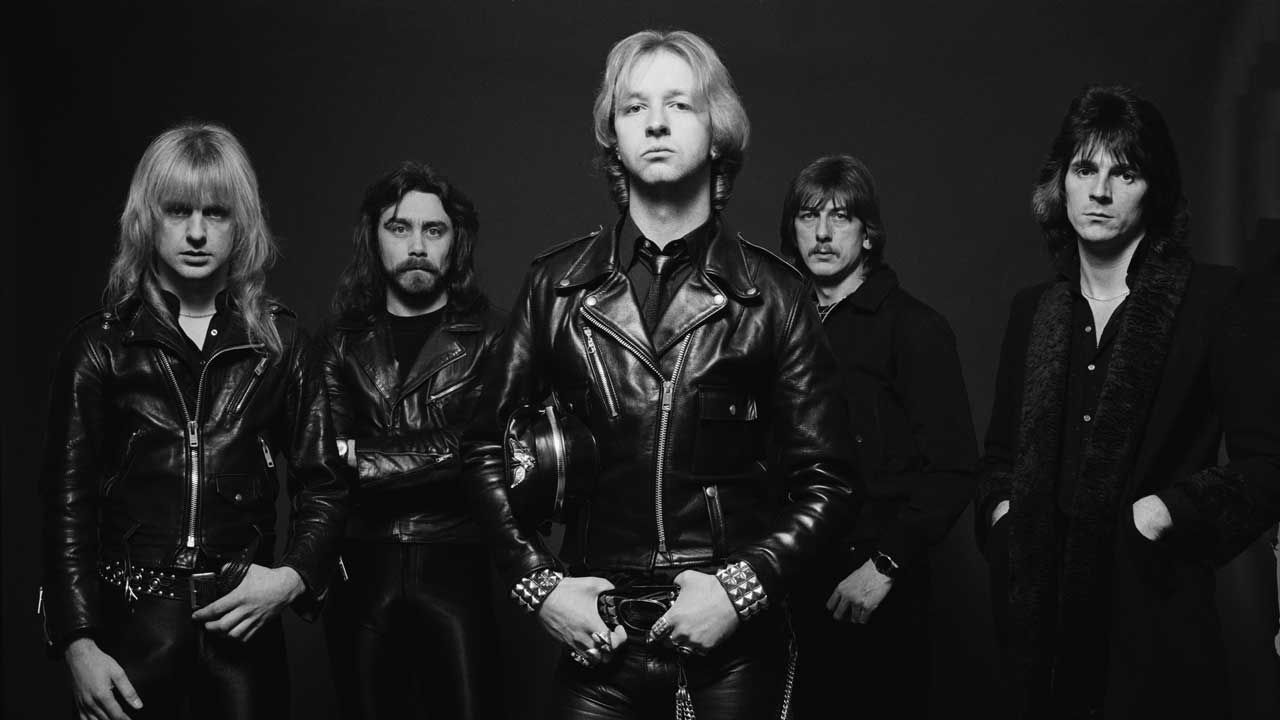
In the spring of 1980, Judas Priest released an album that was to prove so successful within the parameters of its genre that it would almost come to define the term ‘heavy metal’. British Steel, the Birmingham group’s sixth studio record, was a masterclass in leather-and-studs bombast.
More than four decades on, British Steel remains a cherished gem from the golden age of British metal. What separated Judas Priest from the heavy metal crowd was their ability to marry the primal, industrial pounding that had reverberated around their industrial-heartland birthplace to a bloody good chorus.

“Although I say so myself, British Steel is a very, very good album,” says guitarist Glenn Tipton. “We had gone into Tittenhurst Park, the home of Ringo Starr, who’d bought it from John Lennon, after a previous attempt at another studio, and with only half of its songs written. Until that point, we’d never worked that way before.
“I’ll always recall that 1980 was a great summer, and being in such an inspirational surrounding definitely rubbed off on us,” he continues. “What came out was a set of very simple yet effective songs that, I’d like to think, helped to shape what else was going on [in heavy rock music] at the time.”
Living After Midnight, the first of the album’s three huge hit singles (the others being Breaking The Law and United), was among the songs conceived at Tittenhurst, near Ascot.
“One night while we were there, John Lennon was on the TV playing Imagine, and of course it was very weird to be in the actual room where he’d been filmed,” Tipton remembers. “You could almost visualise the white piano in the corner.”
In an equally eerie scenario, singer Rob Halford got the inspiration for the lyrics for Living After Midnight as his bandmates kept him awake by blasting out riffs and drum beats in the studio below. “He came downstairs to complain and said: ‘Hey, guys, come on. It’s gone midnight.’ Which shouldn’t really have bothered such a heavy metal icon as Rob,” Tipton says, laughing at the memory.
“It was 4am and we’d been working all day,” Halford protests. “But when I said what I did, the guys went: ‘That’s a brilliant title. Write it down.”
“Rob’s comment proved to be a spark for a very important song for us,” says Tipton. “It was one of those lucky spontaneous things that sometimes just happen.”
If the song’s swaggering, chest-beating, nocturnal-themed lyric – ‘I’m getting hotter by the hour/Loaded, loaded’ – seemed to set up Halford as a bit of an all-conquering, love-’em-and-leave- ’em sex machine, then the singer has no complaints.
“Yeah,” he smiles when reminded. “It made me sound like Clint Eastwood from A Fistful Of Dollars, clutching a condom.”
Living After Midnight begins with a drum intro from the then newly arrived Dave Holland (formerly of Trapeze), and then it goes straight to the chorus.
“I really don’t know why it turned out like that,” Tipton admits. “Sometimes the simplest ideas just work out the best. Maybe that was in the back of our minds.”
“There’s a lot to be said for the very famous phrase that goes: ‘Don’t bore us, get to the chorus,’” says Halford. “In this instance, we took it pretty literally.”
Both agree that the vision of producer Tom Allom, who had been retained after the band’s live Unleashed In The East, was fundamental to the project’s success. In those pre-sampling days, Allom suggested the band raid the studio’s kitchen to rattle trays of cutlery as an enhancement of the ominous grind of Metal Gods. (He also recorded the sound of smashed milk bottles and a police siren for Priest’s more commercial-sounding Breaking The Law.)
“We used to make our own samples in those days, and Tom had such great ideas. I sometimes think that even we [the band] overlooked his importance,” Tipton offers. “He was such a diplomatic guy, and great at getting guitar and drum sounds. What an underrated producer.”
Like the hilarious video for Breaking The Law, in which Priest robbed a branch of Barclays Bank in London’s Wardour Street, armed with their Flying V guitars, and then made their getaway in an open-topped convertible, the video for Living After Midnight was a suitably ludicrous affair. Directed by Julien Temple and shot at Sheffield City Hall, it boasted Dave Holland playing an invisible drum kit.
“The air guitarists, and everybody piling onto a coach, those were early days of videos,” Tipton says of Priest’s comedic vent. “Although corny, I still think they were great.”
Although Living After Midnight didn’t chart in the US (it reached No.12 in the UK), the immediacy of it opened the door there for Judas Priest.
“It was absolutely pivotal in breaking the band in many parts of the world,” Halford says.
“Heavy metal is all about getting together with your mates, donning the gear, drinking a few beers and watching some great music,” adds Tipton. “And in the morning you go back to work, school, college or whatever. It’s therapeutic, nothing more and nothing less."