Get all your news in one place.
100's of premium titles.
One app.
Start reading
Digital Camera World
David S Young

It cost US$995 but, if the battery of this 1990 digital compact camera died, ALL your photos vanished forever!

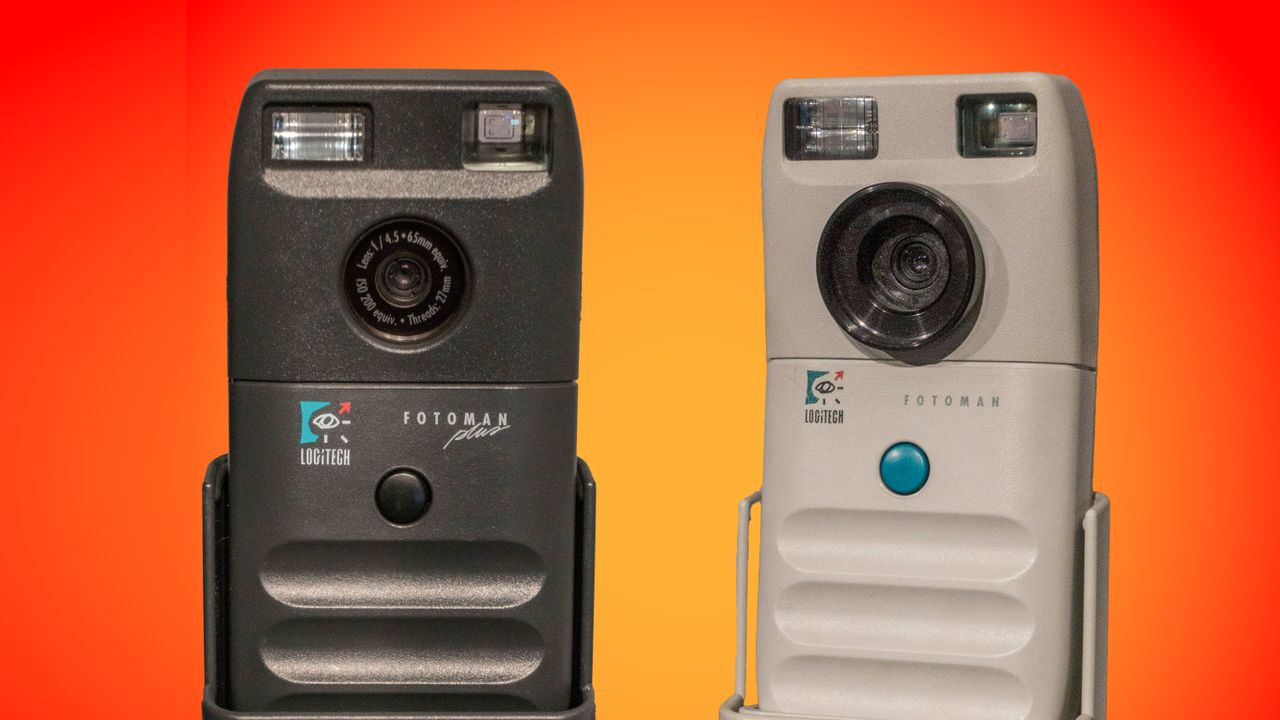
Logitech Fotoman-1 and Logitech Fotoman Plus cameras.

Dycam Inc was an American technology company based in Chatsworth, California. It was best known for developing and manufacturing the Dycam Model 1, which is widely recognized as the world's first commercially available digital camera.

Fujifilm had created and shown its Fujix DS-1P digital camera in 1988, in cooperation with Toshiba, but it was never commercially available – not even in Japan.

When the Dycam was released, in November 1990, $995 bought you a camera capable of taking 32 black-and-white, 8-bit images, each one just 376 x 240 pixels or 0.09MP. They were stored as highly compressed JPEG images, so as to fit all 32 into a single megabyte of memory.

And that memory was volatile, meaning that if the batteries went flat you lost your photos. But assuming your photos were still there, they could be uploaded to your computer using a cable.

The lens was a fixed-focus, 8.5mm (35mm equivalent), f/4.5 optic. It had a built-in electronic flash and an electronic shutter with speeds from 1/30sec to 1/1000sec (1/25sec when using flash), all packed into a very modern-looking, landline telephone-handset-style case in black plastic.

Power was supplied by two nickel-cadmium AA-sized rechargeable batteries, under the hood. Battery drain was fairly high, thus they batteries needed frequent recharging, so the camera came with a nifty recharging dock/stand.

Once charged, before you could take any photos, you had to connect your camera to a computer to download the software that made it run. Another reason to keep the camera charged!

The whole affair was pretty basic by today’s standards. But it beat the competition – because there was no competition!

The Fotoman Plus was a follow up to the original Fotoman-1 which increased resolution to 496 x 360 pixels and offered JPEG images (Image credit: Future)

The computer accessory company, Logitech, wanted to market a camera. It saw cameras as the next big thing in computer peripherals, so it licensed the basic technology from Dycam for one million dollars and set about creating its own software to run the camera.

The Logitech Fotoman-1 came out in mid-1991 with very similar specs to the Dycam, but a few differences. Because Logitech was originally a Swiss firm, rather than having it made under contract by Dycam, the Fotoman was made by the Swiss watch-making firm that had made its first mice.

The big, visible difference was that the Fotoman cameras came in an off-white shell, rather than Dycam’s black. Essential specs were identical to the Dycam, but Logitech offered improved firmware and software that offered additional features. The software was more frequently updated, too.

More importantly, though, Logitech had worldwide distribution channels, while the Dycam models were made and sold in the USA only. Thus, the Logitech sold a lot more than the Dycam and is often thought to be the first consumer-level digital camera. And it’s almost true!

Logitech’s brand recognition and aggressive marketing (free camera bag sent when you registered your purchase and similar promotions) also helped with sales.

Both cameras were classed as “consumer” cameras, but the high price (£499 in the UK) meant limited uptake. So, in the beginning, both were aimed at businesses such as real estate agents and insurance adjusters, who needed a quick turnaround.

Following the Model 1, Dycam continued to refine its technology with subsequent versions including Models 2, 3 and 4, before eventually expanding into more conventional designs.

Eventually the firm gave up on cameras and evolved into Tetracam Inc, which continues to operate as a specialist in multi-spectral imaging systems – particularly for agriculture.

Logitech abandoned the digital camera market after the Fotoman series, to concentrate on peripherals like mice and keyboards. It later became a leader in webcams, but never made or marketed a standalone digital camera again.

You might also like…

Take a look at the best point-and-shoot cameras you can buy today.

Sign up to read this article
Read news from 100's of titles, curated specifically for you.
Already a member? Sign in here
Related Stories
Top stories on inkl right now
One subscription that gives you access to news from hundreds of sites
Already a member? Sign in here
Our Picks
Fourteen days free
Download the app
One app. One membership.
100+ trusted global sources.