
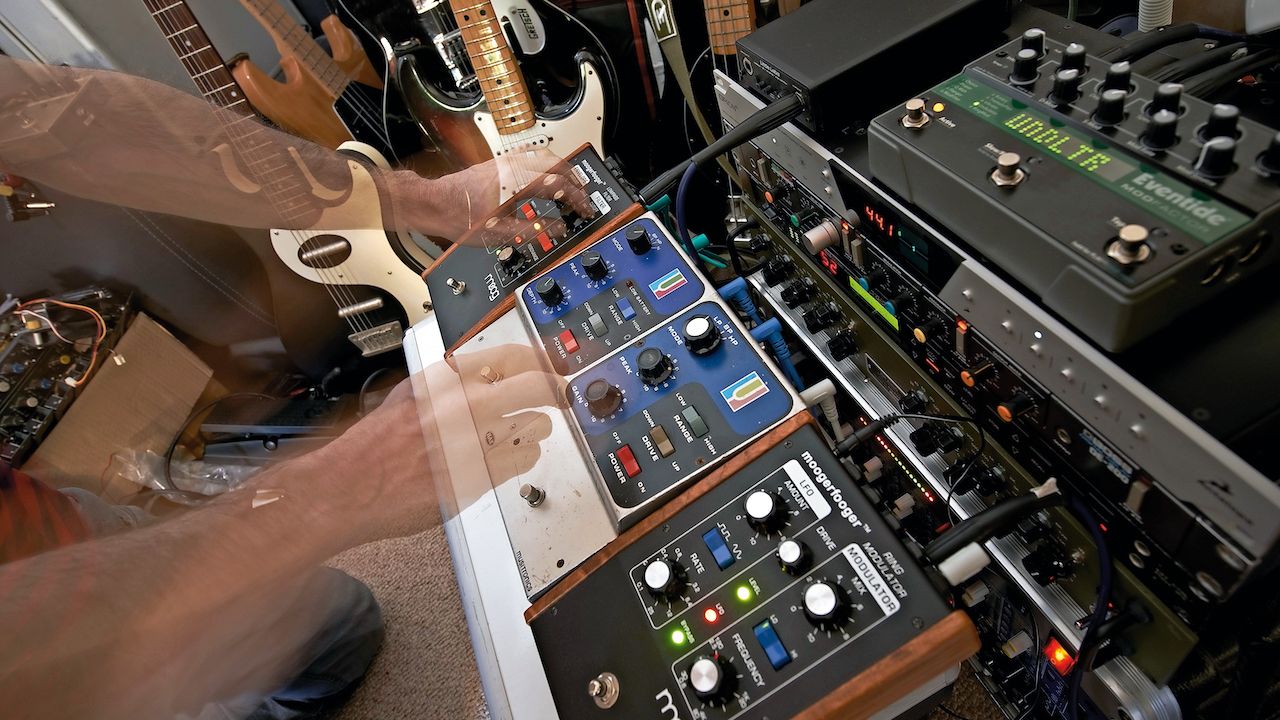
Where demand for pedal effects grew exponentially during the early ’70s as musicians sought new sounds, many stompbox designers turned to the synthesizer for new inspiration.
Mike Beigel was among the earliest engineers who realized that synth modules could easily be adapted into standalone effects. Although Guild hired Beigel to develop a synthesizer in the early ’70s, the project got canned, which inspired Beigel and former Guild chief electronics engineer Aaron Newman to form their own effects company, Musitronics, in 1972.

Beigel and Newman developed the prototype for their first product, an envelope filter called the Mu-Tron III, during the summer of 1972, and it became an overnight sensation when Stevie Wonder used the effect for his supremely funky Clavinet riff on the hit Higher Ground released in mid-1973.
The circuit consists of an envelope follower that uses optocouplers to control a voltage controlled filter. The optocouplers respond to input signal playing dynamics to sweep the EQ filter, resulting in a funky wah sound that is exceptionally expressive and responsive.
The wah sounds go well beyond those of a typical wah pedal, producing a wide variety of textures that include duck-like quacks, vowel-like vocal tones, piercing synth squeals and bowel-shaking bow wows.
Controls on the Mu-Tron III include a Mode switch with low-pass, band-pass and high-pass filter settings, a Peak (Q) knob for adjusting the resonant peak, a Gain knob and low/high Range and down/up Drive rocker switches.
Most guitarists prefer the fatter, thicker sound of the low-pass setting, which provides full bass and rolls off harsh treble frequencies. The early versions run on either two 9-volt batteries or an 18-volt power supply, while late-’70s versions (when Musitronics was owned by Arp) have a built-in power supply.
“We used a dual supply instead of a single supply so the effect could have a wide dynamic range,” Beigel said. “That way you could really smash on the guitar and not distort the whole effect.”

When combined with other effects like distortion, phase shift/flanging and pitch shifting, the Mu-Tron III can generate some dazzling, unusual sounds. Because the effect is dynamically responsive, it should be placed at the front of the signal chain and effects like compression and distortion should be plugged in after it.
Although the Mu-Tron III’s sounds are undeniably funky, and the pedal made a strong impression in the hands of funk musicians like keyboardists Stevie Wonder and George Duke and bassist Bootsy Collins, most of the guitarists known for using one hail from genres other than funk. Psychedelic jazz fusion guitarist Larry Coryell was an early adopter during the ’70s, as were Jerry Garcia and Frank Zappa.
Andy Summers and Steve Vai (taking a cue from his mentor Frank Zappa) employed a Mu-Tron III frequently during the ’80s and ’90s, and more recent, users include Trey Anastasio, Ira Kaplan (Yo La Tengo), Larry LaLonde, and Peter Frampton, who expertly summoned vocal-like textures from his Mu-Tron III on his 2006 cover of Soundgarden’s Black Hole Sun.
- This article first appeared in Guitar World. Subscribe and save.