Get all your news in one place.
100’s of premium titles.
One app.
Start reading
The Independent UK
The Independent UK
National
Sam Metz and Melanie Lidman

Israel says Iran is using cluster bombs. What we know about the weapon 120 countries have banned

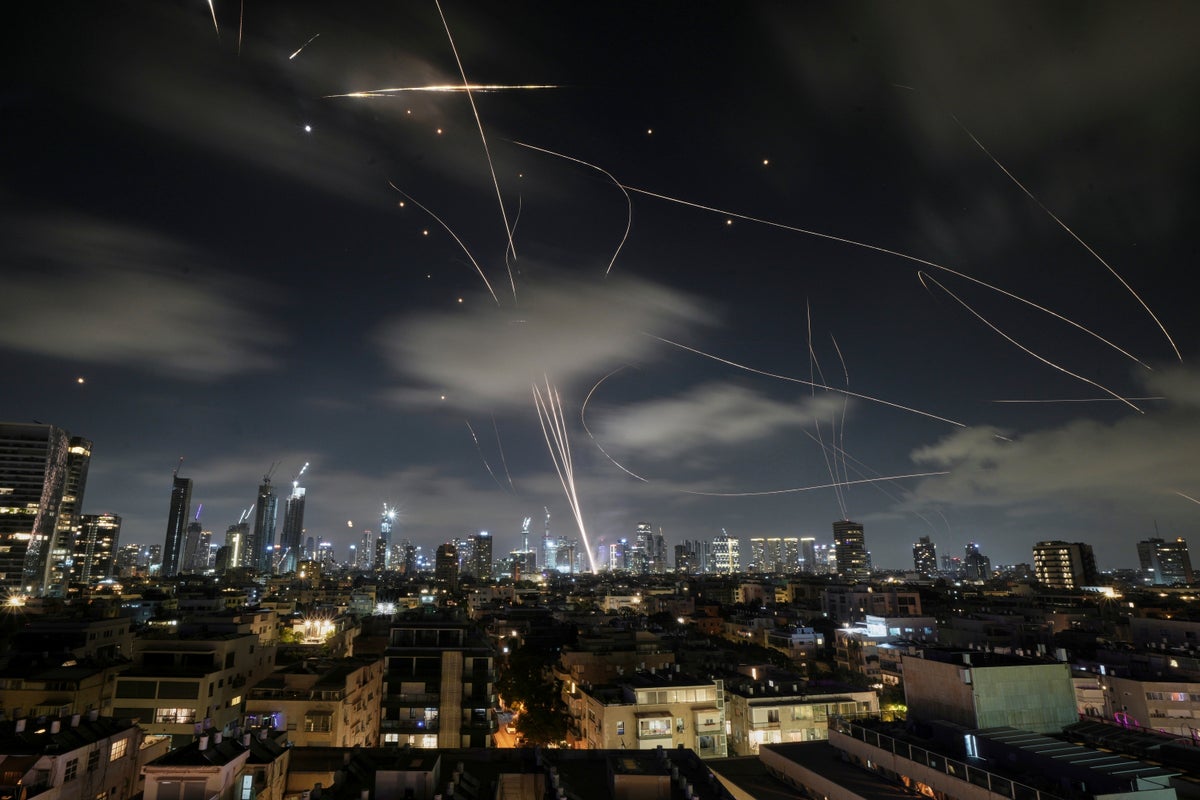
The Israeli Iron Dome air defense system fires to intercept missiles during an Iranian attack over Tel Aviv, Israel, early Wednesday, June 18, 2025. (AP Photo/Leo Correa) - (Copyright 2025 The Associated Press. All rights reserved)

Israel has accused Iran of deploying cluster munitions throughout their 10-day conflict, adding a complex and lethal challenge to its already stretched air defence capabilities.

These warheads detonate at high altitudes, scattering dozens of smaller bomblets across a wide area. The smaller explosives, resembling orange fireballs at night, are difficult to intercept and have proven deadly.

Typically cautious about releasing information on Iranian strikes, Israeli authorities have recently sought to educate the public about the dangers. This includes the persistent threat of unexploded bombs on the ground, even after civilians leave shelters.

Over 120 countries have signed an international convention banning cluster munitions, though Israel, the United States, and Iran are among those not party to the treaty. Israel itself used the weapon in 2006 against the Iran-allied Lebanese militant group Hezbollah.

Here’s what to know about cluster munitions:

After what’s called a parent munition is launched, it releases smaller submunitions at an altitude of 7-10 kilometers (4-6 miles). These bomblets scatter across a large area, from several hundred meters (yards) to several kilometers (miles), trading precision for coverage.

Critics worldwide argue that cluster munitions kill or maim indiscriminately, with unexploded bomblets remaining dangerous long after their use. In Israel, they can be especially dangerous because most of the missiles have been aimed at its densely populated center.

“Cluster bombs don’t create real damage to buildings, only people,” said Yehoshua Kalisky, a senior researcher at Israel’s Institute for National Security Studies.

Rocket trails are seen in the sky above the Israeli center coastal city of Netanya amid a fresh barrage of Iranian missile attacks on March 9, 2026 (AFP/Getty)

Israel’s Arrow missile-defense system has done a good job intercepting incoming ballistic missiles, Kalisky said. But if cluster munitions are released before the missile is destroyed, there is little that can be done.

Israel’s Iron Dome system is geared toward intercepting smaller rockets fired from short ranges and lower altitudes. But it isn’t designed to destroy the clusters once they’ve dispersed into dozens of bomblets, Kalisky added.

Unlike heavier explosives, the bomblets — often weighing less than 3 kilograms (7 pounds) — are most dangerous to targets like cars, storefronts or people caught outside shelters.

“They pose a particular threat to the civilian population both during and after use, with victims often including a high proportion of children,” according to the Convention on Cluster Munitions.

The submunitions fail to explode more often than other kinds of warheads. Unexploded ordnance can act like a land mine, detonating later and killing indiscriminately.

The Open Source Munitions Portal, which authenticates publicly sourced images of munitions worldwide, has published several images of unexploded submunitions found in Israel this week.

The Israeli Iron Dome air defense system fires to intercept missiles over Tel Aviv, Israel, June 13, 2025. (AP Photo/Leo Correa, File) (Copyright 2025 The Associated Press. All rights reserved.)

Most of the damage in Israel has been caused by larger Iranian missiles, but Iran has been using cluster munitions on a “nearly daily basis,” said Lt. Col. Nadav Shoshani, a military spokesman. He says Iran fired similar projectiles during the 12-day war in June.

The military said the Iranian warheads contain between 20 and 24 bomblets with explosives weighing up to 5 kilograms (11 pounds).

The Israeli military’s Home Front Command has distributed flyers warning residents not to touch unexploded submunitions. A public service announcement from police also warned people not to touch anything they see and to call authorities instead.

In this picture released by the Iranian Defense Ministry on Thursday, May 25, 2023, Khorramshahr-4 missile is launched at an undisclosed location, Iran

According to the Missile Defense Project at the Washington-based Center for Strategic and International Studies, Iran said in 2017 that its Khorramshahr medium-range ballistic missile could carry multiple warheads. The missiles are the largest of Iran’s submunition-dispersing arsenal. Iran also has submunition-equipped shorter range Zolfaghar missiles.

Cluster munitions, including those seen in Associated Press video flying westward toward Israel, can look like falling fireballs — an effect caused by the friction of reentering the atmosphere.

N.R. Jenzen-Jones, director of Armament Research Services, said little open-source information exists about Iran’s cluster munitions beyond state television reports of leaders touring missile factories and videos from military exercises. But videos showing them used last week indicate that some Iranian missiles carrying cluster munition warheads are designed to open at high altitude, scattering them across an area far larger than most military targets.

Design components that disperse them at such heights — including a protective coating on the submunitions that can withstand the heat of atmospheric reentry — appear to show they were built for far less precise use than cluster munitions seen in other conflicts.

“The design seems to scatter submunitions so widely as to suggest it was designed purely as a weapon of terror, scattering its explosive cargo indiscriminately over a wide area,” Jenzen-Jones said.

In July 2025, after the 12-day war between Iran and Israel, Amnesty International said Iran’s “deliberate use of such inherently indiscriminate weapons is a blatant violation of international humanitarian law.”

Police officers look at collected fragments of the Russian rockets, including cluster rounds, that hit Kharkiv, in Kharkiv, Ukraine, on Dec. 3, 2022 (Copyright 2022 The Associated Press. All rights reserved.)

Cluster munitions — including those more targeted than Iran’s — are not illegal but are barred by the Geneva Conventions for use in civilian areas. They’re also banned under recent international agreements signed by more than 120 nations.

Cluster munitions were first used by Nazi Germany, when it dropped “butterfly bombs” on the United Kingdom in World War II. The U.S. has used various kinds in Vietnam, Laos, Iraq and Afghanistan, and provided cluster munitions to Ukraine. Russia was accused of using cluster bombs in its 2022 full-scale invasion of Ukraine, a charge Moscow denied.

During a 2006 war in Lebanon with the militant group Hezbollah, the U.N. estimated some 30% to 40% of Israeli cluster bombs failed to explode, leaving southern Lebanon littered with hundreds of thousands of bomblets.

The U.S. State Department said Israel likely used American-made cluster bombs in civilian areas during the 2006 war, after U.N. demining teams found unexploded bomblets in hundreds of locations.

Israel is not using cluster bombs currently, according to a military official who spoke on condition of anonymity under the military’s briefing rules.

Sign up to read this article
Read news from 100’s of titles, curated specifically for you.
Already a member? Sign in here
Related Stories
Top stories on inkl right now
One subscription that gives you access to news from hundreds of sites
Already a member? Sign in here
Our Picks
Fourteen days free
Download the app
One app. One membership.
100+ trusted global sources.