
If you were heading to an important dinner, you’d want a friend to clock you on the galaxy leggings, right? It’s not always easy to hear, but sometimes it’s better to know when the design trends we once loved have crossed into cringe.
That kind of honesty requires both taste and candor. So Homes & Gardens asked top interior designers to give it to us straight.

Let’s not be caught dead with the living-room equivalent of a Labubu in 2026. Ahead, the three ‘cringey’ trends designers are officially leaving behind – and where the tides are turning instead.
3 Cringe Trends to Leave Behind in 2026
1. Bouclé

Call us psychic, but we – along with designers like Molly Kidd – flagged the end of bouclé ages ago. Now there’s official confirmation we weren’t alone.
‘If I see one more stark white bouclé swivel chair, I might scream!’ exclaims Jennifer Jones, principal designer at Niche Interiors. ‘Bouclé can be beautiful in a range of colors, but upholstering everything in ivory and white is so overplayed. Retail outlets have beaten this trend to death.’
What’s replacing bouclé is still cozy – don’t worry – but feels richer and more grounded. Texture is staying, but it’s shifting toward materials with a bit more depth and tactility, like shearling or mohair. ‘Instead of a stark white bouclé, consider a warmer neutral wool or woven fabric in almond or flax tones to add more depth to a space,’ Jennifer suggests.
You don’t need to swap out major furniture to get a heavy hit of texture. This mock-mohair ottoman, finished with charmingly bulbous wooden feet, slips easily alongside an existing seating arrangement.
If you were among the many millions who fell victim to the bouclé accent chair, don’t panic. Shearling – or a convincing faux like this – offers the same impossibly cozy appeal without pandemic-era baggage.
A bouclé pillow, once eye-wateringly expensive, now runs about the cost of a fast-casual lunch (there’s a reason they’re all suddenly on sale). But this is one category where it actually pays to invest. Nothing beats the exaggerated shag of real Mongolian fur, which somehow reads even more indulgent in navy.
2. All-Beige Everything

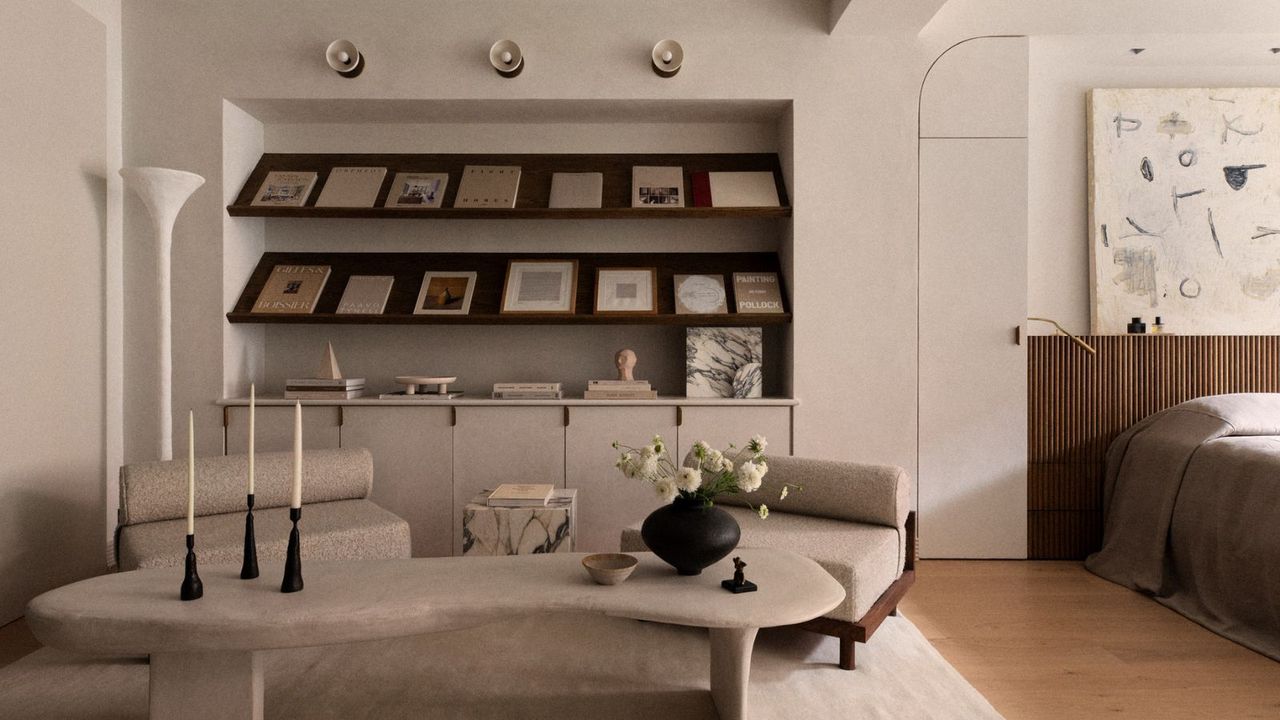
For a little too long, beige doubled as a shortcut to taste. Paint the thing neutral, and call it ‘timeless.' Thus began the era of monochromatic everything, so pervasive that even Christmas trees felt ‘cheugy’ unless they came in camel. In 2026, that spell is finally breaking, and color is back in the conversation.
‘As we head into 2026, one trend that feels firmly past its prime is the all-beige interior,’ observes Jennifer Beget, owner and lead designer at J Beget Designs. ‘Beige sofas, coffee tables, accessories, and layered neutral palettes have become visually flat and lack depth or personality,’ she adds. ‘Aesthetically, the look feels overdone, and functionally, light, monochromatic spaces are difficult to live in and maintain, homes shouldn’t feel precious or untouchable.’
In a moment when so many interiors are recycling the same visual language, individuality is what actually reads expensive. ‘What I’d like to see replace it is a more confident use of color, pattern, and materiality,’ Jennifer continues.
Where tapers once lived exclusively in beige stoneware, color is finally back in the conversation. This stacked geometric candlestick offers chromatic confidence in threes, blending sea-glass blue-greens with amethyst and red.
If there were any doubt that color isn’t a trend so much as a constant, Ginori 1735 settles it. The storied house has been dishing dopamine front and center for centuries.
Primary hues do the heavy lifting in these red-piped blue cotton napkins, which cut straight through any beige relics still clinging to the table.
3. Mid-Century Scandi Saturation

Let’s tread lightly. Mid-century Scandinavian design is not – and will never be – going anywhere. The issue isn’t the interior style itself, but what’s happened to it. Years of commodification have flattened an originally thoughtful, organic design language into a collection of cookie cutters. When great Danish design is reduced to replicas bought by the boatload and drop-shipped into influencer living rooms, it, regrettably, stops reading as rarified.
‘I say this with caution,’ prefaces McKenzie Milhousen, founder and principal of By George Collective. ‘While the trend to incorporate vintage isn’t going anywhere in 2026, I think we’re going to see a shift away from mid-century modern Scandinavian furniture that has dominated the past couple of years, or at least start to incorporate a range of time periods.’
What’s replacing it isn’t, believe it or not, a wholesale pivot to Art Deco, which McKenzie admits is feeling equally oversaturated right now. ‘But I actually think we’re going to look for vintage from earlier periods – the ’20s, perhaps even dipping back to Victorian antiques.’
And to reiterate: this is not a call to purge. ‘Please don’t ditch your Alfred Christensen chair or your Henning Kjærnulf dining chairs or anything like that!’ McKenzie insists. ‘These are beautifully made pieces that are timeless. Just incorporate additional time periods around them for visual interest.'
When it comes to shells, no era trumps Art Nouveau. That enchanted reference point feels especially relevant amid another antique piece revival we’re loving right now: the candle sconce.
Fringe is everywhere in 2026: on lips, minds, and, increasingly, couch cushions – but it was the Victorians who first brought it into the fore. A nod to that lineage feels right now, layered lightly over an otherwise simple base.
Joanna Gaines ensured this brass vase arrived already rich with antiqued detail, but true to her character-forward approach, it’s also made to age well. The patina only deepens over time, growing more soulful by the minute.
You may have noticed the throughline: bouclé, beige, mid-century Scandi – it’s all rooted in minimalism. If that language still feels true to you, it absolutely has a place. But the collective urge to edit everything down in the name of ‘good taste’ is starting to ring hollow. In 2026, the real flex isn’t repression, it’s having the confidence to choose something different.